Excerpts from Jim Conrad's
Naturalist Newsletter
from the July 31, 2005 Newsletter issued from the Sierra Nevada foothills
somewhat east of Placerville, California, USA
ACORNS OF CALIFORNIA BLACK OAKS
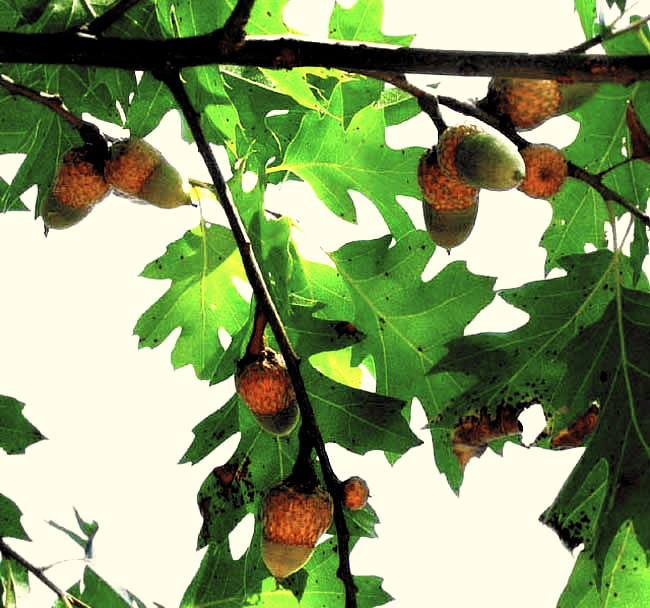
The oaks above my trailer are California Black Oaks, QUERCUS KELLOGGII. You can see a view up through this handsome tree's branches above.
As the above image shows, this oak looks a lot like the East's Black Oak. However, it's profoundly different. For one thing, it sprouts robustly from its roots, so it is highly adapted to life in these fire-prone foothills. For germination, California Black Oak acorns even need to lie on mineral soil or a light duff, similar to ground conditions after a fire.
This isn't to say that California Black Oaks are resistant to forest fires, because moderate fires damage them severely or kill them. This is another species whose fire strategy is to surrender its above- ground body to any conflagration, trusting in its ability to be reborn from its roots.
You might be thinking it's a little early in the season for acorns to be dropping. Well, members of the black oak group need two years for their acorns to mature, so the acorns falling now are over a year old. Also, the acorns rolling off the tin roof next to my trailer are smaller and less developed than those remaining on the branches. The tree is ridding itself of its weakest acorns, aborting them, so that it can focus its energies on its very best ones. Nature is not at all sentimental about these things. She knows she must channel her limited resources to those most likely to survive. She has little sympathy for the weak and malformed.
There's nothing malformed about the acorns remaining on the trees. Each day I look at them and marvel at how large they're getting, how handsome are the cups with their triangular, tan-colored scales, and how voluptuous are the green-turning-mahogany nuts, sharp pointed at their tops like old-time heaps of Dairy-Queen ice cream.