from the April 10, 2005 Newsletter issued from the Sierra Nevada foothills
somewhat east of Placerville, California, USA
CALIFORNIA NEWT BEFORE A RAIN
Seeing this species was especially exciting for me because it's endemic just to California -- found no other place on Earth. In fact, California Newts are separable into two subspecies. One lives only along the state's coast while the other -- ours -- is found only in the Sierra Nevada foothills up to 7,000 feet in elevation. Below, you can see a picture of this species taken by my friends earlier this spring when an individual appeared right outside their glass door:
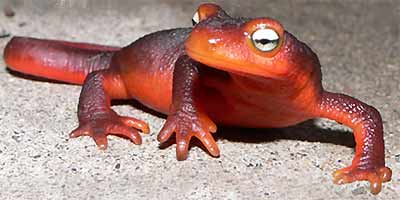
Male California Newts are known to enter the water in March or April in preparation for mating. Once they've assumed an aquatic life their skin becomes smooth and puffy, and their tails compress into a finlike shape to aid in swimming.
How is a newt different from a lizard and other lizardy things?
First of all, lizards are reptiles with scaly skin, claws and external ear-openings, while newts are amphibians, thus with scaleless skin, feet without claws, and heads without ear-holes. Remembering that amphibians evolved before reptiles, one way of describing the situation is to say that salamanders and newts are so primitive that the first of their kind appeared before Mother Nature had come up with the newfangled concepts of scales, claws and ear-holes.
In North America we have two main amphibian groups, or orders: One of those orders embraces frogs and toads while the other includes seven families of salamanders and salamander-like creatures. One of those families is the Newt Family. One feature separating members of the Newt Family from regular salamanders is that the skin of newts isn't slimy like a salamander's, but rather rough-textured.