
Different people have different lists of root types. What follows is a look at kinds of root backyard naturalists are most likely to run across, and it's to be noticed that the types often overlap.
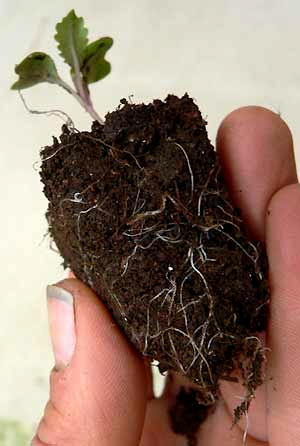
FIBROUS ROOTS
At the right you see the slender, much branching and rebranching fibrous roots of a cabbage plant removed from its pot. Fibrous roots do a good job of taking water and nutrients from the soil they grow through, simply by occupying the soil with lots of little roots.
On our Roots Introduction Page we recall a study that found a single rye grass plant producing 380 miles (612kms) of branching and rebranching fibrous roots, bearing about 14 billion root hairs. Fibrous roots, then, provide a great amount of water- and nutrient-absorbing surface area relative to actual root mass. This is one reason that fibrous roots are probably the most common of all root types.
STORAGE ROOTS
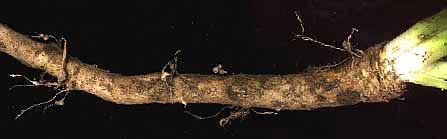
The root of the Horseradish plant, Armoracia rusticana, shown above, is a storage root in the sense that it stores calorie-rich carbohydrate for future use. Normally plants with storage roots live for two or more years. One challenge for plants with overwintering, nutrient-rich storage roots is that many animals would like to eat the roots. For that reason, often plants with storage roots contain chemicals that are bad tasting or toxic.
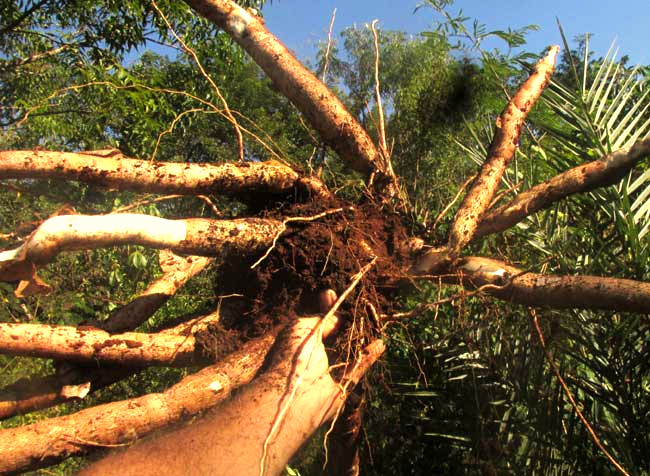
Even the Horseradish plant's storage roots are too hotly pungent for most people to eat without dilution. In the tropics, you can die from cyanide poisoning if you don't properly cook or else soak, scrape and dry the storage root of Cassava, or Manioc, shown at the right.
TAPROOTS
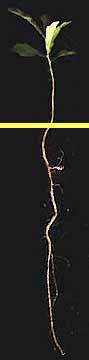

Taproots result when the main or primary root grows downward much more vigorously than the secondary roots arising from it. At the right, the seedling of a Water Oak, Quercus nigra, is sending down a strong tap root toward both deep moisture and secure anchorage for the future tree. A root can be both a storage root and a taproot, as with the garden carrot shown at the left. However, the oak seedling's taproot is far too slender and woody for storing much nutrition.
AERIAL ROOTS
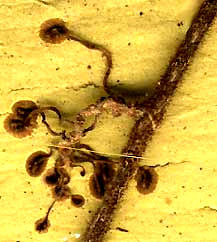
Aerial roots are simply roots that grow in the air instead of the soil. Examples include English Ivy, Poison Ivy, Trumpet Creeper, many species of orchids and bromeliads, and the Virginia Creeper, Parthenocissus quinquefolia, whose stem-borne roots are shown at the left. In that picture the vine's aerial roots end in adhesive discs. When the root tip makes contact with a hard surface, it produces mucilage which spreads out and dries, then hardens, stuck to the surface. In the picture, the surface is a yellow-painted window shutter, and when the tendrils were pulled on, the discs tore away large flakes of old paint.
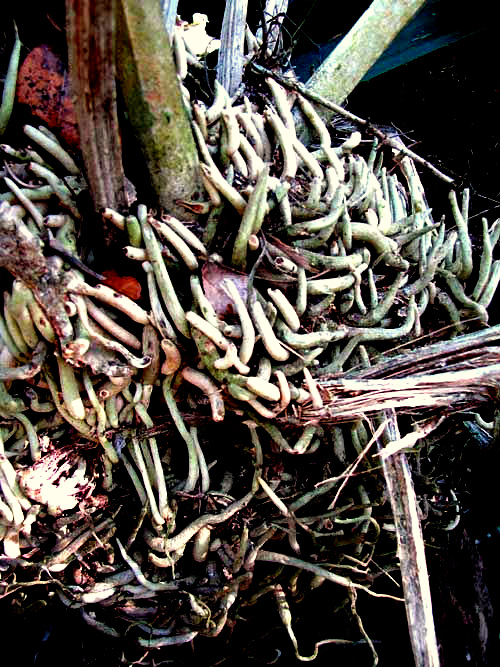
At the right, plants of the tropical Anthurium schlechtendalii, which grows atop thick layers of humus, dead logs, diagonal tree trunks and such in deeply shaded forest, produces a specialized for of aereal root, shown at the right. These roots grow upward, instead of earthward. When plant parts orient away from the Earth's gravitational pull, they're said to be negatively geotropic. The roots' upward-growing nature collects dead leaves and other debris, which decays into a spongy material that soaks up and holds rainwater, protecting the plant from dry periods. These roots also are distinctive for their thick, white appearance. This appearance is caused by several layers of root epidermis tissue, which is referred to as the velamen.
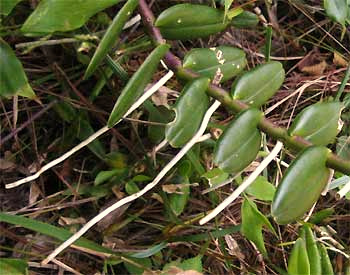
Many orchid species and several other kinds of monocot plants also produce velamen-covered roots. At the left, the ground-dwelling orchid Epidendrum radicans produces velamen-covered roots along the stem, some of them penetrating the deep humus layer and others just hanging in the air. This orchid occurred in a high-elevation cloudforest with frequent mist and fog, so its velamen absorbed significant moisture from the air. Velamen itself absorbs and stores water, plus in the species shown and many others velamen has been found to support mychorrizal associations, in a mutual symbiotic relationship with the host plant. (see Rebecca Sanchez, 2017) Fungi in root velamen provide the plant with nutrients as the plant provides the fungus with shelter and more.
ADVENTITIOUS ROOTS
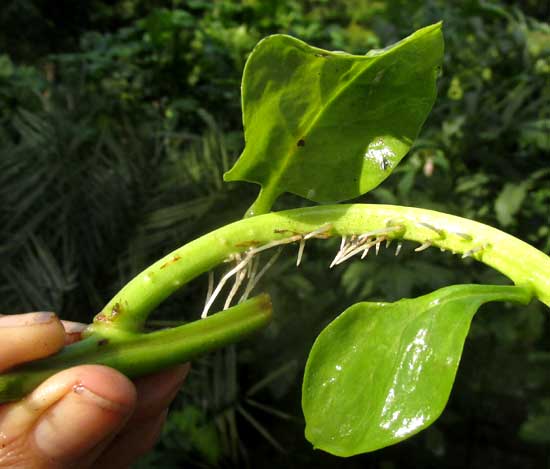
Adventitious roots arise from someplace on the plant other than the underground root system which originated with the radicle issuing from the seed. At the right, white roots sprouting along the stem of Climbing Spinach, Basella alba, are easily recognizable as adventitious roots. However, the definition of adventitious roots requires that a regular root must have in its history the downward-growing, root-producing radicle that issued from the seed from which the plant arose. This leads to some very normal-looking roots technically being defined as adventitious. For example, most monocots (grasses, sedges, lilies, orchids, etc.) produce adventitious roots, and typically those adventitious roots are fibrous, as described above.
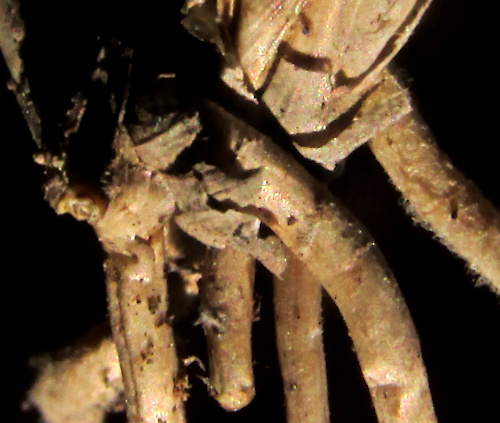
The reason is that nearly all monocot roots don't arise from a root system that began with the radicle, but rather from what technically is the stem. These details may be hard to confirm in the field. At the left, maybe you can see that roots issuing at the bottom of a Purple Three-awn Grass, Aristida purpurea, aren't arising from an original root issuing from a seed. They're growing from stem tissue. Unless you can see this, you just have to remember that the vast majority of monocot roots are adventitious fibrous roots, not "regular roots."
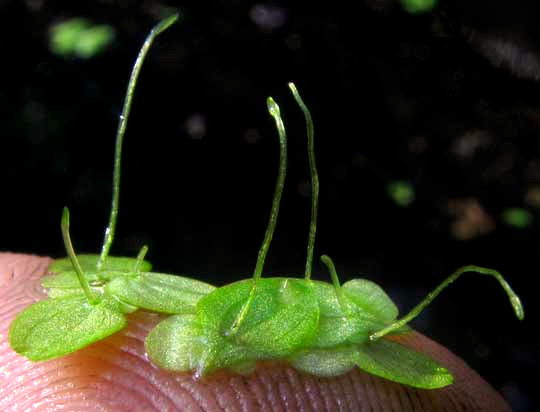
Duckweed, like the Lemna aequinoctialis shown at the right, is a green-confetti-like flowering plant that normally floats at the surface of water, with its filamentous roots hanging downward. In the photo, plants are shown upside down on a fingertip. Duckweeds are monocots, and nearly all monocots produce adventitious roots, but are those non-branching filaments really adventitious roots? The authoritative Flora of North America, describes the green duckweed body as "...fronds corresponding partly to leaf and partly to stem," so that indicates the that -- since the roots have no history of a radicle issuing from a seed -- they're truly adventitious, as WS Hillman confirms in his 1961 analysis in the Botanical Review. But duckweed roots truly are unusual ones.
PROPROOTS
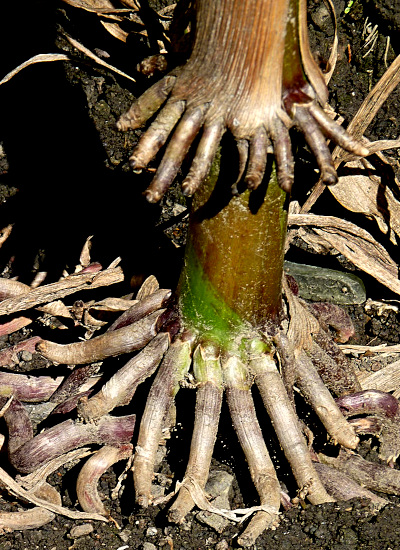 photo courtesy of Jamain in France
A special kind of adventitious aerial root is shown at the right. Those are prop roots of a corn or maize plant Zea mays. Prop roots prop up stems which without some extra support might fall over during a stiff breeze or when the ground becomes soft from rain. Prop roots are much more common on tropical and subtropical plants than in the Temperate Zone.
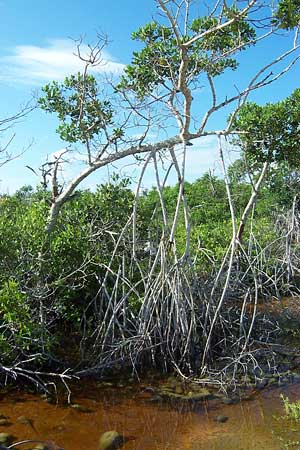
At the left, prop roots of the tropical Red Mangrove, Rhizophora mangle, often are called "stilt roots." They are aerial roots which ultimately root in mud below the water.