
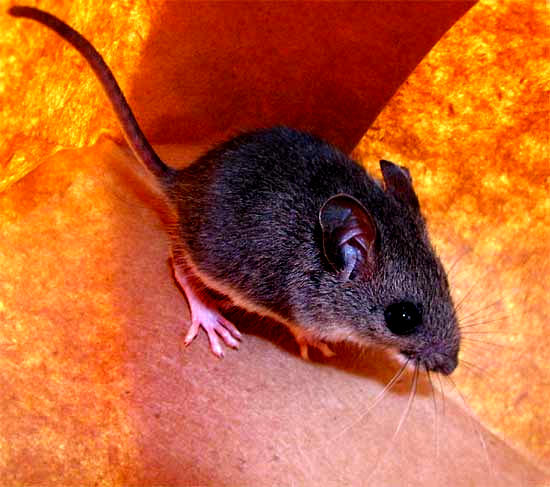
 Rats, mice, and voles have an image problem. The only rats and mice people usually hear of or see are the Norway Rat, Rattus norvegicus -- usually just called "rat," and the common House Mouse, Mus musculus; and many people haven't even heard of voles.
With regard to the Norway Rat (thought to have originated in northern China) and the House Mouse (native to India), both of these species are invasive, or introduced species, in North America. Their negative impact on humanity isn't at all representative of the behavior and ecological importance of wild rats, mice and voles. Moreover, in North America, Norway Rats and House Mice normally don't survive away from human habitations, because they can't compete with native species.
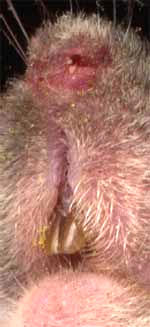
Rats, mice and voles are all members of the Murid Family, the Muridae, in the Rodent Order, Rodentia, so they're all "murids" and they're all rodents. Murids constitute the largest of all rodent families, holding over 700 species. The family is so vast that among evolutionary biologists there's uncertainty about the unifying features of the Murid Family.
One physical feature in common to them all, however, is their typically rodent set of front teeth, their incisors, adapted for gnawing. At the left you can see the sharp, chisel-like incisors of a White-footed Mouse, poking down from behind the mouse's cleft upper lip. The cleft also is an excellent adaption, keeping the upper lip out of the way during the gnawing process.
To get a handle on how diverse the murids are, here's a breakdown of the North American species, according to the Peterson Field Guide Mammals of North America, Fourth Edition:
DEER MICE................. 17 species
HARVEST MICE............... 7 species
GRASSHOPPER MICE........... 3 species
POCKET MICE............... 20 species
KANGAROO MICE...............2 species
JUMPING MICE................4 species
RICE RAT....................2 species
COTTON RATS................ 4 species
WOOD RATS..................12 species
KANGAROO RATS............. 16 species
MUSKRATS................... 2 species
VOLES......................26 species
LEMMINGS....................6 species
INTRODUCED SPECIES..........3 species
MEXICAN SPINY POCKET MOUSE: 1 species
TOTAL.................... 125 SPECIES
Admittedly, few of these will appear in average backyards. Most are very specialized and only occupy niches in places like deserts and forests. The Merriam Mouse, for instance, requires mesquite and scattered brush in low elevation desert. The Bushy-tail Wood Rat is restricted to high mountains where it lives among rock slides, pines, and at the edgea of cliffs. The California Vole specializes in marshy ground.
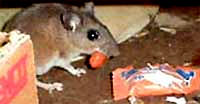
From the point of view of our wanting to see and study these animals, one problem is that they're mostly nocturnal -- they're active during the night, like the White-footed Mouse at the left, caught pilfering candy in the middle of a summer night in Mississippi. However, there's at least one way to get a closer look, and that's to live-trap them.
This is a touchy subject. On the one hand, even though here we're talking about non-violent live-trapping, any wild animal suddenly discovering itself trapped is going to be traumatized, especially if it's trapped all night and must wait until you can take a look at it and release it. On the other hand, often people just don't want a rodent in their house, but have one, and don't want to kill the creature. Therefore, how do you trap them?
Here are three home-made kinds of traps:
You'll have to experiment with various baits. Chunks of bread, smelling of the grain that many native mice eat, often serve well, as does peanut butter, smelly cheese, and bits of banana.
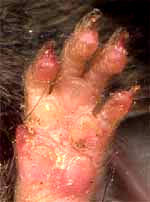
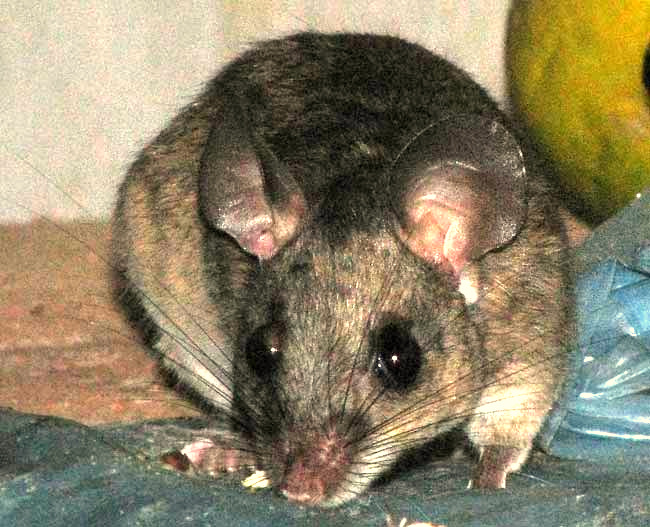
If you do catch something, remember what a terrifying situation it is for the animal. Don't jar it around too much. It's best not to handle them, for even a tiny mouse can inflict a painful bite with those sharp incisors. Keeping in mind the eerily human mouse foot picture at the right, use your best instincts in choosing where to release the little being.