PLANTS | ANIMALS | ECOLOGY | FUNGI | GEOLOGY | GARDENING | TOOLS
MEXICAN PLANTS & ANIMALS HOME

Excerpts from Jim Conrad's
Naturalist Newsletter
from the December 29, 2006 Newsletter issued from Sierra Gorda Biosphere Reserve, QUERÉTARO, MÉXICO
MARGARITA'S TUNITAS
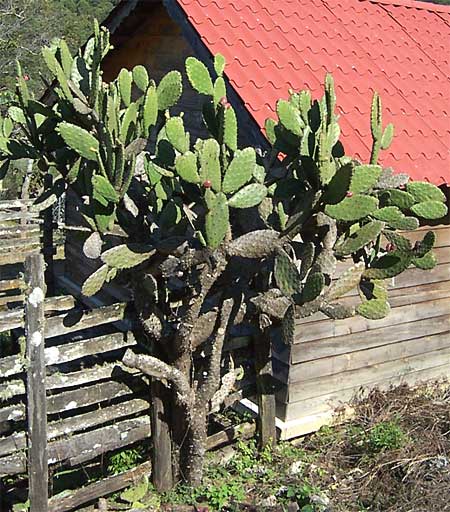
In Margarita's garden there was a tall Nopal Cactus like the one talked about in last week's Newsletter, and it was just covered with flowers and flower buds. When Margarita saw this she was delighted and said we had to get to work gathering our next meal. I was confused, for I didn't see a mature fruit on the whole cactus.
Margarita fetched a long bamboo pole and began knocking off flower buds -- actually the ovaries of the flowers before flowering had occurred. She said that after flowering the fruits would be too fibrous to eat. She also explained that this was one of the many varieties of Nopal Cactus, one producing edible flower ovaries instead of edible fruits. You can see a pretty picture of what we collected that day below:
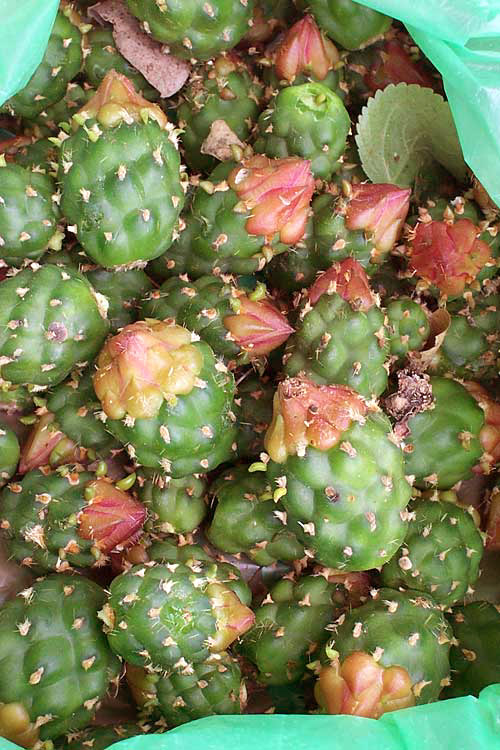
In that picture you can see that each ovary bristles with tufts of glochids -- the minute, very sharp spines I told you about last week. Even wearing plastic bags over our hands while retrieving the ovaries -- referred to as tunitas -- we got glochids in our fingers.
When we got back to town we dropped by the house of Margarita's aunt and asked if we could prepare an impromptu meal of tunitas in her kitchen. We were completely unexpected but this is Mexico and it's something special to have a bag full of tunitas, so the aunt was delighted with the idea, and immediately preparations began.
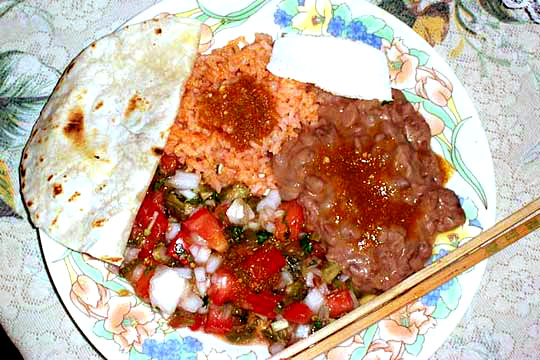
The tunitas were placed on the ground and switched just as described in my last newsletter, to remove the glochids. Then they were washed and once absolutely glochidless they were cut up and sautéed in a skillet while onions, tomatoes, garlic and cilantro were chopped. The diced tunitas cooked up just like okra -- slimy. The finished dish also tasted as good as any okra dish, with a slightly sour taste. You can see a plate of it, along with the obligatory beans, tortilla, white cheese, and even some rice, all generously spritzed with hotsauce, below:
Folks here think of the tunitas-providing cactus as just one of the many varieties of Nopal Cactus, which provides edible cactus fruits, or tunas, and edible cactus pads. Now that my eye is starting to pick up subtle details in the flora, I've realized that the tunita cactus isn't a variety of the Nopal at all, but rather an entirely different species.
It's OPUNTIA AUBERI. Sometimes the species is called Lengua de Vaca in Spanish (Cow's Tongue), but lots of things here are called Lengua de Vaca. The main Nopal Cactus is OPUNTIA FICUS-INDICA, but several edible-fruit-producing cacti are called Nopal. Really, when dealing with the varied world of cacti in Mexico, you just about have to use Latin names.
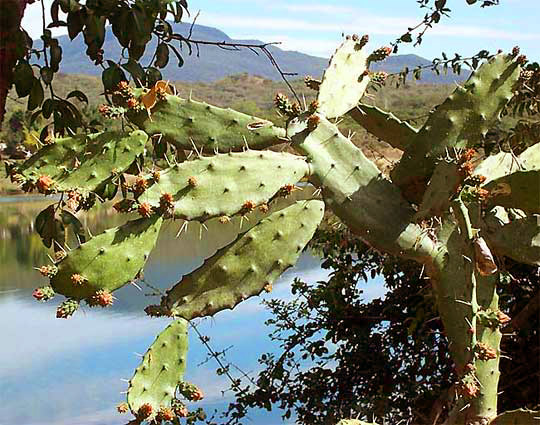
You can see a picture of our tunitas-producing Opuntia auberi along the lake beside our offices below:
The Opuntia ficus-indica I photographed last month at San Juan is at www.backyardnature.net/n/06/061218t.jpg.
Both of these species produce cylindrical, bark-covered tree-like trunks, and the Cow's-tongue's trunk is even taller and more slender than the Nopal's.
The cacti I'm finding here are wonderful and I expect to be learning a lot more about them. Just in little Querétaro state, occupying only 1% of the Mexican nation, about 112 cactus species are known, in about 30 genera. Amazing!