PLANTS | ANIMALS | ECOLOGY | FUNGI | GEOLOGY | GARDENING | TOOLS
MEXICAN PLANTS & ANIMALS HOME

Excerpts from Jim Conrad's
Naturalist Newsletter
from the June 15, 2007 Newsletter issued from Jalpan de Serra, N21.23°, W99.47°, elevation ~800m (~2600ft), QUERÉTARO, MÉXICO
SILVIANO'S TEPEGUA
Tuesday morning Silviano was watering plants near the office buildings. As I walked by he bent over, picked a leaf from an unspectacular-looking "weed" growing next to the fern he was watering, crushed the leaf, and even before he held it beneath my nose I smelled it's wonderfully refreshing odor, much like the fragrance of cilantro, but even sharper and more piquant, maybe like cilantro mingled with tangerine-rind or arrugula. Silviano called it "Tepegua" and he described it as a common weed that country people around here use a lot as a seasoning. Also it was medicinal, but he didn't know what it was used for. You can see Silviano's Tepegua next to its fern below:
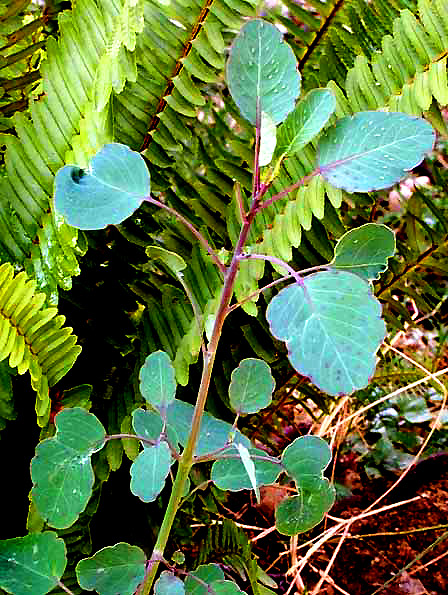 .
.
Bearing no flowers or fruits, I couldn't imagine what plant family it belonged to. Especially the slit-like "pellucid glands" ornamenting the leaves didn't make sense. These glands, filled with aromatic oils that impart to the leaves their fragrance, can be seen below:
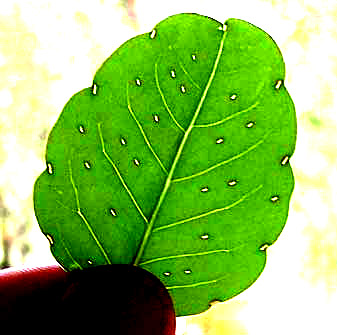
On the Internet I found Silviano's "Tepegua" listed as a name for a plant more commonly known in the rest of Mexico as Pápaloquelite (PAH-pa-low-keh-lee-teh). The "quelite" part of that name derives from the Nahuatl language spoken by the ancient Aztecs and still heard in much of Mexico. "In Nahuatl, "quilit" is a generic term used for plants with edible leaves -- what a Kentuckian might refer to as "greens."
Silviano's Tepegua is POROPHYLLUM MACROCEPHALUM*, which surprises me by being a member of the Composite/Sunflower Family. The Porophyllum genus name refers to the leaves' oil-filled "pores." I don't recall having ever seen a composite with such leaves. The species is somewhat related to marigolds. Marigolds also bear leaf-glands filled with aromatic oils, but those oils are too musky and bitter to taste good.
What a treat to find out about a new plant like this, to have a friend introduce it to me, to learn about its deep roots in history, to see what botanically curious features distinguish it, to smell it, to taste it, and think about future dishes atop which I'll sprinkle a few leaves and the whole room will blossom with such a unique, friendly fragrance...