PLANTS | ANIMALS | ECOLOGY | FUNGI | GEOLOGY | GARDENING | TOOLS
MEXICAN PLANTS & ANIMALS HOME

Excerpts from Jim Conrad's
Naturalist Newsletter
from the July 27, 2007 Newsletter issued from Sierra Gorda Biosphere Reserve, QUERÉTARO, MÉXICO
SATELLITE SPHINX MOTH CATERPILLAR
The moment I saw the caterpillar shown below I figured I knew what it was related to:
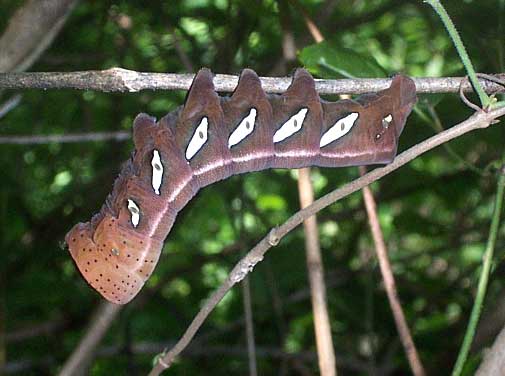
That larva's finger-length size, thickness and side markings reminded me a lot of the hornworms that used to populate my tomatoes back in Mississippi, despite it bearing no "horn." Hornworms are the caterpillars of sphinx moths so on the Internet I searched for sphinx moth caterpillars. The caterpillar in the above picture turned out to be the larva of the Satellite Sphinx Moth, EUMORPHA SATELLITIA. You can see the moth and more images of the caterpillar at http://www.silkmoths.bizland.com/esatesat.htm.
If the moth picture at the above page looks like a hummingbird moth to you, that's OK, since moths of this family, the Sphingidae, are variously known not only as sphinx moths but also hawk moths and hummingbird moths.
At the above website you can see that younger caterpillars -- early " instars" -- possess a spiny "horn" just like the hornworms on my tomatoes. The spine doesn't appear on the last instar, however.
An odd feature of the caterpillar in the picture is its flat-looking head. Actually the larva has a normal, rounded head, but when the larva is disturbed or resting it can withdraw its first three or so segments into its body, like a collapsing telescope.
Satellite Sphinx Moths are distributed from the US border into South America, as well as the Caribbean. The caterpillars are known to eat viny members of the Grape Family. At night female moths emit a "pheromone plume" which males detect and follow to its source. A pheromone is a chemical that triggers an innate behavioral response in another member of the same species, in this case sexual activity.
It's interesting how when you're in a far-away, exotic area you keep meeting "variations on themes" you first learned about in your own home area. I'd never seen a Satellite Sphinx Moth caterpillar before last weekend, but the moment it appeared before me I already knew a lot about it, thanks to my tomato hornworm days in Mississippi.