PLANTS | ANIMALS | ECOLOGY | FUNGI | GEOLOGY | GARDENING | TOOLS
MEXICAN PLANTS & ANIMALS HOME

Excerpts from Jim Conrad's
Naturalist Newsletter
from the March 24, 2007 Newsletter issued from Sierra Gorda Biosphere Reserve, QUERÉTARO, MÉXICO
A CARPET OF FLOWERING PONDWEED
Down below the reservoir dam where nowadays the river is reduced to a trickle, boys fish for tilapia, bass and other species in shadowy pools of green water beneath broad-trunked Mexican Cypresses. The boys use hand-tossed lines (no reels, no poles, no floats, just lines with hooks on them, and earthworms on the hooks). Some of the sunnier pools have pondweed growing thickly along their edges. You can see floating pondweed leaves and emerging flower spikes below:
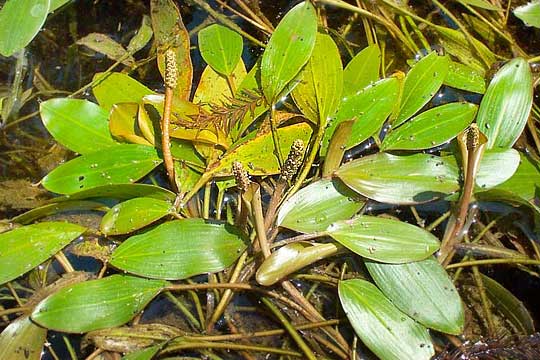
This is Long-leafed Pondweed, POTAMOGETON NODOSUS, of the Pondweed Family, and there may be some of this very species near where you live because the species is found worldwide, except in Australia. Several aquatics are similarly distributed over an enormous area, migrating waterfowl helping with the dispersal. This species is distinguished from most of the 80 or so other pondweed species by its big leaves on long petioles. Actually this species has two kinds of leaves: The submerged ones are long and thin, up to eight inches long, while the floating leaves are broad and grow up to five inches long.
Despite their cosmopolitan nature, most of us can go for a long time without seeing pondweeds because nearly everywhere our wetlands have been abused and destroyed. Pools of shallow freshwater almost anyplace where there's sunlight should have its pondweeds. A rainbow of aquatic life uses pondweed to hide in, or to eat. Our Long-leafed species produces chains of starchy tubers very important to certain waterfowl and mammals.
In the picture, the four emergent spikes are not flowers themselves but rather clusters of very simple, much reduced blossoms. The actual flowers are tiny things congested on the spikes, each flower consisting of four female pistils almost looking like a mint's four nutlets nestled in an old calyx, then surrounding those are four pollen-producing stamens and then there are four petal-like things generally interpreted as growths arising from the stamens. This is an unusual flower anatomy, especially when you consider that pondweeds are monocots (like grasses and orchids), not dicots.
I think of flowering pondweeds as late summer/ early fall blossoming plants, so it's neat finding flowers here in March. I also think of pondweed as indicating a wetland in fairly good condition. However, the ones in the picture were growing in water smelling of human feces, probably because of untreated sewage from unofficial-looking homes upstream, and nearby was a little park where lots of people hang out. A lady washed clothing in a wheelbarrow full of water from the stream not far away.