PLANTS | ANIMALS | ECOLOGY | FUNGI | GEOLOGY | GARDENING | TOOLS
MEXICAN PLANTS & ANIMALS HOME

Excerpts from Jim Conrad's
Naturalist Newsletter
entry dated May 21, 2022, notes from a camping trip among hills about 7kms ENE of Tequisquiapan, Querétaro state, MÉXICO
elevation about 2020m (6700 ft), near N20.57°, W99.85°
ANGLEWING PRIMROSE-WILLOW
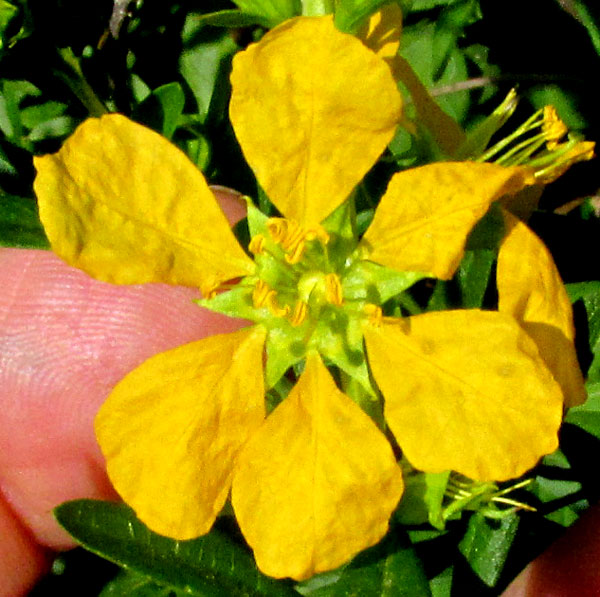
Here at the end of an especially dry dry-season the landscape is mostly gray and brown, except in those rare spots at the bases of cliffs and the heads of canyons where spring water seeps to the surface. In such locations a small but lush and green oasis forms, where all through the day birds and other animals come to drink, and plant species turn up not found out in the sunbaked scrub. One of those species, in a water-saturated low spot below a cliff, was a semi-woody-based, densely branching bush about shoulder high bearing flowers like the one shown above. Note that the flower has six petals and sepals.
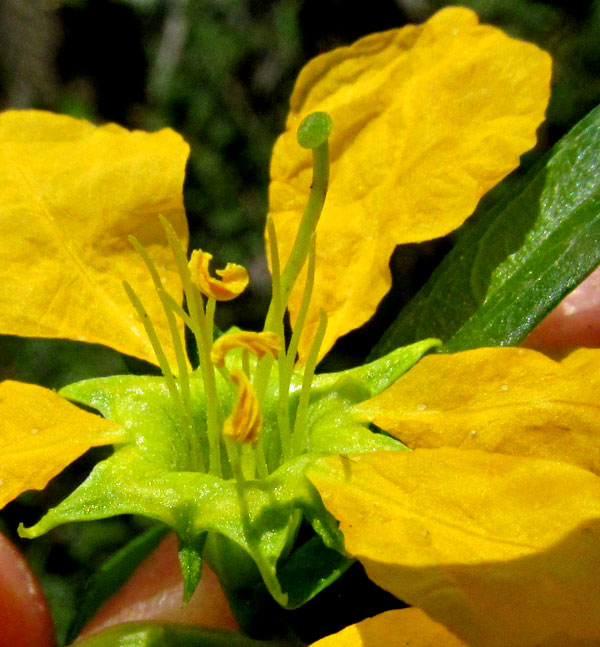
The above close-up gives a good view of the flower's interior, which includes some surprisingly twisty anthers. You can also see that the leaf at the right is perfectly hairless. Here's a better look at the leaves, still hairless:
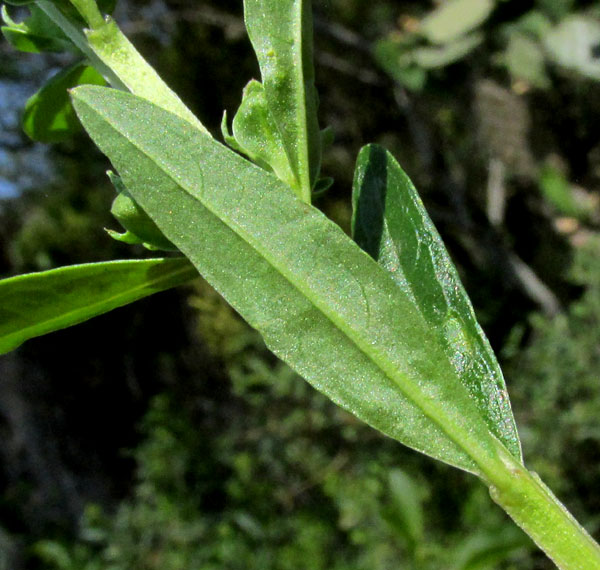
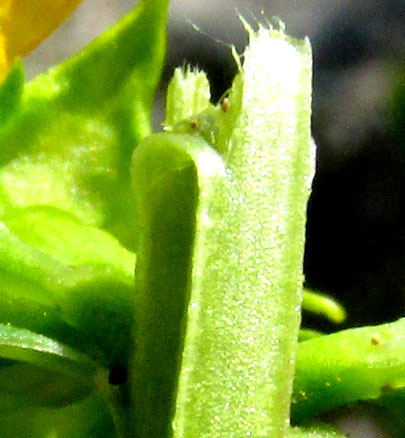
At the above picture's lower-right corner, notice how the leaf margins at its base continue onto the stem as pale "wings." A better grasp of what stem wings on a squarish stem looks like is shown below:
Finally, here's a view of the whole semi-woody-based, shoulder-high plant:
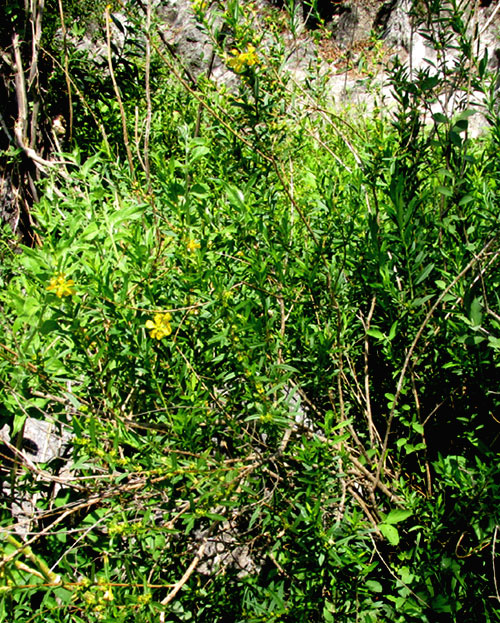
*UPDATE: Most wildflower appreciators in North America will look at all the above and decide that it's seedbox, genus Ludwigia, in the Primrose Family, the Onagraceae. That's what I thought, specifically, the Anglewing Primrose-willow, Ludwigia leptocarpa, well known up North. However, in 2025, when this page's images were uploaded onto the wonderful iNaturalist website, user "mauro_rojo" recognized it as a mostly Mexican and South American species, the Sun Opener, HEIMIA SALICIFOLIA, a genus I'd never heard of. It's not even in the Primrose Family, but rather the Loosestrife Family, the Lythraceae. Like seedboxes, it also occurs in muddy spots. This must be another instance of convergent evolution: Unrelated organisims evolving toward the same most-adaptive appearance, for any given habitat, such as a muddy seep below a cliff.