PLANTS | ANIMALS | ECOLOGY | FUNGI | GEOLOGY | GARDENING | TOOLS
MEXICAN PLANTS & ANIMALS HOME

Excerpts from Jim Conrad's
Naturalist Newsletter
from the January 19, 2007 Newsletter issued from Sierra Gorda Biosphere Reserve, QUERÉTARO, MÉXICO
"BIZNAGA" CACTUS
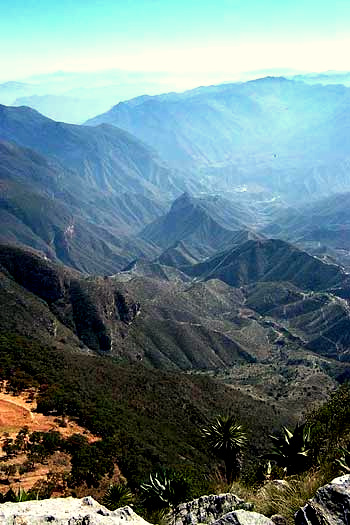
Last Friday four professors from Cuernavaca arrived with botany students and I became their botanical guide until Sunday afternoon. For me the star destination was 8500- ft-high (2600 m) Cuatro Palos (meaning "Four Trees"). Up there the light is crystalline and sharp, the view majestic, and plants and animals are especially adapted for edge-of-world conditions. One view can be seen above.
At a rocky, exposed tip of a limestone ridge above the village several fabulous plants found a foothold. One little gem was a small, oval, sublimely spiny and flowering cactus, seen below:
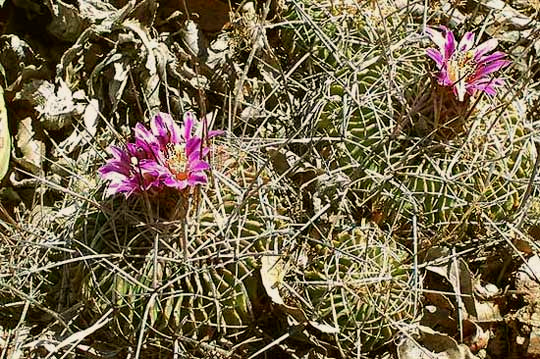
The locals gave the name of this cactus as Biznaga. But I've heard that name many times before. In fact, Mexicans call any roundish, very spiny cactus Biznaga. An unflowering Mammilaria growing nearby with a completely different body structure (composed of "nipples" instead of "ribs" like our flowering one) also was called Biznaga. We were told about waist-high, barrel-shaped cacti with foot-long spines living down lower in the dry valley and they also were Biznagas. There couldn't have been a better demonstration to the students of the value of scientific names, for if you're trying to determine whether a species is rare or not, how can you even talk about it if everything is called "Biznaga"?
We set ourselves down next to the "Biznaga" and began "keying it out," using a technical dichotomous key. Right off, the key asked whether glochids were present. Remember that glochids are tiny spines at the base of big spines. Our specimen had no glochids. Other important features of this species were that its body surface was folded into thin, waferlike, vertical, sinuous ribs atop which the spines arose, and the flowers sprouted from the cactus's top-center, not from along its sides.
Our cactus keyed out to be a species of the genus Stenocactus, which is endemic to Mexico. It was STENOCACTUS CRISPATUS*. Apparently the species has no common name because it's not commonly known, but plant taxonomists sure have kicked it around, giving it one scientific name after another. I count about thirty scientific names it's been known as.