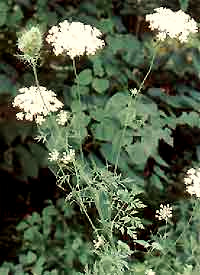
The wildflower or weed called Queen Anne's Lace, shown at the right, is the wild form of the carrot grown in people's gardens. Both the wild and garden forms are known by the binomial Daucus carota. Like many roadside weeds in North America, Queen Anne's Lace is a native of Eurasia.
The large, white items in the picture are not flowers, but rather clusters of many tiny, white flowers. Those clusters of flowers are known as inflorescences, and this particular flat-topped kind of inflorescence is called an umbel.
By producing tiny flowers grouped in large clusters the plant accomplishes two main goals. First, by having large, bright clusters of flowers, pollinators are attracted from far away. Second, since each individual flower is small and just one of many, if something happens to it, the plant has plenty of other flowers remaining to get the job done.
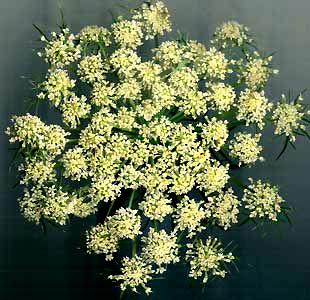
At the left you see an umbel from a garden carrot plant, which may be a little larger than generally found on the wild, weedy plants, but otherwise identical. Notice how the cluster consists of smaller clusters. The inflorescence is flat-topped, with the small clusters on the outside of the big cluster resting atop longer "stems" than the small clusters in the center. The small clusters are known as umbellets. A number of species produce such umbels with umbellets. An umbel with umbellets is referred to as a compound umbel.
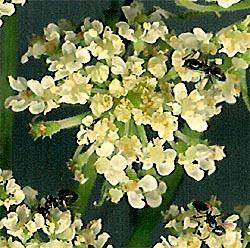
In the picture of an umbellet at the right you can see the individual very small flowers (as well as some ants). To understand what you see you may want to review our Standard Blossom Page. Each "real flower" bears five petals, five stamens alternating with the petals, and the ovary is inferior (arising below the petals.) If you look closely at an umbellet in your hand, you'll see that its outer flowers have larger petals with a much greater difference in size than flowers in the center.
The flowers' ovaries consist of two long cells next to one another, and each cell produces a single seed. The mature fruit with its two seeds is about 1/8-inch long (3mm) and bears tiny bristles along its ribs.