
PLANTS | ANIMALS | ECOLOGY | FUNGI | GEOLOGY | GARDENING | TOOLS
Excerpts from Jim Conrad's
Naturalist Newsletter
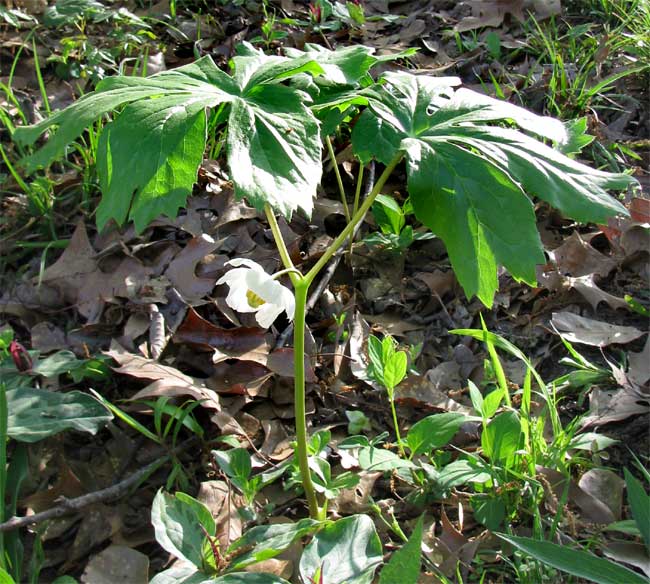
from the the March 30, 2009 Newsletter, issued from the forest near Natchez, Mississippi; elevation ~400ft (120m), ~N31.47°, ~W91.29°:
MAYAPPLES FLOWERING
Any wildflower book featuring the best known and prettiest of North American wildflowers will include the Mayapple, PODOPHYLLUM PELTATUM, shown above.
Mayapples also are among the easiest to identify of all wildflowers, with their white, waxy-petaled, single, two-inch broad flowers nodding from the branching points of Y-shaped stems.
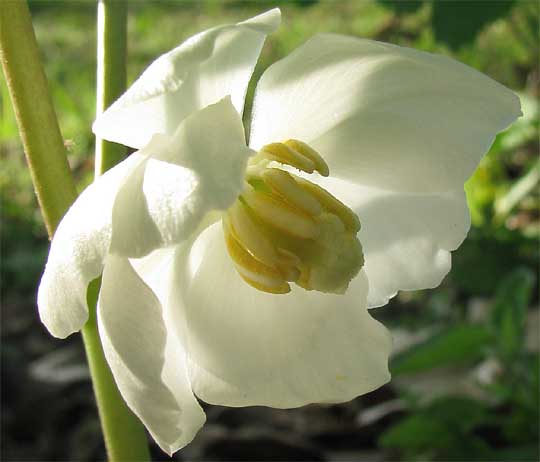
Above a close-up of a flower shows the stamens' banana-like, yellow anthers releasing pollen, the stamen number being twice that of the number of petals. Inside the anther cluster you see the female green ovary topped with a cauliflower-like stigma, the stigma being where pollen grains germinate. A few weeks from now the ovary will have matured into a pleasant tasting yellow fruit, but usually animals eat them before they're ripe enough to entice humans.
Another name for Mayapples is Mandrake, and with a name like that you might expect it to have some medicinal uses. When I was hermiting near here, each spring researchers from Ol' Miss interested in Mayapple's medicinal value came to study a population near my camp. Especially the root contains powerful chemicals that can give you dermatitis if you get root juice on you. One chemical in Mayapple root, podophyllin, is much studied as a cancer medicine because it interferes with cell division.
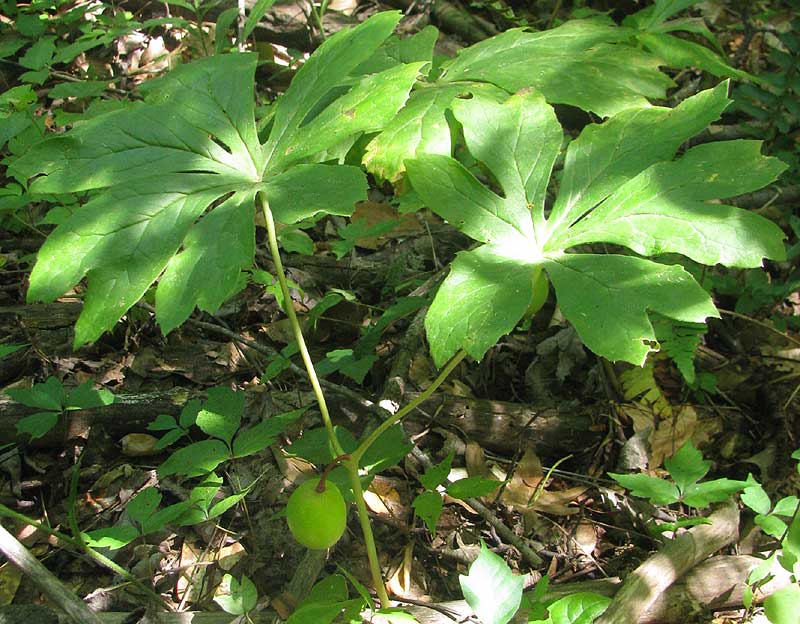
from the the May 6, 2012 Newsletter issued from the woods of the Loess Hill Region a few miles east of Natchez, Mississippi, USA
MAYAPPLE IN MAY
The expert who wrote Wikipedia's current page on the eastern North American wildflower called Mayapple, PODOPHYLLUM PELTATUM, writes that "...it is the flower that appears in early May, not the 'apple.' The fruit or 'apple' is produced in early summer and ripens later in summer." At the top of this page you can see a picture made on May 1, 2012 proving that in the US Deep South that's not true.
On a steep, tree-shaded ravine slope, in our area this Mayapple's "apple" isn't ripe, but if we wait until it's ripe to photograph it more than likely we'll never get the picture, since critters eat the fruits as soon as they begin emitting ripeness odors. Still, it looks like this Mayapple apple will mature in May.
Unripe Mayapple fruits shouldn't be eaten because they are mildly toxic. In fact, the whole plant is somewhat toxic, especially the roots, because of the presence of the compound podophyllotoxin, which serves the plant by keeping animals from too readily eating it. The "apple" technically is a fleshy berry because it's pulpy, contains more than one seed, and doesn't split open at maturity.
Some Native American groups used Mayapple root powder as a laxative and to control intestinal worms. Modern medicine uses Mayapple extracts against genital warts, HIV-related oral hairy leukoplakia and certain skin cancers. Of course the trick in using these cures is to know what the dosage should be because if you take too much orally you can kill yourself.