PLANTS | ANIMALS | ECOLOGY | FUNGI | GEOLOGY | GARDENING | TOOLS
Excerpts from Jim Conrad's
Naturalist Newsletter
from the the September 27, 2009 Newsletter, issued from the Siskiyou Mountains west of Grants Pass, Oregon:
ARTICHOKES ON THE STEM
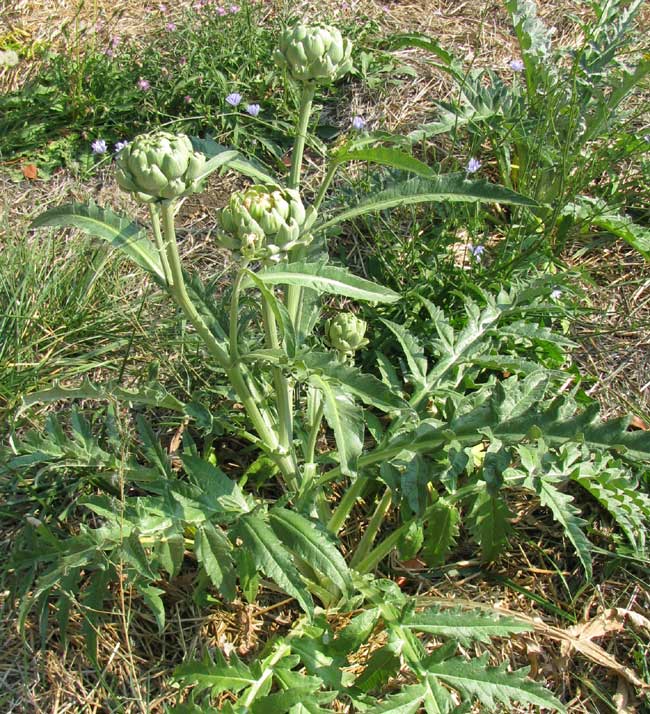
Maybe you've never seen what an artichoke looks like before it's sold in the supermarket. Some neighbors grow them and you can see one of their plants above.
This is a good time to talk about artichokes because we've been looking so closely at involucral bracts, or phyllaries. Each big, green, tough, pointy, scale-like part of an artichoke is nothing more than an involucral bract.
Since artichoke plants are members of the Composite Family "tribe" (family subdivision) of the Cynareae, which is the "thistle subfamily," artichoke plants are pretty close to being thistles.
If the artichokes in the picture aren't cut, eventually flowers should emerge from among the bracts. You might be able to guess what part of the Artichoke flower is the flat, round, soft, good-tasting thing we eat from inside the artichoke head. That's the receptacle -- the table-like platform on which future composite flowers will be stacked.
Artichoke plants are CYNARA SCOLYMUS.
It's not known where Artichoke plants came from originally but it was probably from in or around northern Africa's Maghreb Region, for wild Artichokes are still found there.
from the June 8, 2014 Newsletter issued from the Frio Canyon Nature Education Center in the valley of the Dry Frio River in northern Uvalde County, southwestern Texas, on the southern border of the Edwards Plateau; elevation ~1750m (~5750 ft); N29.62°, W99.86°; USA
FLOWERING ARTICHOKE
Most gardeners who grow artichokes cut off the flower buds to eat, so the Artichoke plant never produces flowers. My neighbor Deborah, though, just wanted her plants to be pretty and happy, so she let them grow as they pleased, and was rewarded with the pretty thistle heads seen below:
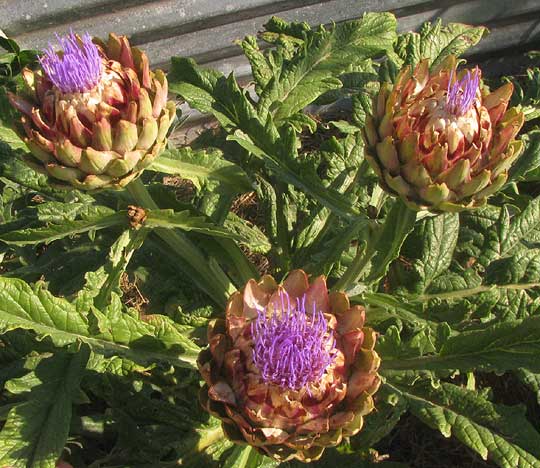
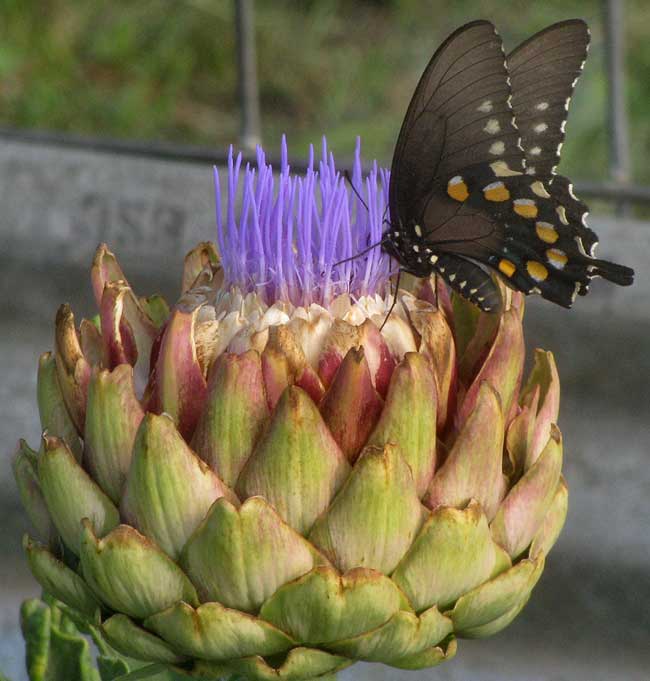
You just can't miss the general similarities between the heads of the weedy Nodding Thistle and those of the Artichoke. A close-up of a single Artichoke flowering head being visited by a Pipevine Swallowtail butterfly is presented below: