
PLANTS | ANIMALS | ECOLOGY | FUNGI | GEOLOGY | GARDENING | TOOLS>
Excerpts from Jim Conrad's
Naturalist Newsletter
from the January 2, 2011 Newsletter issued from Hacienda Chichen Resort beside Chichén Itzá ruins, central Yucatán, MÉXICO
OUT-OF-HABITAT THRUSH
As I returned a wheelbarrow to the shop, movement atop the hill caught my eye. You can see what it was below:
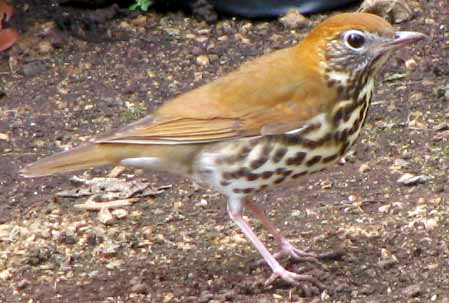
It was a very familiar old friend from forested eastern North America, the Wood Thrush, CATHARUS MUSTELINUS, and I was especially happy to see him because this species' numbers have diminished by about half from when I was a young birder. However, it was jarring to see this particular bird where he was. For, Wood Thrushes are quintessential denizens of moist, shady, well developed forest, but here this bird was hopping about on a barren, sun- and wind-swept, highly eroded hill crest that not long ago had been a cow pasture.
Moreover, Howell's distribution map for the species shows the northern limit of its winter distribution to be a bit south of here, with its presence here in the more arid north expected only during migration.
What I'm hoping is that Wood Thrushes are proving flexible enough in their habitat requirements that they can start surviving in other than their usual moist, shaded, more or less intact forests. Maybe this individual atop our barren hill has genes adapted for the new world to come, and he'll be a pioneer for future Wood Thrushes in habitats very different from their traditional ones.
But, what would it feel like to hear the Wood Thrush's rich, fluty, echoic call floating across a scorching, scrubby barren?
from the June 5, 2005 Newsletter issued from the Sierra Nevada Foothills east of Sacramento, California
DISAPPEARING WOOD THRUSHES
My friend Jarvis in North Carolina is an official BBS survey taker and he writes that:
I have finished my two Breeding Survey routes for this year in southeastern N.C. For the first time ever, I found no Wood Thrushes on my route that begins in Pender Co. The average number of Wood Thrushes on that route for the first 12 years I ran it was 4.9. I found 3 Wood Thrushes on my route that begins in Columbus Co. but that's a lot less than the average number of 7.7 during the first 12 years. The number of Wood Thrushes on those routes has been substantially lower in recent years than it was earlier. The amount of good Wood Thrush Habitat on those routes seems to be about the same as it was back in the early 80's.
Jarvis's observations confirm other reports. Even during my ten years in southwestern Mississippi I noticed diminishing Wood Thrush numbers. You can read more about the Wood Thrush's decline at https://abcbirds.org/bird/wood-thrush/.