
PLANTS | ANIMALS | ECOLOGY | FUNGI | GEOLOGY | GARDENING | TOOLS>
Excerpts from Jim Conrad's
Naturalist Newsletter
from the December 9, 2012 Newsletter issued from the valley of the Dry Frio River in northern Uvalde County, southwestern Texas, on the southern border of the Edwards Plateau; elevation ~1750m (~5750 ft); N29.62°, W99.86°; USA
NERVOUS ROBINS
Occasionally you hear the unmistakable nasal calls and cluckings of American Robins. Below you can see a freshly molted one in a tree beside the cabin:
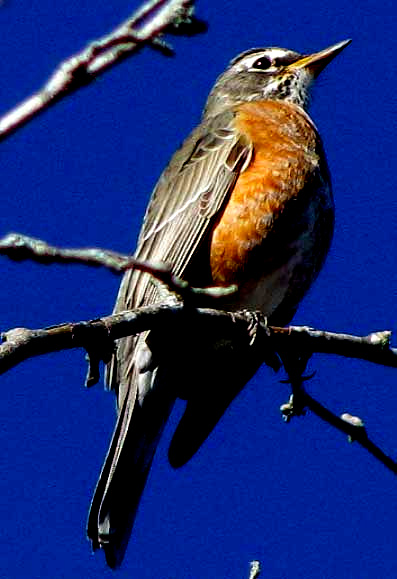
This is interesting because during the hot breeding season robins don't occur in southern and most of western Texas. They nest in the southern half of Canada and the greater part of the US, but not here and nearly all of Florida. You can see their summer distribution map at http://www.mbr-pwrc.usgs.gov/bbs/htm96/map617/ra7610.html.
That map can be compared with their winter distribution map at http://www.mbr-pwrc.usgs.gov/bbs/cbcra/h7610ra.html.
The winter map shows that during the cold months American Robins are common in southern and western Texas as well as throughout most of the US, though they've mostly vacated Canada. Consequently, in most of the US you can see robins year round, but they're not the same birds. The whole population shifts southward, so the birds seen at my old hermiting spot in southern Mississippi may have spent their summer at my childhood home in Kentucky, or farther north.
Winter birds also behave differently, not hopping around on suburban lawns and defending their territories as in the summer, but rather they join in flocks that mostly stay in the countryside. These winter birds are relatively nervous and much less approachable. The one in the picture was constantly eyeing me and clucking his danger call. In the winter, American Robins are found throughout much of highland Mexico, too.
from the April 19, 2009 Newsletter, issued from the Siskiyou Mountains west of Grants Pass, Oregon:
ROBINS HERE, TOO
Travelers like to see new things but maybe just as important is to gain new perspectives on what makes up everyday life back home. That's the way it is when I travel and see American Robins, TURDUS MIGRATORIUS. Few songbirds are more familiar, yet there's always more to know about them, more to appreciate about them.
When I was a kid in Kentucky robins were the birds hopping around looking for earthworms in our lawn. During my hermiting days in Mississippi in the fall they flocked in big Pecan trees above my trailer alternately basking in sunlight and gorging themselves on Poison Ivy fruits. The first bird I saw here was a robin. If you're in a robinless part of the world you can see what the one outside my door looks like below:
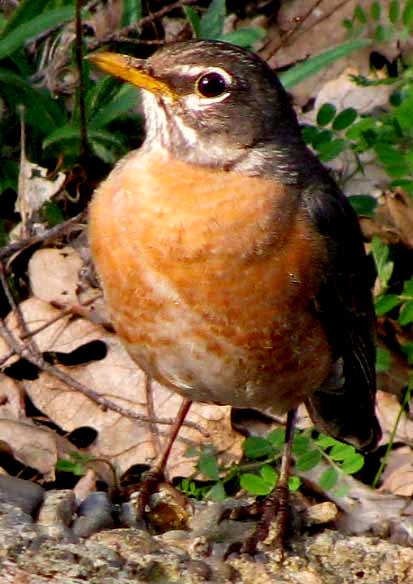
Mature adult males in summer wear darker gray upperparts than the one in the picture, and their breasts are more intensely orange. Here's what we read on A.C. Bent's Robin Page in Life Histories of Familiar North American Birds online for free at http://birdsbybent.com/ch31-40/robin.html.
The most frequent notes we hear the robin utter, perhaps, are fretful expressions of uneasiness, complaint, or resentment at our presence or at some other distraction, yet it is characteristic of him to break out with a phrase or two of song even in the midst of complaint. He seems always apprehensive, often standing alert and restless, wing tips lowered or twitching, head high, and tail pumping, on the watch for danger, and the least alarm upsets his equilibrium and startles him into vociferous, unrestrained remonstrance.
Those words were published in a Smithsonian museum bulletin in 1949. I relish the old naturalists' way of putting their hearts into such descriptions, offering a richness of detail no modern technical journal would permit for fear of being accused of unscientific anthropomorphism.
But, what a picture of the robin those words paint! If you want to see your common backyard robin from several new perspectives, go read that Robin page linked to above.
from the November 18, 2001 Newsletter, issued from near Natchez, Mississippi:
AMERICAN ROBINS
Lately on some mornings a flock of about 30 American Robins has been landing in the top of my big Pecan trees where they content themselves with alternately basking in the brilliant sunlight and gorging themselves on Poison Ivy fruits. To any American suburbanite who this summer has seen American Robins in his or her lawn every day this might seem too ordinary an event to be remarked.
However, here these flock visitations are something special. For, these are the first American Robins I have seen all year. Last spring I participated in a major migratory-birdcount lasting several months, during which time each Friday I counted every migratory bird I saw or heard. There was not a single American Robin among them. Nor have I seen one all summer. I'm really not sure why this is so. Though I haven't been in Natchez enough to know for sure, I suspect that American Robins are common there, at least during the summer.
These American Robins have profoundly split personalities. The sleek, nervous, gregarious birds in my Pecan trees are very different creatures from the round-chested, turf-hopping earthworm-pullers found in America's summery suburban lawns. During nesting time those summer birds defend lawn-and-hedge territories and fight epic battles with neighboring robins who venture too close to their claim. If you're lying in a lawn chair, an American Robin may fearlessly hop to within just a few feet of you, glaring at you as it pulls up earthworms.
But in the fall these birds become their opposites. They forsake their boundary fights and unite into the kinds of noisy, loose-knit flocks that now visit my Pecan trees. They grow skittish. This morning as they created a cacophony of busy chattering among themselves, when I snapped a small limb for firewood every bird escaped to other trees.
Their diet also changes. Their obsession for earthworms and other animals becomes an obsession for vegetarian fare. One study found that in the spring vegetable matter constitutes only 21% of their food, while during the fall it rises to 81%.
Sometimes I amuse myself with the thought that each year American Robins alternate between "extreme conservative" behavior, and "extreme liberal." In the summer each bird is the daring individualist defending his privately proclaimed plot of land, singing incessantly of home and family. They are true red-meat Republican birds. But then winter makes them all into shifty vegetarian communists who disdain personal property and spend their days flocking from one easy meal to the next. What this means to me is that Mother Nature finds that sometimes the right-wing approach works, other times the left-wing approach works. As is the case so often in nature, diveristy hand in hand with pragmatism equals survival.
Though in most of the US American Robins can always be found, they are migrators -- their Latin name is TURDUS MIGRATORIUS. During the summer they are distributed from northern Canada south to about here. Then during the winter their distribution shifts southward. Their northern boundary lies somewhat south of the US/Canada border, but their southern distribution extends as far as Guatemala.
My bird fieldguide shows the American Robin's southern distribution line going right through the Natchez area. Maybe a local Newsletter reader will send me a mail saying whether Natchez lawns are graced with American Robins during our summers.
from the February 23, 2003 Newsletter, issued from near Natchez, Mississippi:
ROBINS EATING CHINABERRY FRUITS
Blackbirds weren't the only birds flocking through the forest this week. I was wandering the forest looking for interesting fungi when something small but heavy began thumping into the leaf litter all around me, then something marble-size and whitish bounced off my shoulder. Directly above me were about 20 American Robins gorging themselves on Chinaberry fruits.
Chinaberry, MELIA AZEDARACH, is another introduced plant abundant at Laurel Hill, and especially conspicuous at this time of year. Now the short-lived trees are leafless but among their upper limbs they bear basketball-size, diffuse clusters of whitish fruits. Friday's robins made a racket issuing nasal tik-calls as the feasted upon the fruits. While calling they would stretch from their perches to reach the fruits or else fly up to a fruit, nab it in midair, then instantly returning to their perch.
The birds were pretty persnickety about what they collected, for about half the time, after they had held the fruit in their beaks for about a second, they would simply drop their prize onto the forest floor and choose another. If the fruit was OK, the bird snapped back his head and gulped down the fruit whole, which was something to see, for one wouldn't think a robin could swallow such a relatively large fruit. To me the fruits seem entirely too pithy and stinky to consider even nibbling. Clearly, robins have another opinion.
from the July 5, 2009 Newsletter, issued from the Siskiyou Mountains west of Grants Pass, Oregon, USA:
NESTING ROBIN
Everyone at least once in his or her life should have the fun of watching a wild bird's daily nesting routines. This week an American Robin, TURDUS MIGRATORIUS, has been incubating her eggs in a nest in an Oregon White Oak's forking branch about fifteen feet up and twenty feet from my door. She's sitting there as I type this, unmoving, her eye fixed on my door, the nest so well camouflaged that I wouldn't notice it if sometimes she didn't fly back and forth. As I look there now all I can see of her is her yellow, upward-tilted beak. You can see her, too, below:
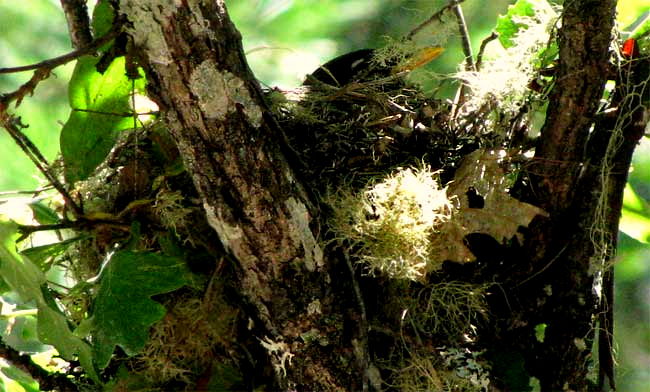
Both the male and female built this nest. Though the female's head is slightly paler than the male's usually I couldn't make out which mate was doing what. Probably the following description penned a century ago, now online at the Birds by Bent Robin Page at http://www.birdsbybent.com/ch31-40/robin.html still is about right:
"On every journey, practically, the female brought larger loads than the male, and twenty-two more of them. The actual shaping of the nest was done entirely by the female, the male usually dropping his load haphazard on the edge of the structure."
Robin nests usually hold four eggs, though the number can vary from three to seven. The incubation period ranges from 11 to 14 days
from the July 19, 2009 Newsletter, issued from the Siskiyou Mountains west of Grants Pass, Oregon, USA:
HOT ROBIN NESTLINGS
A couple of Newsletters ago I mentioned the nesting American Robins outside my window. Since then I've witnessed remarkable behavior.
For instance, twelve days ago at dusk I noticed both parents on the nest's edge peering inside. The male flew off, returned with a tiny earthworm, seemed to offer it to a nestling three or four times but apparently no nestling would take it, so the father swallowed it himself.
That was the last hint I had that there might be a nestling until a week later when the father arrived with an earthworm and up popped two fuzzy nestling heads with gaping beaks. And then, amazingly, the mother sitting amidst her babies also threw back her head, fluttered her wings and gaped just like her babies, begging to be fed! The male fed a nestling and flew away.
I figured that that would be the beginning of a frenetic feeding period but, no, most of this week the mother stayed most of each day on her nest, searching for worms mainly near dawn and dusk, and the male only rarely visited with worms, right before dusk. This weekend, however, the rate is picking up, and there are three nestlings, their eyes barely open.
On Thursday afternoon the temperature reached 91°. That felt pleasant to me because the humidity was very low but it seemed to stress the robins. For awhile as a hotspot of sunlight crossed the usually shaded nest two nestlings poked their heads from beneath the mother's wings and all three gaped panting but otherwise unmoving, cooling off as water evaporated from their mouths' moist membranes, as you can see below:
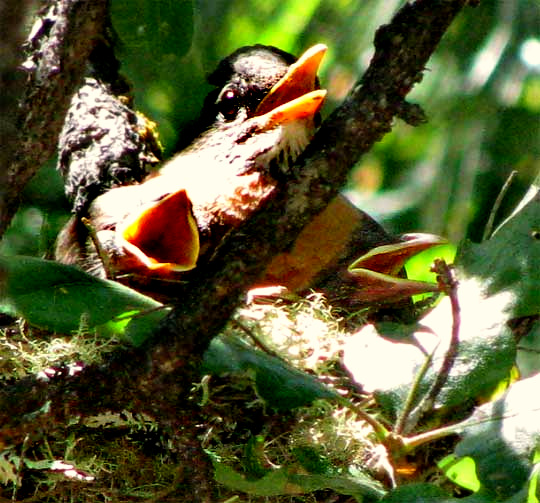
Whenever the mother plops worms into her nestlings' mouths she then bends down beneath them and scoops up their fecal pellets -- their droppings -- and swallows them. That's nutrient recycling. I haven't seen the male do this.
One of Anita's housecats got the nesting Tree Swallows I profiled a while back -- the mother and all the nestlings. This robin nest has about 15 feet of open space beneath it so we'll see what happens with them.