
PLANTS | ANIMALS | ECOLOGY | FUNGI | GEOLOGY | GARDENING | TOOLS>
Excerpts from Jim Conrad's
Naturalist Newsletter
from the January 23, 2011 Newsletter issued from Hacienda Chichen Resort beside Chichén Itzá ruins, central Yucatán, MÉXICO
GYMNASTIC GNATCATCHER
Little Blue-gray Gnatcatchers quietly flit about, so small and fast and plain-looking that they're easy to overlook, unless one of them makes his soft, slightly buzzy, nasal call. The other day one came working along the forest's edge in front of my hut searching beneath this and that leaf, checking out the trunk's other side, hopping from twig to twig, and I took a whole series of photos without getting a single shot showing the bird in any position other than what looked like a painful contortion, and always certain body parts were blurred by quick movement. A tail-bent example is seen below:
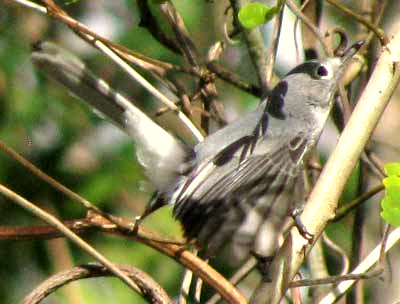
Maybe you remember how back in Querétaro (see below) during the winter months Blue-gray Gnatcatchers were often the most commonly seen bird in the acacia-rich scrub surrounding the big reservoir. Here you see them fairly regularly, but not every day. Here it's also possible to see Tropical Gnatcatchers and maybe White-lored Gnatcatchers and even Long-billed Gnatwrens, so each time a gnatcatcher flits by I mentally confirm the Blue-gray's field marks -- white eyering, white tail underside, dark wings, no black on head...
Though in parts of Mexico Blue-gray Gnatcatchers are only winter visitors, in many places, including the Yucatán, they're permanent residents. In most of the US they're just summer residents, but they're present year-round in the southernmost states, from coast to coast.
from the September 14, 2007 Newsletter issued from issued from Sierra Gorda Biosphere Reserve, QUERÉTARO, MÉXICO
BLUE-GRAY GNATCATCHERS ARRIVED
During the winter dry season the most common bird species out in the scrub is definitely the Blue-gray Gnatcatcher. Sometimes so many buzzy TZEEEER sounds come from around you that it's funny.
Gnatcatchers have been absent here the last few months. That's kind of surprising because the distribution map in my "Howell's" -- as birders refer to the two-inch-thick tome that's the last word on Mexican birds -- shows the species as a permanent resident here. Plus the similar Black-tailed Gnatcatcher also is a permanent resident. Still, I haven't seen a single one of either species all "summer."
In all but the cooler parts of North America Blue-gray Gnatcatchers are common though many birders who just watch species in their backyards may not know them. Gnatcatchers like treetops, plus they have small, slender beaks for catching insects, so they don't find birdfeeders holding seeds so attractive.
Despite their being so abundant here, it's always a pleasure hearing their buzzes among the Sweet Acacias, and seeing their long tails flitting through the trees' frilly, diffuse leaves.
from the May 26, 2002 Newsletter issued from issued from the woods near Natchez, Mississippi, USA
MYSTERY NEST
The hunters who lease hunting rights at Laurel Hill have planted about 20 acres of beans in the hope that deer will eat the plants and thrive. The other day deep inside one bean field I found a bird nest lying on the ground, surely blown there by last weekend's strong winds.
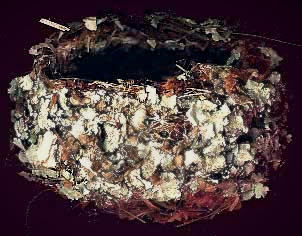 It was a beautiful little nest only 2.5 inches across at its widest (6.35 cm). Naturally I've scanned this nest and you can see it at the right.
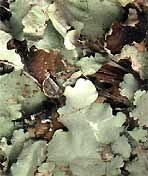
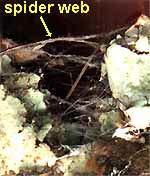
On our birdnest page I tell all about the detective work done to figure out that the nest had been constructed by a Blue-gray Gnatcatcher. The main pieces of evidence were the nest's size, its globular shape, its being encrusted with flat flakes of gray foliose lichens, and the whole thing being stuck together with spider webs. Below you can also see how the webbing was incorporated into the nest.
Maybe the most striking part of the whole mystery-nest experience was that I learned that the Internet is even a more powerful information resource than I had imagined -- and I already had a profound respect for it. I'm particularly impressed by the process of "Googling," an information-gathering procedure available to anyone with a computer and access to the Internet.
I Googled my mystery nest by going to the Google search engine at www.google.com, and when the word box appeared typing in these words: BIRD NEST SPIDER WEB LICHEN GLOBULAR. That's not very grammatical, but search engines look for keywords, not good grammar.
Google came up with several pages about the Ruby-crowned Kinglet. The problem with this response was that Ruby-crowned Kinglets are in our area during the winter but not during late spring and summer, so they don't build nests here. Nonetheless, mention of the Ruby-crowned Kinglet was important, for we do have a small woodland bird here during the summer which belongs to the same family as the kinglets, the Blue-gray Gnatcatcher. And usually birds in the same family build similar nests.
Now I re-Googled my nest, this time using Google's "Images" feature, with the keywords BLUE-GRAY GNATCATCHER NEST. Now up came pictures of nests looking as much like the mystery nest as they possibly could. Therefore: Blue-gray Gnatcatcher!