
PLANTS | ANIMALS | ECOLOGY | FUNGI | GEOLOGY | GARDENING | TOOLS>
Excerpts from Jim Conrad's
Naturalist Newsletter
from the the October 30, 2011 Newsletter issued from Mayan Beach Garden Inn 20 kms north of Mahahual, Quintana Roo, México
HERON POSE
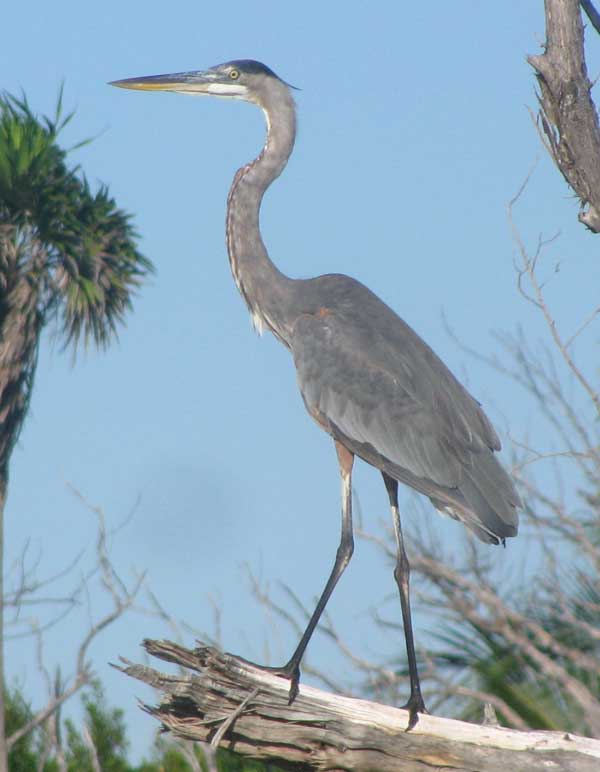
Great Blue Herons are widely distributed and so common that usually I don't give them a second look. However, this week one landed near me and struck such a classic pose that I just had to photograph him. That's him above.
from the August 23, 2009 Newsletter, issued from the Siskiyou Mountains west of Grants Pass, Oregon:
GREAT BLUE HERON IN WANDER TIME
This is wander time for a lot of birds. Even among permanent residents you're apt to see species suddenly appear where they haven't been all summer. Often their plumages are different from either their summer or their winter ones -- the ones illustrated in field guides. Lots of these wanderers are young birds so sometimes you also see them doing things a well adjusted adult wouldn't -- such as fly onto a limb and lose his balance, or let a housecat get too close.
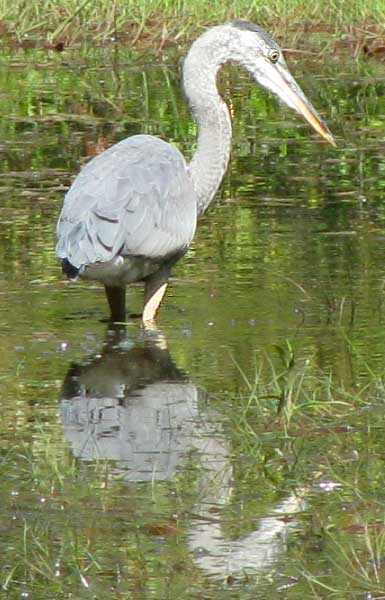
Up at the pond this week a juvenile Great Blue Heron, ARDEA HERODIAS, has been letting me get closer than he should. You can see him about to jab at something here.
I've mentioned how these days most of the pond is clogged with Jointed Rush, the stuff in the above picture emerging from the water like grass. Not long ago fish in the pond swam around in conspicuous schools near the water's surface but since the heron's arrival the fish have been hiding in that rush. Well, also this week a Belted Kingfisher has been taking his toll, so really those fish are cowering in any dark, deep place they can find, hardly ever showing themselves. You just see big bullfrog tadpoles darting to the surface, gulping mouthfuls of air, and skedaddling back onto the mud floor. I'll bet the heron is eating more tadpoles than fish.
Watching the heron puts me in a certain mood. He's always there, usually elegantly posed with a fish-staring tension similar to how he is in the photo. He doesn't move much but his moves are meaningful, and beautiful to behold, redolent of Chinese-landscape-watercolors, end-of-summer, slightly sad, Augusty feelings.
On the Great Blue Heron's wonderful "Birds by Bent" page at http://www.birdsbybent.com/ch1-10/gbh.htm the old-timey naturalist talk there says of the juvenile's plumage that "the upper parts, back, and wing coverts are plain gray, 'deep mouse gray' to 'deep Quaker drab,' without any signs of plumes anywhere."
Wouldn't it be neat to live in a time when people could speak of "deep Quaker drab" with the expectation that others would understand?
from the September 11, 2011 Newsletter issued from Mayan Beach Garden Inn 20 kms north of Mahahual, Quintana Roo, México
GREAT BLUE HERON OFFSHORE
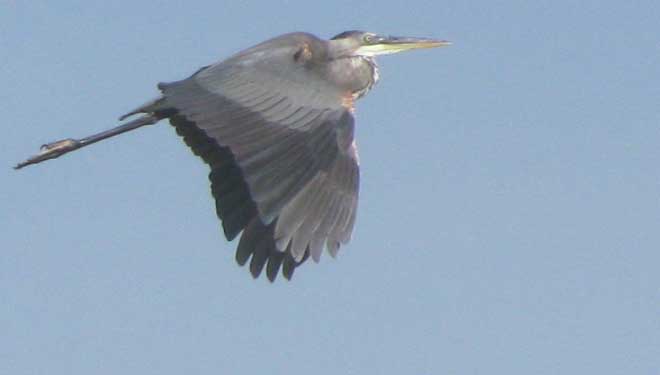
Northern Birders are familiar with Great Blue Herons, the largest of dark herons and common in North America from coast to coast. They're common in Mexico, too, stalking prey in both fresh and saltwater, though mostly they're only winter visitors. Here I haven't seen one all summer, so it was a nice surprise when one showed up wading in Turtleweed shallows a stone's throw from the beach. He wouldn't let me get close enough for a picture of him wading, but he was curious as well as cautious, so instead of flying away he flew by me, and I got the picture of him on the downbeat below:
Howell reports Great Blues as present in the Yucatán from September through April, plus there's a disjunct breeding colony in Sian Ka'an Biosphere Reserve just to our north.
from the March 29, 2015 Newsletter issued from Río Lagartos, on the north-central coast of Yucatán, MÉXICO
THE GREAT BLUE HERON'S "WHITE MORPH"
This week Paco and I were on a flamingo viewing tour with a group from British Columbia and Nebraska when a large, all-white heron turned up foraging near a mud bar. The bird was clearly larger than the commonly encountered Great Egret, Ardea alba, plus its beak was dark but yellow-tipped -- the Great Egret's is all yellow -- but we couldn't see the legs, since they were submerged, and we needed to see them for an identification. Slowly we approached, the idea being to snap a picture when the heron flew, revealing his legs. The strategy paid off, as you can see below:
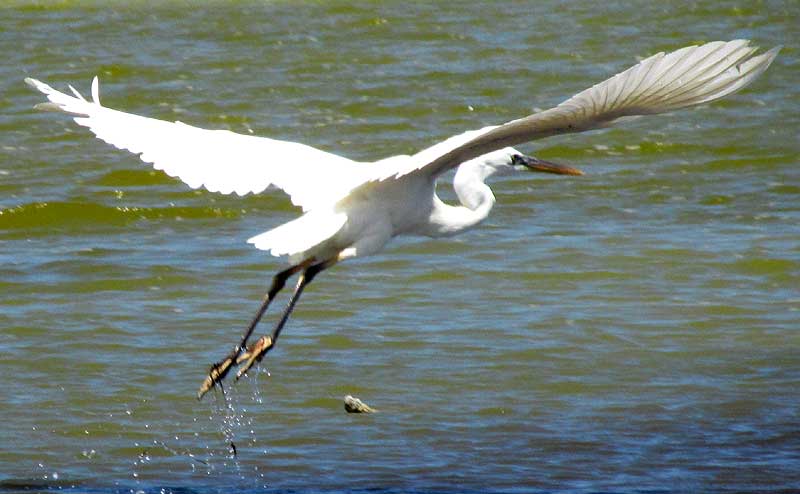
This bird's legs are dark, but yellow at the top, and with yellowish feet. The bird in the picture landed on the mud bar, offering an even better view of the beak and legs, shown below:
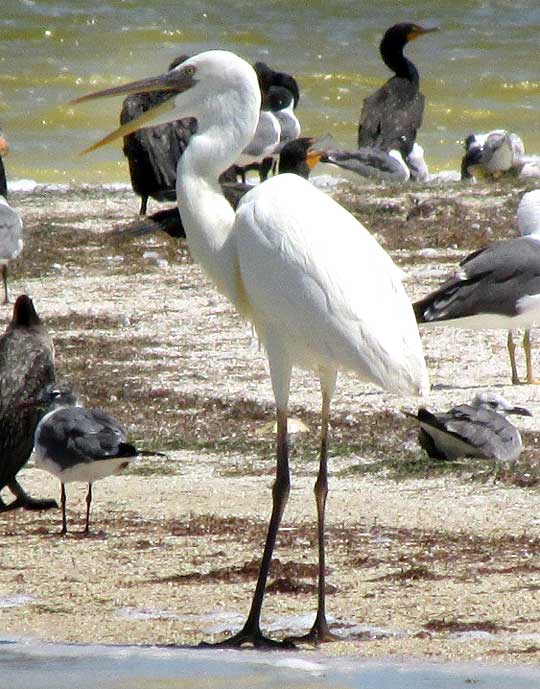
Here was something different, and interesting. For, in field guides for American birds, in descriptions of the common but spectacular Great Blue Heron, usually there's mention of a bird that looks and behaves exactly like the Great Blue Heron, except that it's white. And this is what Paco and I were seeing. My dogeared old Birds of North America by Robbins, copyright 1966, calls it the Great White Heron, Ardea occidentalis, and says that it's "very closely related to Great Blue Heron." It's illustrated as a bird with a brightly yellow beak and legs, and described as occurring in southern Florida and the Florida Keys.
But, a few years after the Robbins guide was published, new field guides came out interpreting the Great White Heron as something else. I lined through the names in my Robbins and wrote "Great Blue morph, Ardea herodias." The name Ardea herodias is the same used for the common Great Blue Heron. In other words, a few years after the Robbins book, experts decided that the big, all-white heron was not a separate species, but rather just a color phase of the common Great Blue Heron -- a "morph."
Bird morphs are not geographical races or seasonal forms. To be a morph, individuals displaying the distinct color phase must occupy the same habitat at the same time as the more broadly recognized species of which it's considered a morph. Morphs don't need to occupy the entire area of distribution of the species -- as shown by Robbins describing the Great White Heron's white morph as only found in southern Florida. Also, morph individuals need to occur within a species more frequently than do random mutations. White morphs such as the Great Blue's are not albinos, which are birds whose pigments didn't develop properly because of a randomly occurring genetic malfunction. Amazingly, even still, scientists aren't sure whether the quality of being a morph is inherited. At this time, the Great Blue Heron's Wikipedia page lists the "white morph" as a subspecies of the Great Blue, whose scientific name is Ardea herodias ssp occidentalis.
However, it isn't that simple. The Sibley Guide to Birds, published in 2000, has been the authority for a generation of North American birders. In 2010, David Sibley, the guide's author, publicly announced that, with regard to the white morph of the Great Blue Heron, "... the more I learn the less clear-cut this seems, although I still think it's at least a good subspecies." His well documented statement of doubt is nicely presented here.
On that page, Sibley states that Great Blue morphs "... are also said to occur in Cuba, Jamaica, the Yucatan, and off Venezuela but are apparently smaller than the Keys birds and scarce (not a majority). What do these birds actually look like and what is their status?"
So, here we have more information about what Great Blue Heron morphs look like, and what their status is. Diego had told us that in Ría Lagartos Estuary about six Great Blue morphs are known to exist. Our bird's dark legs with yellowness at the extremities, and the dark bill flushed with yellow, match those of others pictured on the Internet. Diego agrees that our pictures show a Great Blue Heron white morph.