
PLANTS | ANIMALS | ECOLOGY | FUNGI | GEOLOGY | GARDENING | TOOLS>
Excerpts from Jim Conrad's
Naturalist Newsletter
from the November 29, 2009 Newsletter issued from Hacienda Chichen Resort beside Chichén Itzá ruins, central Yucatán, MÉXICO
CATBIRD IN THE SHADOWS
Catbirds, DUMETELLA CAROLINENSIS, are gifted singers belonging to the same family as mockingbirds and thrashers. They nest throughout most of the US and southern Canada but are migratory so at this time of year they're found along the US Southeastern cost and south through eastern and southern Mexico all the way to Panama. During the summer up North they tend to slink through dense cover, and it's the same down here during the winter; in both places you more often hear them than see them. This week once or twice I heard one halfheartedly break into his rambling summer song but mostly I've just heard the occasional nasal, catty mew. Still, sometimes a Catbird does pop into view, as one did this week, providing the picture below:
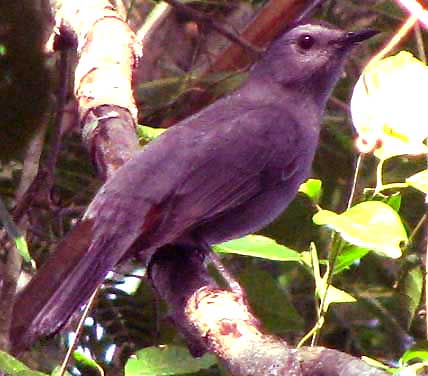
It's always good to see a species you know so well up north now perfectly at home down here. You visualize the long flight south, remember how hard it was on you, yet this bird had to fly every inch of the way, one wingbeat after another.
When we see these birds up north we don't think about them spending half their lives in places like this, where they must eat completely different foods, where predators with completely different looks and manners chase after them, and where life demands of them a whole different living pattern.
The good part of that is that down here there's no pressure to find a mate, establish and defend a territory or to feed and care for young. Here the goal is simply to stay alive until it's time to head back north. Eat, build up fat for later, avoid snakes and hawks... The main problem with here, I would suppose, is dealing with the ever-intensifying dry season, which coincides with the North's winter. As the dry season develops there'll be an ever more drastic reduction of food, water and cover.
When a bird pops up for half a second, like the one in the picture, and then is gone, it's like walking by a library with the doors open, where for a second you glimpse untold thousands of stories worthy of consideration.
from the June 15, 2006 Newsletter issued from Polly's Bend, Garrard County, in Kentucky's Bluegrass Region
CATBIRDS SINGING
All week a Catbird -- nowadays more officially known as the Gray Catbird -- has been singing outside my window. I'm not talking about the catlike waaaah call it sometimes makes, but the seemingly unending cascade of bubbly sounds it issues when defending its territory. You can hear a brief example of this at http://animaldiversity.ummz.umich.edu/site/resources/steve_pelikan/grca.wav.
This is one instance when understanding a little about the taxonomic relationships of a species actually enhances my appreciation for the organism.
For, Catbirds belong to the same family, the Mimidae, as the Mockingbird and Brown Thrasher. In eastern North America we have only those three species belonging to the Mimidae, but out West there are several other thrasher species.
In the context of songs of the Mimidae, I think of eastern North America's Mockingbird, Brown Thrasher and Catbird as forming a kind of gradient. On one end of the gradient there's the Mockingbird who when singing usually repeats each phrase or sound three or more times, then issues another phrase or sound several times, then another, etc. Brown Thrashers sound a lot like Mockingbirds, except that typically they repeat their phrases or sounds only twice -- bleet-bleet, chow-chow, wa-wa... The Catbird is the least likely to repeat phrases or sounds. He rushes from one statement to another, occasionally repeating himself, but mostly just gushing forth one sound after another like a contented, babbling baby.
You might wonder why now they're calling Catbirds Gray Catbirds. It's to distinguish them from other catbird and catbird-like species in other parts of the world.
For example, in the Yucatan we had the Black Catbird. Moreover, when you look at illustrations of Mexico's 18 or so members of the Mimidae, you see that the distinctions between mockingbirds, catbirds and thrashers aren't nearly as clear as we northerners imagine.