
Excerpts from Jim Conrad's
Naturalist Newsletter
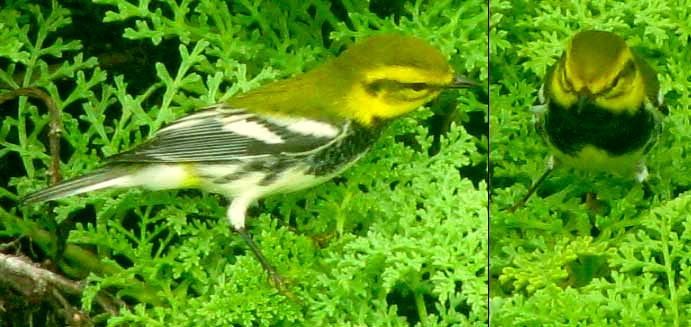
from the October 23, 2011Newsletter issued from Mayan Beach Garden Inn 20 kms north of Mahahual; Caribbean coastal beach and mangroves, ~N18.89°, ~W87.64°, Quintana Roo state, MÉXICO
BLACK-THROATED GREEN WARBLER
Of all the wood-warblers who once awed me with their colors, movement and singing during spring migration up north, one of the most memorable species was the Black-throated Green Warbler. Sometimes in untold numbers they filled cool, spring forests with their wheezy EEE-EEE-uh-EEE calls, which besides being majestic were hilarious to hear. Many warbler calls are musical and complex, but these Black-throated Greens just said EEE-EEE-uh-EEE as if they had cockleburs in their throats, and they said it constantly, dawn to dusk, thousands of birds calling from every direction...
I remembered that this week when I saw what's at the top of this page.
That's a Black-throated Green Warbler restlessly foraging for tiny arthropods atop a carpet of ferny-leafed Coastal Ragweed. His plumage only now is beginning to fade from summer's bright breeding plumage. Like so many other birds being seen these days, this bird has just arrived from up North. He breeds mostly in southern Canada and the adjacent US, and south through the Appalachian uplands. The species overwinters in lowland tropical Mexico south to central Panama.
Down here sometimes during migration I do hear the old familiar EEE-EEE-uh-EEE, but it's just one phrase, and then silence.
from the October 23, 2011, written at Hacienda Chichen adjacent to Chichén Itzá ruins;; elevation ~39m (~128ft), N20.675°, W88.569°; central Yucatán state, MÉXICO
WARBLER QUIZ
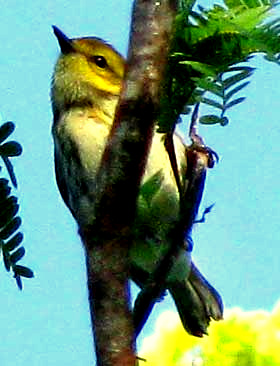 If you're a warbler-watcher, try your hand at identifying the much-changed-from-summer, recently arrived warbler who this week let me snap the picture at the right.
A good hint is that the dark smudge beneath the throat is produced by dark feathers -- didn't disappear when the bird changed position or got into brighter light.
I'm calling this an immature or female Black-throated Green Warbler, DENDROICA VIRENS. I'm not sure I'd have the courage to ID it if I should see it back in Chiapas or Querétaro, for in most of Mexico immature Townsend's Warblers look a lot like it. However, Townsend's Warblers are upland birds not found in the Yucatán.
During summers Black-throated Green Warblers nest in Canada and the northernmost of the US's eastern states, and winters from central Mexico to Panama. I can remember spring woods along the Mississippi Flyway swarming with these birds, their wheezy EEE-EEE-uh-EEE calls sounding all around. What grand memories and how glad I am to see that this one survives despite all the challenges against it.