
PLANTS | ANIMALS | ECOLOGY | FUNGI | GEOLOGY | GARDENING | TOOLS
Excerpts from Jim Conrad's
Naturalist Newsletter
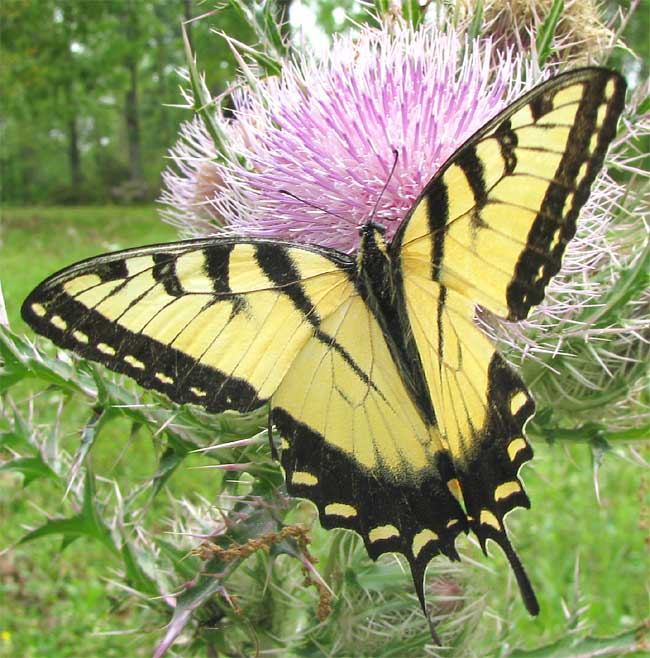
from the April 6, 2009 Newsletter, issued from the forest near Natchez, Mississippi; elevation ~400ft (120m), ~N31.47°, ~W91.29°:
TIGER SWALLOWTAIL ON A THISTLE
The other day an Eastern Swallowtail butterfly, PAPILIO GLAUCUS, was working at one of the Bull Thistles I spoke of last week and, despite the species being so common here, I just had to go take a look. What I saw when I kneeled down next to the thistle is shown above.
That's a male with a wingspan of nearly five inches (12 cm); females are black with powder-blue dusting.
So, the message here is that just because we see something every day we shouldn't forget to sometimes pause and take a closer look. Get down and poke your nose up as close to things as possible, and admire and wonder. Really, I myself had almost forgotten how beautiful this butterfly is, especially when you're so close you can see the black legs, antennae and coiling proboscis so nervously and delicately probing, testing, and trying to deal with the thistle's stiff, stickery floral-head bracts and the tightly packed forest of narrow-throated, purple composite flowers themselves. What I saw was a lilting piccolo melody ephemerally and lightly intoned among base trombone yowlings and sharp drum jolts.
Taxonomically, the Tiger Swallowtail situation isn't as simple as it used to be. In the Appalachians our Papilio glaucus is replaced by the closely-related, larger and only recently described P. appalachiensis and, in the north, it's replaced by the closely related P. canadensis. These three species can be very difficult to distinguish, and earlier were all lumped under our P. glaucus.
from the March 10, 2002 Newsletter, issued from near Natchez, Mississippi:
SWALLOWTAILS
On Wednesday a bright yellow and black Tiger Swallowtail butterfly (PTEROURUS GLAUCUS) turned up alongside the gravel road between here and the plantation center. This is one of the largest, brightest and prettiest butterflies we have, as well as one of the most common.
One reason for its success is its flexibility. Instead of its caterpillars (which resemble bird droppings) eating just one kind of plant, they can be found munching on cherry and plum trees, ashes, tulip-poplars and many other kinds of plants. The adults likewise take nectar from a huge variety of blossoms.
The next day I saw several Zebra Swallowtails, EURYTIDES MARCELLUS, likewise one of the most striking and most common of our butterfly species. Taking an opposite strategy for survival from the Tiger Swallowtail, this butterfly's caterpillars feed on just one host plant in our area -- the Pawpaw. The one-host-plant strategy works here because we have an abundance of Pawpaws.
I wonder if these butterflies will survive, for there just aren't that many flowers blossoming now, and we're bound to have more cold nights. I would guess that the recent unseasonably warm days, which outnumbered our few "historically cold days," caused these butterflies to emerge too early, and that they may become yet other victims of Global Warming's extreme weather vacillations.