
PLANTS | ANIMALS | ECOLOGY | FUNGI | GEOLOGY | GARDENING | TOOLS
Excerpts from Jim Conrad's
Naturalist Newsletter
from the November 24, 2013 Newsletter issued from the Frio Canyon Nature Education Center in the valley of the Dry Frio River in northern Uvalde County, southwestern Texas, on the southern border of the Edwards Plateau; elevation ~1750m (~5750 ft); N29.62°, W99.86°; USA
AQUATIC PILLBUG
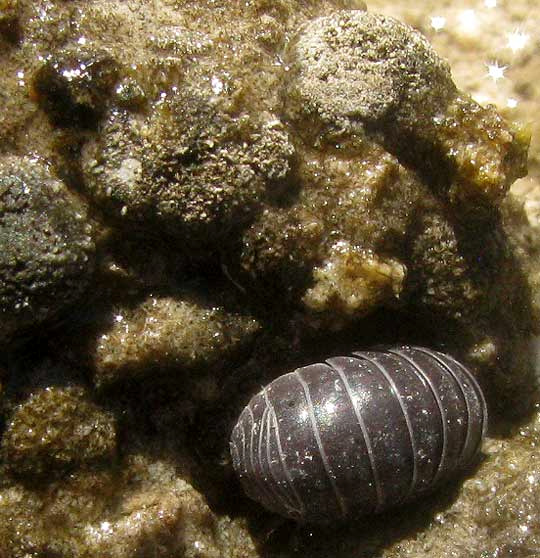
I'm used to finding pill bugs -- also called roly polies, sow bugs, woodlice and other names -- under moist logs, in dank basements and the like, but several turned up this week on the undersides of rocks lying in the Dry Frio's trickling, shallow water. Below, you can see one rolled into its ball-like defensive position, on the undersurface of a rock just taken from the water:
I shouldn't have been surprised to find an aquatic or semi-aquatic pill bug because pill bugs are crustaceans, like lobsters, crabs and shrimp, who are aquatic. In fact, pill bugs are the only crustaceans to have colonized land with much success. As such, they have not evolved the cuticle waxes that waterproof the exoskeleton exteriors of insects and spiders, and thus experience serious problems with drying out.
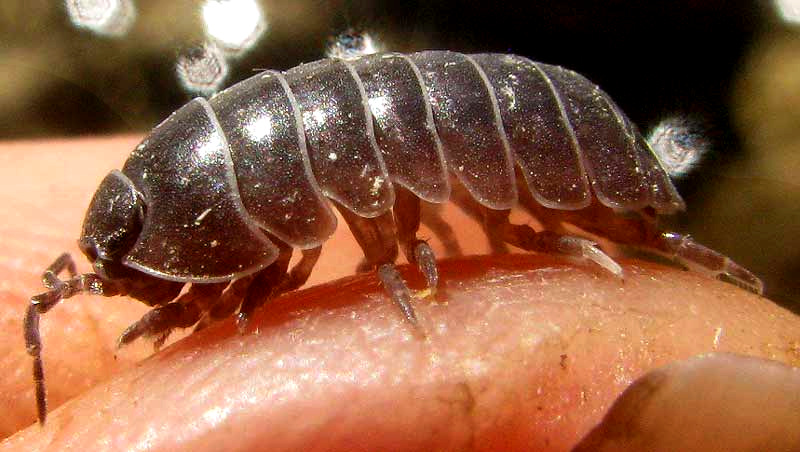
While I had a cooperative pill bug in hand I got a nice picture from the side clearly showing how the top protective plates are formed, shown at the top of this page. A shot of the critter's undersurface was even possible, seen below:
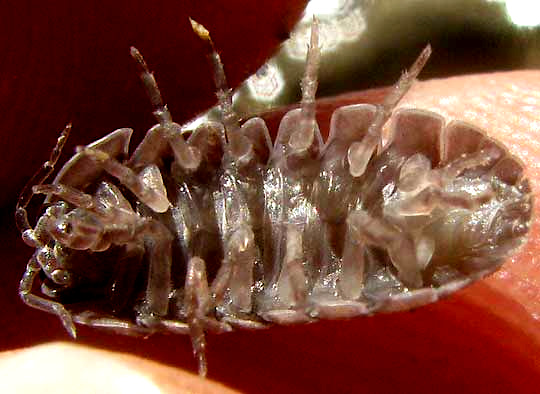
That picture shows several features of the pill bug's basic anatomy. The antennae at the far left in the picture are bent at sharp angles. The body consists of seven main trunk segments, each bearing legs. Behind those seven main segments -- to the right in the picture -- are six smaller ones, known together as the pleon. Pleon segments bear greatly modified legs, of which the first five pairs are known as pleopods, which form a set of overlapping, gill-like structures. To survive, a pill bug's pleopods must be kept moist. Studies show that critical amounts of water are both lost and absorbed through the pleopods. In some pill bug species the pleopods' covering, or cuticle, is in-folded, creating whitish, branching tubules that serve as "pleopodal lungs."
In the above photograph at the far right -- the pill bug's rear -- you can see two, tiny, cylindrical items like little fingers pointing from beneath the last scale toward the picture's right edge. Those are uropods. I read that pill bugs can take up water through their uropods and channel it through grooves along the sides of their bodies to their mouths, and also I read that uropods are sensory and defensive in function; I'm unsure how to reconcile those statements.
By the way, the ability to roll into a ball is to be able to "conglobate." Our first picture, of the rolled-up pill bug, shows a conglobating individual.
from the February 23, 2009 Newsletter, issued from the forest near Natchez, Mississippi; elevation ~400ft (120m), ~N31.47°, ~W91.29°:
PILLBUG ECDYSIS
Arthropods, including all insects, spiders, horseshoe crabs, ticks, centipedes and more, possess hard, plastic-like exterior skeletons known as exoskeletons. As an animal with an exoskeleton grows, periodically its hard covering needs to split so that it can emerge from its old "shell." Then the still-soft-shelled animal enlarges a little and, finally, the new, larger animal's bigger-than-before exoskeleton hardens. Sometimes you find old spider exoskeletons suspended in the spider's web, and of course abandoned cicada exoskeletons often are conspicuous on trees. The process of shedding an exoskeleton or an old skin (as snakes do) is called ecdysis.
So, the other day I picked up a slab of wood lying on the ground and there was a pillbug beneath it undergoing ecdysis, as you can see below.
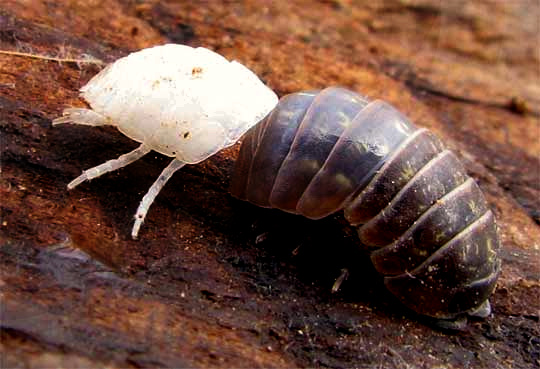
The discarded, white half on an exoskeleton at the left appears to have just been shed by the pillbug, who has withdrawn from it. You can see that the right side of the pillbug in the picture is darker. I read that pillbug molting occurs in two stages, shedding only half their skin at a time. First, the skin splits at the middle and the back half is shed, then a few day later the front half is shed. The picture shows the earlier-discarded back half, and the paler part of the darker pill bug is the front part about to shed. Pill bugs are very vulnerable during their molting period and often stay isolated while the shedding is taking place.
By the way, what's the difference between woodlice, sowbugs and pillbugs? Basically they're all the same, except that some woodlice/sowbugs can't roll into spherical "pills" so they're not called pillbugs. The name pillbug often is restricted to the genus Armadillidium. Other English names for woodlice and sowbugs include armadillo bug, cheeselog, doodlebug, roly-poly, potato bug, roll up bug and chuggypig.