
PLANTS | ANIMALS | ECOLOGY | FUNGI | GEOLOGY | GARDENING | TOOLS
Excerpts from Jim Conrad's
Naturalist Newsletter
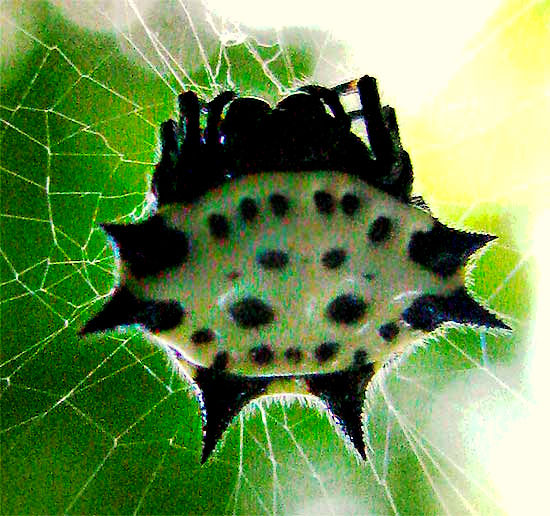
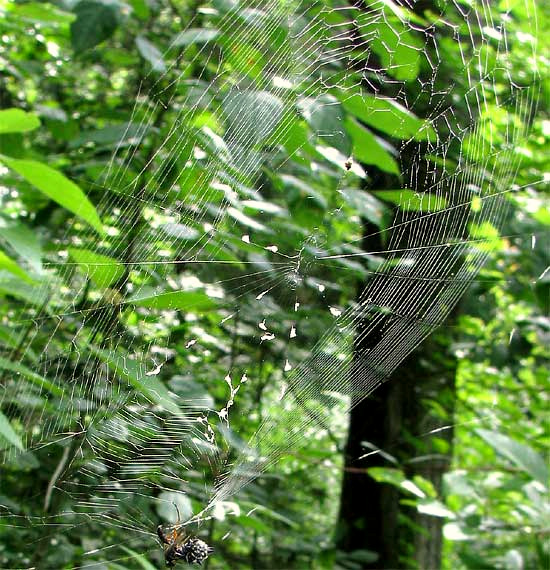
from the June 16, 2008 Newsletter, issued from the forest near Natchez, Mississippi; elevation ~400ft (120m), ~N31.47°, ~W91.29°:
"TRAIL SPIDERS"
If you walk woodland trails around here at this time of year you constantly run into spider webs strung across the trails at face level. For the most part one spider species constructs the webs. They're odd-looking spiders, mostly white with black spots and spines, and only ±2/5-inch across (10 mm), as seen in the topmost picture.
The webs also are distinctive, for some of their individual silk strands are spottily adorned with white, cottony clumps of teased silk, which make the web more visible. You can see such a web, with a spider dealing with prey at the bottom of the second picture above.
These "trail spiders" are members of the genus GASTERACANTHA, which contains tropical and subtropical spiders, so in the US apparently they're present only in the Deep South. If you live farther north than us and think you've seen this same spider across your own trails, probably you're thinking about a closely related but different genus, Micrathena, which similarly constructs webs across woodland trails, but without the white tufts. Micrathena abdomens are also white with black spots and spines.
It's interesting to think about why Gasteracantha spiders would adorn their webs with tufts of teased silk, making their webs more visible. The whole idea of spider webs is to catch prey that blunder into them not knowing they're there.
I'm guessing that the silk tufts are mainly visible to vertebrates with binocular vision and with brains enabling a more circumspect image analysis than enjoyed by the spiders' usual invertebrate prey. Invertebrate vision is less acute, and invertebrate brains may not grasp what the white spots mean. Since Gasteracantha spider webs so frequently are suspended across woodland trails, you can imagine that they are run into not only by wandering humans but also mammals such as deer, and birds. Maybe us "higher animals" tend to avoid the webs if we know they're there. I doubt that deer find it any more agreeable to have spider webs plastered across their faces than humans do.
from the January 10, 2016 Newsletter issued from Hacienda Chichen Resort beside Chichén Itzá Ruins, central Yucatán, MÉXICO
GASTERACANTHA SPIDERS
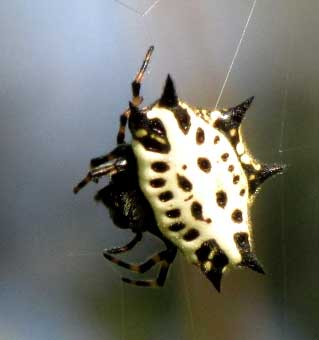
At the road's edge at about shoulder level among bushes, a familiar-looking spider was patiently spinning her web that dewy morning, around and around the web's center she went, laying down her closing spiral of silk. What a pleasure seeing this old friend, the very one that, if you're walking down a narrow forest trail in Mississippi, builds her web across the trail, so that anyone not paying attention walks right into it. With the crab shape and the white abdomen adorned with six thick-based, black spines along the perimeter, it's such a distinctive species you can't forget it. It's GASTERACANTHA CANCRIFORMIS, and below you can see ours at the road's-edge:
I couldn't get to the web's other side to see what that spider looked like below, but six feet away (2m), at about knee level, another spider of the same species was making a smaller web, and this one had her underside facing toward me, showing very different colors and pattern, as seen below:
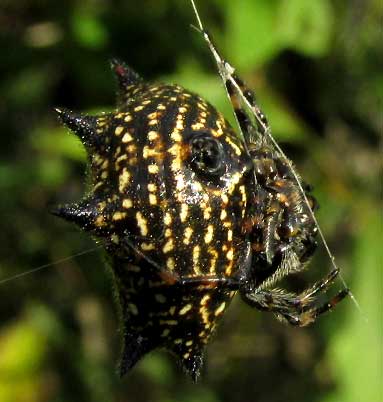
Gasteracantha cancriformis is distributed from the US south throughout Mexico and southward, to Brazil. With such a great distribution area the species manifests many variations. On the Internet you can see yellow versions, and ones looking like ours, but with red spikes instead of black ones.