July 4, 2010
FLYCATCHERS IN THE HUT
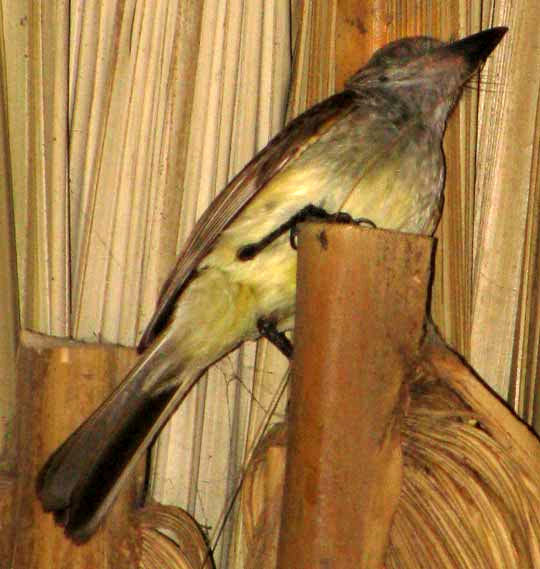
Friday morning after the garden work I entered the hut to find two flycatchers flying around. One is shown at https://www.backyardnature.net/n/10/100704fc.jpg.
They were fledglings keeping silent as they flitted about, and no adults were trying to coax them outside with their calls. The fledglings' plumages hadn't acquired all the adults' colors but they showed enough for me to guess that they were Brown-crested Flycatchers, the common flycatcher species here. If someone wanted to argue for the very similar, endemic Yucatan Flycatcher, I wouldn't debate the issue. I haven't seen adult Yucatan Flycatchers here yet though.
The fledglings stayed the whole day, until a little before dusk, and I suspect that they got hungry. I could imagine the conflicting urges they felt as they perched on my roof beams watching me at the computer. On the one hand they knew that outside they could find insects to eat, yet also they must have been fearful of the world's terrors. That same morning, during breakfast, I'd seen a Yucatan Gray Squirrel carrying something bulky in its mouth hotly pursued by two Clay-colored Robins. I'll bet the squirrel had robbed a robin's nest. The day before a Black Vulture flew overhead and for a fraction of a second as the vulture shook his head to get a better grip on something in his beak I thought I saw the silhouette of wings struggling for purchase on the air.
If you're given to robbing birdnests of nestlings, this is the very moment of the year to do it, here at the beginning of the rainy season when trees and bushes host whole cities of caterpillars providing ready food for growing families.
*****
A FLEDGLING GROOVE-BILLED ANI
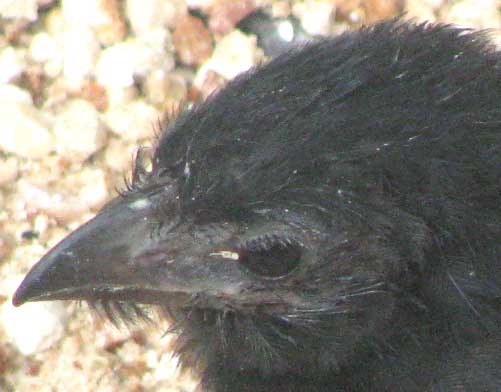
Along the trail a black bird sat on the ground looking around, only fluttering a little as I approached. It was a fledgling Groove-billed Ani apparently fresh from the nest. You can see his interesting head at https://www.backyardnature.net/n/10/100704an.jpg.
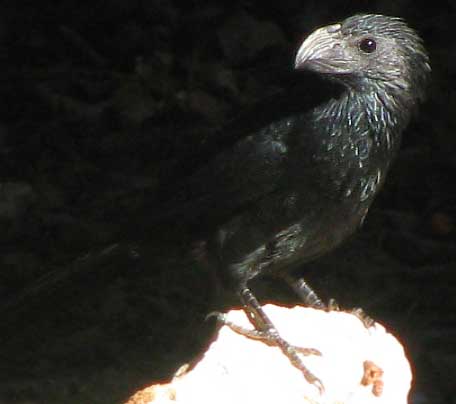
The head is interesting because it shows that the bills of fledgling Groove-billed Anis aren't grooved. The grooves must develop only with age. You can see a mature Groove-billed Ani's strikingly grooved bill in a picture taken here three or four months ago at https://www.backyardnature.net/q/ani.jpg.
The Groove-billed's grooves are fascinating if only because in the Caribbean region and from Costa Rica deep into South America there's a Smooth-billed Ani who gets along perfectly well with grooveless bills. Someday a graduate student will set out to discover the grooves' secret, and maybe the above picture will be useful.
*****
TADPOLES WITH LEGS
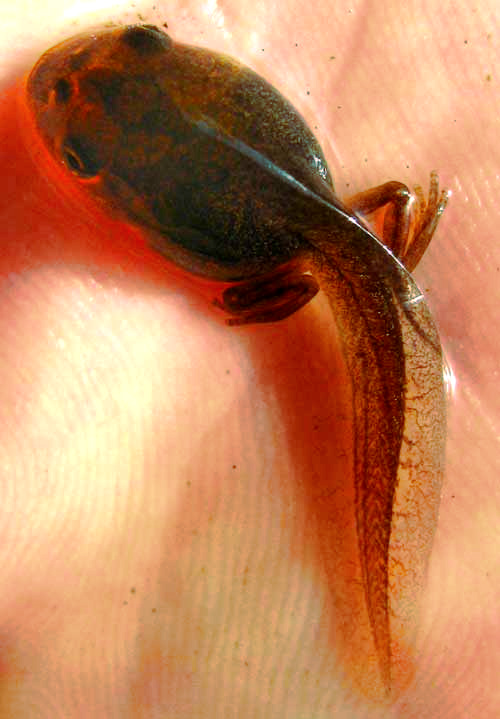
Since May we've been watching tadpoles develop in one of the Hacienda's reflecting pools, where frog eggs were deposited on or around May 17th. As of this week the first tadpoles have appeared with legs, as shown at https://www.backyardnature.net/n/10/100704tp.jpg.
Maybe only one out of 50 tadpoles has legs now, and the ones with legs don't seem to use them. The legged tadpoles swim about simply dragging their unmoving appendages, which probably disrupt their bodies' aerodynamics and cause a bit of drag.
It's hard to believe how many tadpoles still live in that pool. My cupped hand rising from a random spot at the pool's bottom retrieves maybe a dozen wiggly critters after many more have slipped away as my hand rises. The pool's water is emerald green with algae, so apparently that's the tadpoles' main food. But before long the tadpoles' current slender intestines will grow short and thick the way a carnivore's guts are supposed to be, to serve the insect-eating frogs the tadpoles will become. We'll just have to see how that problem resolves itself.
*****
ZEBRA HELICONIAN
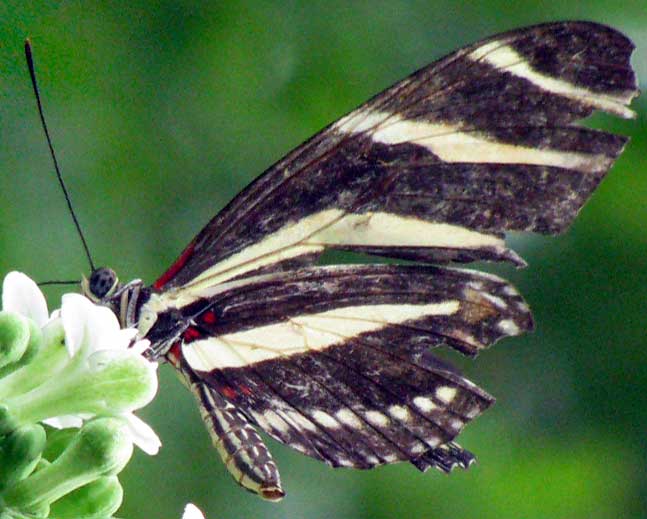
A fair-sized butterfly subfamily known as the Longwings, the Heliconiinae, contains species that typically have long, narrow wings, bright colors and a buoyant, slow, tiptoeing manner of flying. During the dry season I didn't see any here but now that it's raining fairly regularly you see the species shown at https://www.backyardnature.net/n/10/100704zb.jpg.
That's the Zebra Heliconian, HELICONIUS CHARITHONIA, maybe the most widely spread and common of the group. It's a permanent resident from southern Texas and peninsular Florida all the way through here and the West Indies into South America. In the US sometimes it makes surprise appearances in places like Nebraska and South Carolina, where its sighting is considered something special.
Along trails, in the garden and at woods edges you see males patrolling for females. Their patrolling seems to be of a casual kind as they float daintily on narrow, fragile-looking wings about 3.5 inches across (9 cm). However, the males themselves take no prizes for chivalry. Male Zebra Heliconians have been observed waiting next to female Zebra Heliconian chrysalises -- the pupating resting stages between caterpillar and adult -- and mating with the female as she is about to emerge. Then he deposits a chemical on her abdomen that repels other males!
Caterpillars eat passion-vines, of which we have an abundance here.
*****
GIANT WHITES
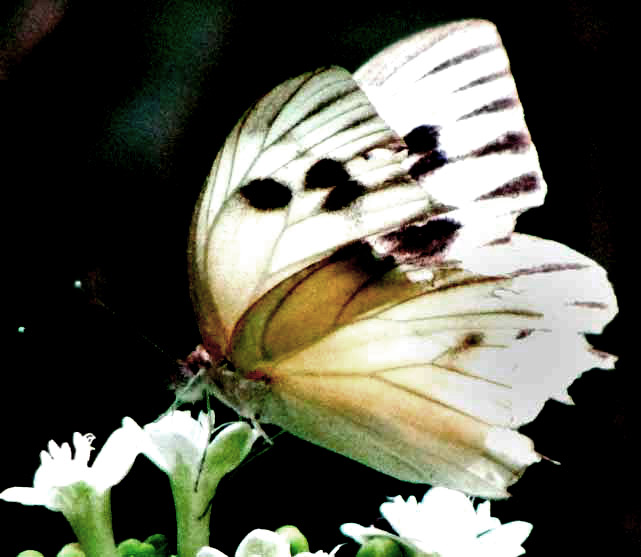
Another species showing up for the first time now that the rainy season is underway is shown at https://www.backyardnature.net/n/10/100704wh.jpg.
Volunteer butterfly identifier Bea in Ontario figures that that's a Giant White, GANYRA JOSEPHINA, a member of the large Family holding butterflies known as whites and sulfurs, the Pieridae. You've seen whites and sulfurs flitting around pools of water and cabbage patches. Generally they're smallish butterflies but the wingspan of this species is about 3-½ inches (9 cm), so it's a "giant," relatively speaking.
The Giant White specializes in open, dry, tropical and subtropical forests such as our scrubby-tending forests in the northern Yucatan. It occurs from southern Texas through Mexico and Central America, rarely straying north as far as Kansas and New Mexico. The caterpillars' food is listed as trees in the Caper Family, the Caparidaceae, which aren't conspicuous in this area, but ought to be present.
*****
JACARATIAS FRUITING
Jacaratias, called Bonete by the Maya, are JACARATIA MEXICANA of the Papaya Family. Already in this year's January 31 Newsletter half a year ago I showed you Jacaratia's strangely finned, torpedo-shaped fruit. One is shown at the bottom of our Jacaratia page at https://www.backyardnature.net/yucatan/jacarati.htm.
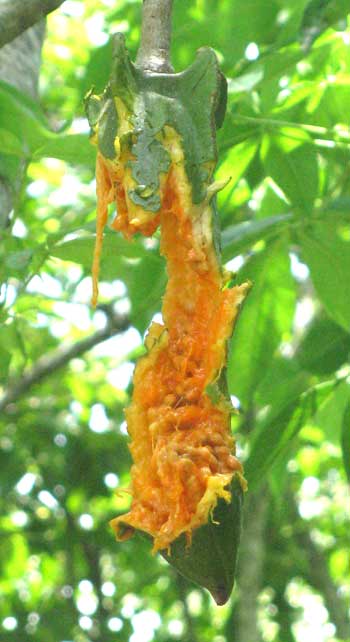
Now that the fruits have been maturing for so many months, with me expecting them to ripen and fall at any time, I see that all along I've entertained a faulty concept of how the fruits eventually would fall and their seeds would get disseminated. Pointed toward the ground and with those swooped-back fins I'd assumed that one day the ripe, orangish fruit would dislodge from the stem and plummet to the ground, maybe stabilized during its fall by its fins, then might even lodge nose-down in the rainy season's mud. But you can see the fruit's final destiny at https://www.backyardnature.net/n/10/100704bo.jpg.
The fruit, still green outside but orangish like ripe papaya inside, remains on the tree while animals eat them in situ. Birds, certainly, but also I suspect fruit bats eat them and probably Kinkajous, who nightly ravish our mango trees without permitting me to photograph them.
My friend José confirms that the fruits don't fall by themselves. "Use a pole," he advises.
*****
BECS FLOWERING
Before dawn each morning as I jog past a certain tree for a few seconds my head swims with pleasure as I run through a pool of fragrance made all the sweeter by the morning's moist calmness. It's the Bec tree in full flower, the same tree profiled last November in my second Newsletter from here, when it was heavily laden with golden-yellow, pea-size fruits, still shown at https://www.backyardnature.net/yucatan/ehretia.htm.
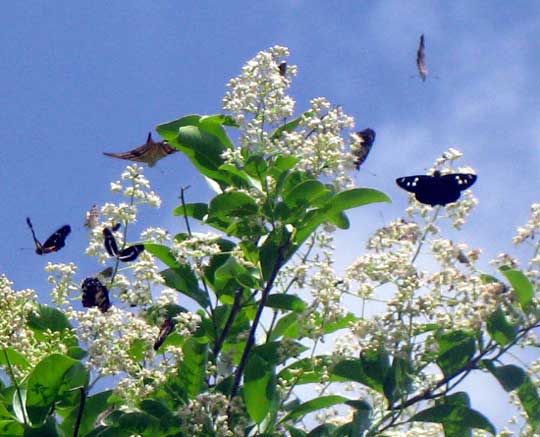
One afternoon when it was 96° F (35.5° C), very humid but deliciously breezy with fast-moving white cumulus clouds scudding across the blue sky I returned to the fragrant Bec to photograph its flowers. I'd expected the tree's branches to be busy with pollinators but certainly not as full of activity as what I found. I've ever seen a tree more teeming with butterflies, bees and other pollinators than that one. You can see a single, windblown, well butterflied branch high up at https://www.backyardnature.net/n/10/100704eh.jpg.
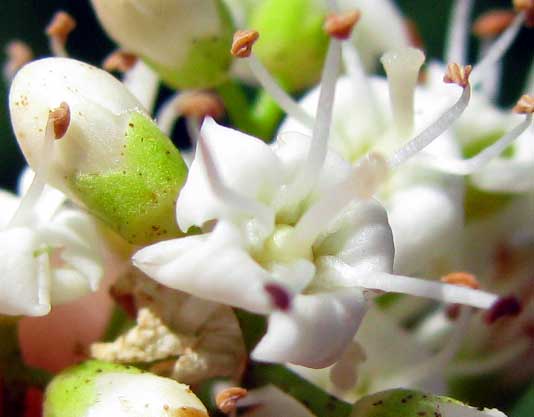
Bec is EHRETIA TINIFOLIA of the same family in which we find bluebells, forget-me-nots, comfrey and borage, the Borage Family, or Boraginaceae. Bec has flowers typical of the family -- calyx and corolla five-lobed, five stamens inserted on the corolla tube and alternating with the corolla lobes, ovary superior... You can see all these details in the flower shown at https://www.backyardnature.net/n/10/100704ei.jpg.
Standing in the sun and wind that day immersed in Bec's perfume and universe of flitting pollinators, I thought that seldom had I seen an organism more generously and beautifully engaged in community service than that tree.
*****
GUAVA'S CALYX LOBES
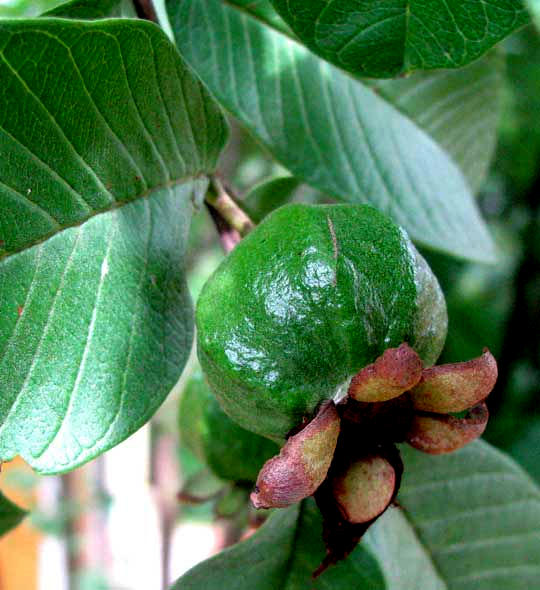
Especially when kept watered, guava trees, PSIDIUM GUAJAVA of the Myrtle Family, might produce guava fruits almost anytime. Certain trees here are bearing fruit now and you can see a half-grown one at https://www.backyardnature.net/n/10/100704gv.jpg.
A botanist would describe that fruit as a "globose berry," globose another word for spherical, and berry being meant in the technical sense. Technically a berry is a pulpy fruit resulting from a single pistil (the flower's stigma, style and ovary), and containing one or more seeds but no true stone (big and hard like a plum seed). A tomato is an excellent berry. Strawberries and blackberries aren't even close to being berries, but blueberry fruits are indeed berries.
Anyway, at the stage of development of the guava fruit in the picture, the most conspicuous feature is that of the five leathery, purplish items at the fruit's bottom.
To grasp what they are you need to remember that a typical flower has its colored corolla and sexual parts arising from a green, cuplike calyx. Most calyxes have five lobes, or sepals. The five leathery, purplish items in the picture, then, are the calyx lobes, or sepals, remaining on the maturing fruit long after the flower's corolla and male sexual parts have shriveled and fallen off. In most flowers the calyx and its lobes also shrivel and fall off, so these "persistent calyx lobes" on guava fruits are something special about the fruits.
*****
ANTHURIUM FRUITS
Aroids are mostly tropical, mostly fleshy members of the Aroid Family, the Araceae, known for their tiny flowers being packed on a fingerlike "spadix" subtended or surrounded by a leafy "spathe." The North's Jack-in-the-pulpit is an aroid. In the North, species of perennially green, shiny-leafed aroids often serve duty as potted plants.
The most conspicuous aroid around here is ANTHURIUM SCHLECHTENDALII, pictured and talked about at https://www.backyardnature.net/yucatan/anthuriu.htm.
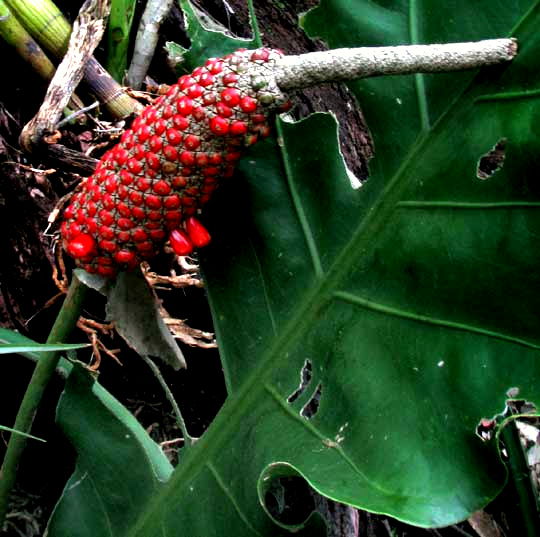
They're fruiting now, and the scarlet fruiting heads rising amidst large, dark green leaves are worth seeing. You can see a typical one near my hut at https://www.backyardnature.net/n/10/100704sc.jpg.
The actual fruits are the red items arranged spirally on the fruiting head. Notice how the most fruits emerge from their seat in the head, making themselves more easily available to any bird or mammal who might come to eat the fruit then in its intestines carry the seed to a new location.
*****
COPPERLEAF
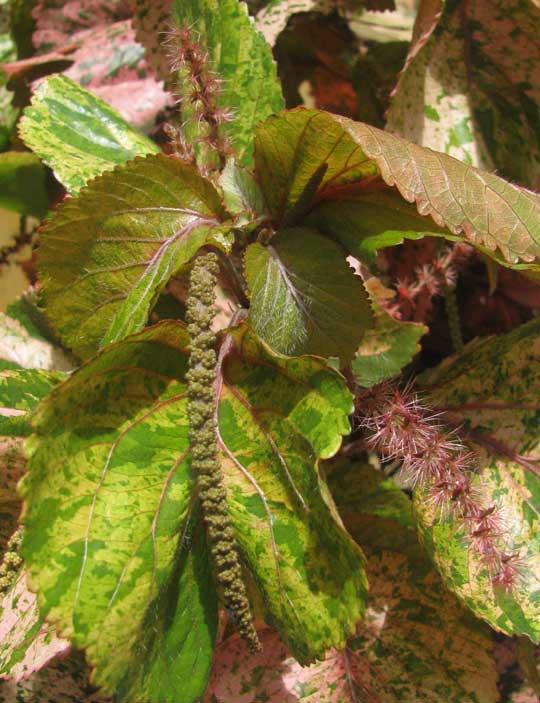
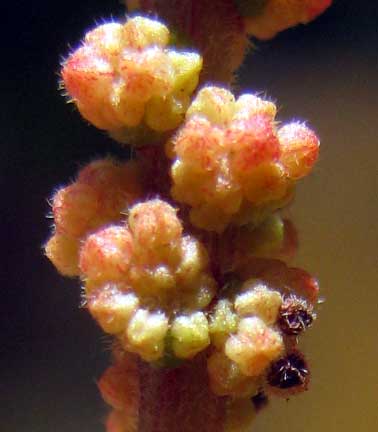
Here and there around Hacienda Chichen they've planted Copperleaf, ACALYPHA WILKESIANA, whose variegated, rainbow-colored leaves and flower spikes are shown at https://www.backyardnature.net/n/10/100704ac.jpg.
Copperleaf is native to Fiji and nearby islands in the South Pacific. It's a shrub growing up to 15 feet tall (4.5 m), though here most plants are only about head high. In the above picture you can see two different- looking flower spikes: the pea-green, grainy-textured one to the left of center, and; the fuzzy, dark purple one below and to the right of center. Both are about eight inches long (20 cm). The one on the left is a spike of male flowers while the one on the right is a spike of female flowers. A close-up of part of the male spike showing five male flowers, each composed of an unseen four-parted calyx and about eight or so stamens with their baglike anthers not yet open, is at https://www.backyardnature.net/n/10/100704ae.jpg.
To understand what the female spike's raspberry-colored fuzziness is, remember that the female part of a flower, the pistil, is composed of the stigma, style and ovary. Male pollen germinates on the stigma, the pollen tube with its sex germ migrates down the slender, necklike style, and then union of the male and female sex germ (fertilization) takes place inside ovules suspended in the ovary. Later the ovary matures into a fruit, while the ovules inside it mature into seeds.
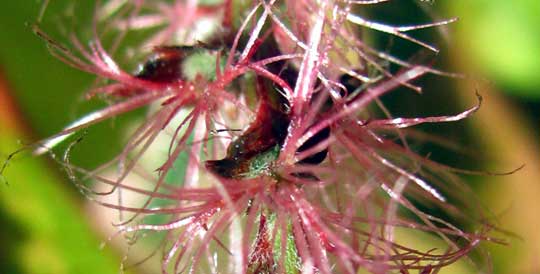
Each female Copperleaf ovary bears three styles atop it, but each style is very deeply divided into several slender segments. You can see the hairy, green top of an ovary (a little below the picture's center) with three, much-divided, purplish styles arising from its top at https://www.backyardnature.net/n/10/100704ad.jpg.
In that picture maybe you can make out the dark, flatish, several-pointed bract (modified leaf) below each ovary. Such bracts subtending each ovary (no corolla) is a distinctive feature of all members of the genus Acalypha.
Back in February we ran into another very pretty Acalypha species here at Hacienda Chichen, Acalypha hispida, the Chenille-Plant. You can see its dazzling female spikes, its fuzzy styles glowing brightly, at https://www.backyardnature.net/yucatan/chenill.htm.
A big difference between the Chenille-Plant and the current Copperleaf is that Chenille-Plants are "dioecious" while Copperleafs are "monoecious." In other words, both species bear unisexual flowers but Chenille-Plants have their male and female flowers on separate plants, while Copperleafs -- as we saw in the first photo -- bear male and female flower spikes on the same plant.
Copperleafs are so pretty and easy to cultivate -- at least in the tropics and subtropics -- that horticulturalists have produced many cultivars. The one called 'Marginata' has coppery-green leaves with pink or crimson margins. 'Macrophylla' has larger leaves that are variegated with bronze, cream, yellow and red. The leaves of 'Musaica' are mottled with orange and red. 'Godseffiana' has narrow, drooping leaves with cream-colored margins.
The genus to which Copperleaf belongs, Acalypha, is a big one, and several weedy Acalypha species occur throughout Mexico and North America. Acalyphas are members of the same family in which we find Poinsettias, Castor Bean plants, spurges and last week's Variegated Croton, the Euphorbiaceae.
*****
ZEN SUFI HUT
Tropical Storm Alex passed over us last weekend so all day last Sunday it rained and was nice and cool. A friend agreed that hot tea sounded good and that she'd fix a pot of soup for supper if I'd tend the campfire. The topic of discussion was the question of what I, with my education, experience, and at age 62, am doing in a dirt-floored Maya hut with pole walls, staring in the face an old age without money.
But, it was a discussion with long intervals between words, so I put music on the computer, something to complement the sound of raindrops on the thatch roof, of robins singing in the rain, of the campfire crackling beside us.
It was a kind of meditation music, Zen in structure, the lone crystalline chime-tone suspended in space, its trailing, interrelating subtones and harmonics long-lasting, attended by random taps of dry wood on dry wood, the emptiness around the taps defining the shocking instance of each note itself, purifying it. I said:
The emptiness between this hut's dry wood wall-poles admits calls of frogs and robins from without. Those song-sounds are interrelating harmonics and subtones defining the shocking instance of my being here, and they purify me.
Then with campfire smoke drifting outside between the hut's pole walls, dispersing into wet greenness, there came Sufi music, music evoking the spiritual through dance. Hypnotically rhythmic dancing melodies easily and unendingly intertwining and unraveling, caressing and moving away, always there, more and more, but always letting go, the climax just beyond. I said:
My own dance of life, always simplifying, always intense, always letting go, has led me into this hut. My being here now is the music we hear as it is to us at this very moment, no past and no future, but is not its caressing and embrace and the dance itself a wondrous thing?
Soft, soft the night, without and within, the hut, the Sufi, the Zen.
*****
Best wishes to all Newsletter readers,
Jim