December 30, 2005
THE BIRDS OF CHRISTMAS
Longtime readers of this Newsleter know that on Christmas I like to go birding, and this Christmas I did just that.
On Christmas morning as soon as it was light enough to walk around I carried my breakfast makings into the center of the rubble heap next to the building where I sleep. The rubble is what's left of the big structure where once they milled henequen but it was destroyed by a hurricane and now nothing remains of it but one wall with useless, high-hanging doors and windows, and lots of rubble. I make my campfire amidst the rubble because there's less chance there that my fire will escape. At 6AM it was 64°, foggy, and the sky was just light enough for me to see that it was going to be blue. A fine day was dawning and the fog's chilly wetness felt good.
While I composed the campfire the sky lightened minute by minute, the fog grew denser, and the morning chorus of birdsong began. These are the species I noted, in the order they came to me:
1: WHITE-WINGED DOVES, several of them, soulfully hooing from all around me out in the fog
2: GREAT KISKADEE excitedly calling his sharp ki-DEER call from Coconut Palm silhouettes between me and the eastern sky now acquiring a pink hue, and I see nothing of the bird's bold yellow, brown, white and black plumage
3: MELODIOUS BLACKBIRDS, all black, also inside the palms prettily and enthusiastically calling what- CHEER, what-CHEER
4: GOLDEN-FRONTED WOODPECKER with his zebra-striped back and red-topped head calling his rough a-a-a-a-a from somewhere behind the big ruin-wall
5: PLAIN CHACHALACAS, large, brown, wild-turkey-like birds calling from the foggy scrub beyond our walls. Their hilarious chorus is made up of very loud, fast- given, squeaky KNOCK-it-off, KNOCK-it-off calls and gruffer, lower-pitched KEEP-it-up, KEEP-it-up calls
6: FERRUGINOUS PYGMY-OWL with his pulsating, monotonic whistle gamely keeping a friendly beat with my flickering, orange campfire flame
7: YUCATAN QUAIL, looking and sounding so much like North America's Bobwhite briefly calling with sharp dog-whistles from deep within scrubby chachalaca territory
8: GREAT-TAILED GRACKLE, a large, black, slender bird erupting with sharp, sassy whistles and grinding feather-flaps from high in a big, spreading Guanacaste tree
9: TROPICAL MOCKINGBIRD issuing his warning check- call from inside an orange tree deep green with bright orange oranges, reminding me of the tangerine my friend Karen gave me for Christmas in 2003; I ate it during that morning's birding walk along Sandy Creek near Natchez, and how good it was with that day's cornbread
10: KILLDEER's sharp DEEEEE call slicing through the heavy fog from far away, surely somewhere on the rocky ground of someone's citrus orchard
11: TURQUOISE-BROWED MOTMOT articulating his hoarse look-at-YOUUUUUU call from the windmill tower rising in the fog, the bird's long, pendulous tail nervously tick-tocking beneath his gorgeous green, brown, black and turquoise body
12: RUDDY GROUND-DOVE with rusty-red body and gray head scurrying mouselike into 50-ft-long wall of abundantly orange-red-flowering Bougainvillea along the stone wall behind me, the overload of gaudy color somehow made brighter by the gray fog, and what must it be like to be a nervous little ground-dove inside such an incandescent bouquet?
13: ALTAMIRA ORIOLE, 3 of them, hunting bugs among bushel-basket-sized, diffuse, yellow inflorescence of Coconut Palm blossoms, sometimes perching atop large green coconuts, the birds' yellow-orange-and-black plumage shining against palm-frond greenness like shiny oranges in an orange tree
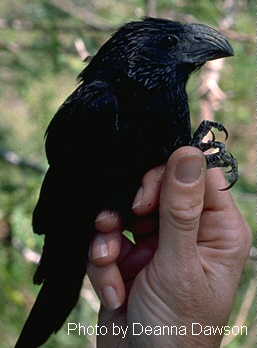
14: GROOVE-BILLED ANI the size and black color of a sleek grackle but somehow primitively shabby looking instead atop an arching Bougainvillea stem, holding his wings away from his body to dry and warm in the day's first direct rays of sunlight, like a Mississippi Anhinga
15: LEAST FLYCATCHER catching flies in and around a Dwarf Poinciana now past flowering but heavy with flat bean pods, and I can identify this tail- flicking, mousy-colored flycatcher only because the Least is the only species of the genus Empidonax overwintering in the Yucatan, and I know an Empidonax when I see it.
16: SOUTHERN HOUSE-WREN brown and plain-looking as can be bubbly-singing from inside the rampant Bougainvillea wall
17: NORTHERN PARULA, little warbler gray, yellow and white, quietly but assiduously gleaning bugs inside a strangler fig tree astride a white limestone wall
18: RUFOUS-BROWED PEPPERSHRIKE like an overgrown yellow vireo with rust-red eyebrows belly-laughing its descending whistle from neighboring citrus orchard
19: INDIGO BUNTINGS, five of them, chubby, brown and nervous like sparrows in tall grass, the males looking like they're breaking out in blue measles
20: ROSE-BREASTED GROSBEAK at tip-top of Ceiba tree in brown juvenile plumage but issuing sharp PEEK call like a rosy-breasted adult
21: WHITE-EYED VIREO with yellow spectacles, white throat but no white eyes stealthily calling from dense bushes just as if he were in a Mississippi summer
22: CATTLE EGRETS, three of them, flying over, white spots in blue sky, nice curved necks, graceful, graceful, graceful
23: BLUE-GRAY GNATCATCHER like tiny gray mockingbird sometimes calling a thin, buzzy CHEEE, foraging for bugs in a Neem tree
24: PALM WARBLER mostly yellow with a bright yellow rump above its nervously wagging tail silently but assiduously gleaning bugs inside a Neem tree
25: GREAT HORNED OWL perching silently and greatly, even ponderously, a black silhouette in deep shade inside a Neem tree
27: YUCATAN JAYS, six of them, noisily complaining from fire-killed tree snags rising in seriously weedy cornfield near hacienda, and every cornstalk has been broken halfway up so that the stalk's top part hangs straight down, the ears thus pointing earthward so rain can't enter, and this is the way this farmer dries his ears of corn before picking them, but I think that this way the jays and raccoons get their share
28: BLACK VULTURE soaring now that the morning breeze is getting up
29: RUBY-THROATED HUMMINGBIRD looks like he's gathering spiderlings whose ballooning gossamers have caught in the cornfield's snaggy dead trees
30: TURKEY VULTURE soaring over henequen field
31: SHARP-SHINNED HAWK fast soaring over henequen field like kite on stiff breeze drifting southward
Amazing how by 9 AM nearly all birds just stop singing and start lying low. When I return to my casita at 10:30 AM it's 82° and a good breeze keeps the windmill busy. I stand there watching its blades whir and its piston makes a good beat and I'm thinking this has been a pretty good Christmas Day.
*****
BIRD-STARS OF CHRISTMAS DAY
Of the above 31 species, probably the prettiest and "most exotic" was the Turquoise-browed Motmot, which I see several times every day and you can see at http://ontfin.com/Fav/TBMO2.htm.
The most rarely seen here was the Sharp-shinned Hawk, a very small accipiter often spotted in Mississippi, but visiting here only during the winter. See him at http://www.ownbyphotography.com/newpage93html.htm.
The only Yucatan-Peninsula endemic species was the Yucatan Jay, which you can see at http://www.mangoverde.com/birdsound/picpages/pic189-16-2.html.
The kind of bird that you as a Northerner probably have heard about least was the peppershrike. You can see the Rufous-browed Peppershrike at http://www.mangoverde.com/birdsound/picpages/pic195-51-2.html.
Maybe the weirdest looking bird was the Groove-billed Ani, because of his thick, curved and grooved, Jimmy Durante beak. I'm not sure what the bill's grooves do. There's another ani species in southern Florida and the Caribbean called the Smooth-billed Ani and it does very well without grooves. You can see our groove-billed one at http://www.mbr-pwrc.usgs.gov/id/htmsl/h3840pi.jpg .
In the above list, nine of the 31 species are winter visitors -- 29%. When you think about it, it's quite a change when a neighborhood is enlarged nearly a third by visitors from the outside.
*****
YUCATAN SQUIRREL
About where I saw the above-mentioned Palm Warbler an awful scolding arose back where I'd just come from, sounding like an upset squirrel. People here had told me that we have squirrels but to me this didn't look much like squirrel territory and I wasn't sure whether to believe them. We have few trees of any reputable size here, except for a few next to buildings and wells.
I sneak back to where the fussing comes from, see some shaking weeds, and my binoculars reveal the smallest, palest gray squirrel I've ever seen. He's just sitting among head-high weeds in an abandoned citrus orchard with patches of 20-ft-high, acacia- like Guaje trees (Leucaena glauca) -- not much of a forest. I don't see much more of the squirrel other than its tiny size and its very pale grayness. However, its chattering would be at home in any oak- hickory forest up north.
Back at the hacienda I dig out Vladimir's FAUNA SILVESTRE DE MEXICO by A. Starker Leopold and learn that I've spotted a Yucatan Squirrel, SCIURUS YUCATANENSIS, a species endemic to the Yucatan Peninsula. Leopold says that Mexico has ten species of gray squirrel.
I just wonder what squirrels eat here. Having seen gray squirrels in the US Southeast eat mushrooms and bird eggs, I wouldn't put it past the local species to eat oranges, cactus fruit and seeds from the Guaje trees, which right now are absolutely heavy with legumes looking like flattened string beans.
*****
SARGASSUM
I hadn't wanted to write about seaweed so soon after introducing you to red algae last week, so this week on the beach I studiously avoided looking too hard at heaped-up seaweed. But then there atop a stretch of naked sand as if someone had dropped the thing there just to make sure I couldn't pass it by, there lay a hand-sized sprig of seaweed so curious looking that I had to investigate it.
It was structured like a cluster of grapes in that the entire thing was composed of smaller clusters. Each of those two-inch-long smaller clusters bore strap-shaped, greenish-brown leaves about half an inch long, mingled with spherical, greenish-tan bladders ranging in size from BB size to as large as small peas. These clustered bladders further made the whole structure remind me of a cluster of grapes.
Poking the discovery into my pocket I headed to Hotel Reef's computer room and Google's image-search feature. Searching on the keywords "algae, bladders, Gulf of Mexico," soon I spotted the picture shown at http://www.jaxshells.org/922uu.htm.
As that page says, I had found a sprig of Sargassum, SARGASSUM NUTANS.
Sargassum!
In-lander that I am, I'd had no idea that Sargassum might be found here. All my life I've read about the great Sargasso Sea, that body of water in the mid Atlantic two-thirds the size of the US, where Sargassum floats in peace because ocean currents flow in a circle around the sea's center, and the sea resides at the latitude known as The Doldrums where trade winds blow neither here nor there.
Sargassum floats in perpetual circles in the North Atlantic's center, in the process providing to untold numbers and kinds of organisms food and protection, just like trees in a forest. The Sargasso Sea is one of the most productive and diverse ecosystems on Earth, a real "floating jungle."
With my handlens I could see that even this little washed-up sprig drying on the sand still bore its share of other organisms. Something like tiny, empty, waferlike combs from a beehive grew over parts of the sprig like a crustose lichen on a rock (I'm guessing it was a bryozoan). Something else was like a thread from which arose hundreds of interlocking Ys, each arm of each Y ending in roundish buds. On some bladders (The bladders keep the plant afloat) were almost microscopic things like barnacles, and here and there were white filaments like fungal hyphae. Yes, just like a tree in a forest, this sprig of Sargassum was home to an enormously diverse community of interrelating organisms!
Water currents at the Sargasso Sea's edges split off from the spinning sea carrying Sargassum far beyond the Sargasso Sea, and winds blow Sargassum in our direction. In fact, the Gulf of Mexico harbors more Sargassum than any other place on Earth, save the Sargasso Sea itself.
The word Sargassum comes from a Portuguese word meaning grapes. Two Sargassum species are abundant in the Sargasso Sea. The one I had found bore thicker, more densely leaved branches than the other. As last week we had a red alga of the Rhodophyta, Sargassum is a brown alga of the Phaeophyta.
Somehow it just does me a world of good to think of the continent-sized Sargasso Sea out in the middle of the North Atlantic nurturingly circling, circling, just taking care of business photosynthesizing and sharing its wealth with all the community, sometimes spewing off arms of itself into the Gulf of Mexico and elsewhere, and all the time not paying any attention at all to me, you, George Bush or the Pope.
You can read more about Sargassum at http://www.crystalbeach.com/weed.htm.
*****
SPRING COMES TO THE SOUTHWESTERN DESERT
Back in 1988 I thought my book-writing career was taking off. I'd sold a book, SPRING COMES TO THE SOUTH, about my wandering throughout the US Southeast chronicling the signs of spring, to Dodd, Mead & Company, a New York publishing company with a very long, distinguished history. They liked my book so much they encouraged me to do a second one, Spring Comes to the Southwestern Desert, where I wandered all through the US Desert Southwest chronicling the arrival of spring.
On my last week of traveling for that book I picked up my mail forwarded to Mexican Hat, Utah and found that Dodd, Mead, after more than a century of publishing, was bankrupt. They wouldn't publish either of my books. They never returned the copyright to me of the first one, which they had bought, so my work on it was completely lost and I took the first of many financial losses on such projects. Eventually I published six books before realizing that I'd never more than break even writing books. Then I began freelancing for magazines, which paid a little better.
The desert manuscript was tossed aside with no further efforts to market it. When the Internet came along I dug it out, brushed it off, and put it online for free. Somehow I've lost most of the pictures but hardcore lovers of nature writing still might enjoy looking at what I wrote, particularly now, since the book begins at this season and progresses through the upcoming spring months.
The book and a few pictures are at https://www.backyardnature.net/desert/.
*****
SNAPSHOTS FROM HERE
I've been putting together some presentations for Hotel Reef for which I needed some pictures of local life. You can see some of them yourself, taken this week with Vladimir's old but serviceable digital camera. Here are the shots:
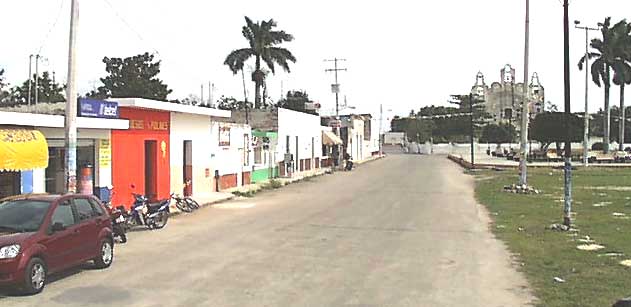
# Downtown Telchac Pueblo about a mile west of the hacienda. Stores appear at the left, the Cathedral to the right, and before the Cathedral sprawls the town park and a grassy area for baseball and soccer: https://www.backyardnature.net/n/05/051230a.jpg.
# A colorful store next to the square downtown: https://www.backyardnature.net/n/05/051230b.jpg.
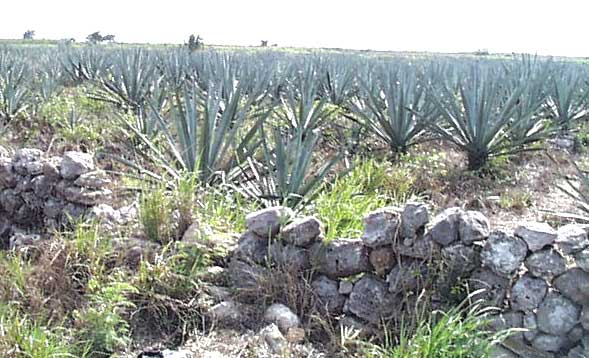
# A field of henequen at the edge of town: https://www.backyardnature.net/n/05/051230c.jpg.
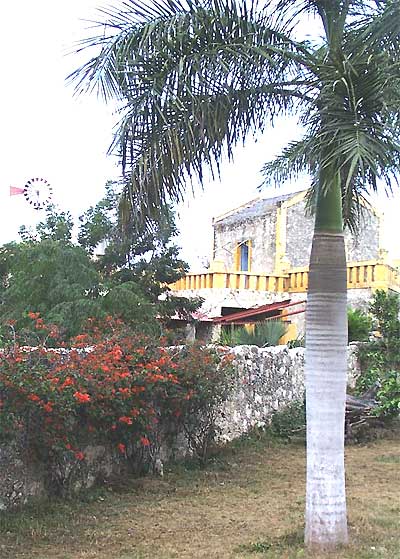
# At Hacienda San Juan, a stone wall covered with red-flowering Bougainvillea, with a young Royal Palm to the right. Across the wall you see the windmill and the building where I occupy the lower level. My building's roof, surrounded by a yellow guardrail, is a fine place for birding and stargazing. https://www.backyardnature.net/n/05/051230d.jpg.
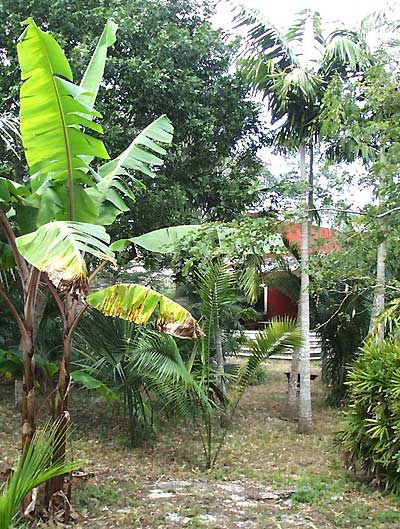
# View through a variety of palms and a banana tree toward the veranda of rentable Casa Chi'ich: https://www.backyardnature.net/n/05/051230e.jpg.
If the above whet your appetite for coming to visit me here, see details at https://www.backyardnature.net/travel/sj.htm.
*****
SITTING IN THE SUN
This week has been unusually cool and dry here, reminding me of early October in Kentucky. On Tuesday morning we had 50°. A radio station in high-elevation Mexico City reported 34° there at the airport, and attributed eight deaths in Mexico to hypothermia caused by the cold wave.
By noon on that Tuesday it was 80° and the sky was so crystal clear that it was one of those cases when the sunny side of your face sizzled while the shadowed side remained chilly and unfeeling. How pleasant sitting in the sun letting the heat seep deeply into the body, Buddha-minding behind red eyelids...
But there's enough Germanic blood and Bible-Belt, rural-Kentucky programming in me for me never to be able to enjoy such moments gracefully. People who know me only by my writings are surprised to see how my foot shakes nervously and eternally beneath a supper table (I just can't help it), and how I feel bound to stay busy all the waking hours. Lazy moments do not come easily to me.
Therefore, in order to find peace at such time as I enjoyed Tuesday, I have to think through the process, to rationalize it. Happily, the older I've grown, the easier it's become to do so.
The reason is because that finally as I'm balding and my beard is turning white, my evolving philosophy of life has matured to the point where it begins supplying insights into such questions as "Is it ever OK to just abandon oneself to an hour or two of pure, self-indulgent laze?"
One insight that's been dawning in me these days is this: That quite possibly nothing "pleases the Creator" more than for Her creations to have evolved to the point where they can experience, reflect on, and be absolutely delighted by and grow to LOVE the Creator's creations. And of course we ourselves are part of the Creator's creations, so being at peace with oneself is part of the equation.
That insight is based on this observation: That every since the Earth was formed life has been evolving toward ever more sophisticated forms of life. Since the general flow of life is in that direction, then, if I have to choose what kind of life I shall live, shouldn't I choose to conduct my life in harmony with that trend? To go with the Creator's flow?
Therefore, at noon, sensuously sitting in the sun behind red eyelids, soaking up being who I am, where I am, this very glorious instant, and wondering what it all means...
Notice that there's a trick involved. The trick is to experience the moment as much more than an animal indulgence. An iguana can lie in the sun apparently enjoying himself, but I as a human have been positioned higher in the evolutionary tree than he. Therefore it's my task to lie in the sun keeping in mind my context within the blossoming Universe, and to struggle to experience not only the heat on my skin but also the musicality of being a super-alert, super-receptive awareness inside this sun-charmed animal body...
Of course, it's impossible to always maintain this higher state of receptivity and insight. The answer is, as with almost everything:
The Middle Path, the Middle Path, the Middle Path...
*****
Best wishes to all Newsletter subscribers,
Jim