October 2, 2005
LAST HIKE UP SLATE MOUNTAIN
This has been my last full week in the Sierra Nevada foothills, so on the morning when I strapped on my backpack for the last hike up to Slate Mountain everything I saw and felt had a special poignancy.
The night before, we'd experienced an unusual thunderstorm. It's still the dry season so we hadn't expected rain here until late this month or November, but that night the lightning had just gone on and on, and we got about half an inch of rain.
Those first whiffs of cold morning air as I began the hike were unlike any I'd experienced here so far. There were odors of rain-saturated sawdust mingled with mud, and of vegetation that hadn't been moist for months. I'd been in dry air so long I'd forgotten how a wet landscape is pregnant with odors, something you never forget in humid Mississippi. I penetrated scent clouds sometimes like stale urine, sometimes like cheesy mushrooms or rotting fruit, but the most powerful odor was a tangy one I'd only smelled so intensely in shadowy, high-elevation rhododendron thickets in the Smokys and I was amazed to find it here among Ponderosa Pines, Mountain Misery and Pacific Madrones. Who knows what causes it? And every odor was married to an association of time and place, so that morning I navigated not only the landscape but also the shadows and bruises of my own mind, walking right past some bear prints in mud pointed out to me later (and photographed -- they are at https://www.backyardnature.net/sierras/bear-b2.htm).
The rain had washed the air, making the Coastal Range 80 miles across the Central Valley to the west look like a neighboring ridge. Until now at best I had only seen a smudgy, purple-silhouetted rim to the Valley but now I saw sharply etched gorges and cliffs, and the upper slopes were green with what Fred tells me are oak woods, but the lower slopes were dun colored just like the parched grass and herbs here. If the Coastal Range hadn't stood in the way I could have seen the sky-blue Pacific, the Farallon Islands off San Francisco, and maybe ships at sea.
I knew all these revelations were significant and were relating to me something important but I with my usual obtuseness couldn't connect the threads, couldn't figure it all out. I just kept on hiking, cataloguing the odors that had lain dormant all these crispy-dry, dusty months I'm now leaving behind.
*****
BLACKBERRY-BIRD WILLOW
I couldn't pass the Bullfrog Pond without sitting among the cattails one more time, for it was windy and there was low-slanting morning sunlight, and I have told you how beautiful the cattails are twisting and heaving in the wind as sunlight cuts through them.
In and out of willows a Black Phoebe flew catching gnats over the pond, and the usual Coot paddled about bobbing her head and looking nervous, pecking here and there in the water milfoil. The pond was majestic, but nothing unusual. I stayed only long enough to finish my breakfast of an apple and a chunk of cheese-and-garlic bread.
Just above the pond, however, I spotted movement in a ten-foot-high, mostly leafless little willow standing like an island in the very center of a quarter acre blackberry thicket, nothing but arching blackberry canes so densely growing together that only a rabbit could feel at home in it, and birds.
My binoculars focusing on the little willow showed this: 16 California Quail with forward-cascading, black, upside-down-teardrop topknots now nearly fully formed, all sunning themselves and looking prosperous and content as only sunning quail can look; one Western Scrub Jay with aquamarine-blue upper parts and gray to white under parts; one White-crowned Sparrow with bold white and black head-stripes, and; one Lesser Goldfinch now with drab fall colors but with a bit of yellow breast making the best of the morning's golden light.
Judging from the various birds' body languages, my impression was that the jay, the sparrow and the finch were there to see what a marvelous thing 16 California Quail in a stunted little willow tree could be. They were like open-mouthed neighbors around the Courthouse Christmas Tree in December, just there to bear mute witness of something gracious beyond words. The quail looked very smug there surrounded by and protected by their quarter acre of blackberry canes and enough sweet blackberries to satisfy their hunger deep into winter, and occasionally one of them would issue the pretty call I've grown to know well by now, which you can hear at http://www.naturesongs.com/caqu1.wav
That song about "a partridge in a pear tree" ... Indeed, the jay, the sparrow, the finch and I all, from our gawky body language, seemed in full agreement about those 16 quail in a willow tree.
You can see how grand a California Quail looks here.
*****
LADYBUGS ON HORSETAILS
Arriving at Slate Mountain I passed by the peak and continued on to Deer View, the old hotel ruin I wrote about a few Newsletters ago. Part of the ruin complex consists of an abandoned pear orchard partly overgrown with blackberry brambles. In late afternoon as I walked into the semi-open orchard area so many ladybugs were flying through the warm sunlight that they constantly got into my beard and between by eyes and my glasses. The open area was surrounded by dark forest so the sun exploding in so many fast-streaking ladybug wings was a thing to see.
As the sun sank below the next ridge, the air cooled quickly and the ladybugs vanished.
Next morning in air so chilly that steam formed as I breathed I wandered along the little stream next to the ruins. In a certain marshy area primitive, spore- producing horsetails (genus EQUISETUM) thickly rose like slender, knee-high pagodas, and over a kitchen- size area at every node on every horsetail 20 to 50 ladybugs were clustered. Later Fred and Diana came up on their yearly blackberry-picking expedition and they brought the camera, so you can see this strange thing at https://www.backyardnature.net/ladybugs.htm.
On that page I also tell a little about ladybugs in general, and explain how the word "ladybug" probably arose.
*****
RED-EARED TURTLE
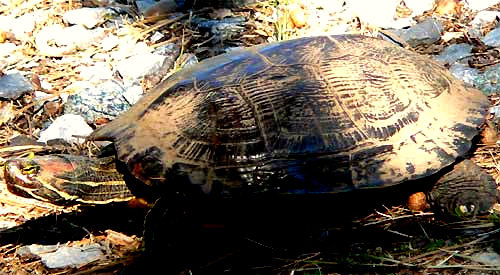
Returning back at Fred's, of all things, there sat a large Red-eared Turtle, TRACHEMYS SCRIPTA, right in the middle of the gravel road. This is the most commonly encountered sun-basking pond turtle found in the Southeast, but I was surprised to see one here.
Moreover, the nearest pond must be half a mile away with a lot of steep slopes and scorched vegetation atop hard-baked, cracking ground between here and there. The river is about half a mile below us but it's whitewater. There are trickling streams here and there, but they are very steep with many waterfalls, and just not where Red-ears are found. Red-ears are inhabitants of sluggish rivers and streams, ponds, swamps and lakes with soft bottoms and dense vegetation -- nothing we have near here. This turtle was dusty as if he'd lugged his big shell a long way, and I think maybe he'd done just that. We happened to have the camera that day so you can see the turtle, dust and all, just as he greeted us at https://www.backyardnature.net/pix/r-e-turt.jpg.
My Audubon field guide to the reptiles and amphibians clearly shows that in North America Red-eared Turtles are mostly a southeastern US species, getting no closer to California than eastern New Mexico. Clearly this is a case similar to what happened with bullfrogs: Both these species have been introduced far from their native homelands. Apparently Red-eared Turtles are common in this area. In fact, I read that now they are found in South Korea, Guam, Thailand, Germany, France, South Africa, Israel and Australia. They're also native from the US Southeast south through Central America into Venezuela.
One reason Red-eared Turtles have spread so far beyond their native area is that they are the original "pet turtle." If, when you were a kid, you told the pet-store clerk you wanted "a plain old turtle to keep in a shallow fishbowl with some rocks," it's almost certain you got a Red-eared Turtle, and almost certain it died not long afterwards.
Kids nowadays of course wouldn't settle for a general fishbowl turtle, plus U.S. government regulations now require turtles to be at least 4 inches long before they can be sold as pets. Nowadays a kid would want a turtle, say, that is lemon yellow with pink eyes. Well, if they got such a thing, it would still be the Red-eared Turtle, because turtle breeders have developed a variety of Red-ear "color morphs," mostly in pastel colors. Actually those lemon yellow ones with pink eyes are pretty common.
This isn't to say that Red-ears are common everyplace. Over large areas their numbers have been decimated by people collecting them for the pet trade, plus pollution and habitat destruction has taken its usual toll, and during recent years many people have taken to trapping them for the food trade, much turtle food being exported to Asia.
*****
DIGGER PINES
Earlier I've mentioned that around here the main pine is Ponderosa Pine, and that we say we're "going up to the Sugar Pine zone," and "going down to the Digger Pine zone." I've already covered the Ponderosas and the Sugars, and this week I finally got some good pictures of a Digger Pine and its cone, which now appear at the bottom of my Pine Page at https://www.backyardnature.net/sierras/pines.htm.
The trunks of both Ponderosa and Sugar Pines are monumentally tall and straight. Digger pine trunks typically are crooked and forked, its wood is coarse- grained and warps badly, and the tree itself seldom rises over 60 feet tall. The needles of Ponderosa and Sugar pines are dark green, thick and they clot heavily on the branches. Much in contrast, the Digger's needles are grayish, stiff and slender, giving the tree such an airy, wispy appearance you can hardly find decent shade beneath it. The only other pine I've seen like it is the Caribbean Pine I got to know while living in Belize. That species typically occupied hot, windblown, sandy flats, so it looks like the species' shared features are adaptations to drought, intense sunlight and hot wind.
One wonderful thing about Digger Pines is the oversized cones they produce, and the remarkably large, edible seeds that come from those cones. The seeds were much eaten by the natives, and still are very important to wildlife. To top it off, during early summer, long before the forest's main fruits and nuts mature, the young cones possess a soft core that can be eaten.
When I first arrived here a lady known for her liberality and strong sense of egalitarianism advised me to not call these trees Digger Pines. That was because the name Digger came from the "Digger Indians," which was a contemptuous name given by white settlers to the Maidu and other Native Americans who occupied this land first, and who spent a lot of time digging for roots. I find the lady's sentiment admirable but somehow I can't transfer the offense I feel for disrespecting the natives to the tree. The name Digger Pine is rooted in our literature and folklore and it's a good name. The scientific name is PINUS SABINIANA, named for Joseph Sabine, an English lawyer and naturalist born in 1770.
*****
PRICKLY-LETTUCE LATEX
The other day I was pulling prickly-lettuce from the strawberry patch and got to thinking about the sticky, white "milk" oozing out wherever a stem or leaf was torn. Why would prickly-lettuce produce such a thing?
Prickly-lettuce isn't the only plant with "milk" in its veins. Of course there's milkweed and closely related plants like Indian Hemp, plus many completely unrelated species such as the spurges, rubber trees and the Opium Poppy. To be spread across so many plant groups, plant "milk" must be important.
And what do you do when you have a question like this? You Google!
So, plant "milk" is actually a latex produced by specialized "lactiferous tissue." The latex is an emulsion of tiny granules and droplets of various substances, all suspended in a solution containing dissolved salts, sugars, rubber-producers, tannins, alkaloids and various enzymes. Among the granules and droplets are grains of caoutchouc (gum elastic), drops of resin and oil, proteid (coagulated protein) crystals and starch grains. In other words, it's a very complex mixture.
This latex doesn't seem to have the same function in all plants, and probably it's correct to say that often or always it serves more than just one function. Some latex ingredients are waste products, so one function of latex is to serve as a dump for metabolic waste and such. Some plants, such as rubber trees, plug their wounds with drying latex. Milkweed latex is so rich in poisonous alkaloids that it prevents certain insects from eating the plant.
But, who knows why wild prickly-lettuce and highly edible garden lettuce both produce "milk"? A number of the lettuces' closest relatives also have milk so maybe lettuce just inherited the feature, which long ago during the evolutionary process served a purpose in an ancestor, but which now doesn't, like the human appendix. Maybe milky latex first evolved merely as a consequence of waste accumulation. Since biological waste often is poisonous, maybe it by chance started defending the plant against being eaten, and then a new evolutionary imperative appeared, that of making the latex more toxic than ever, to keep even more animals from eating the plants.
In nature very often there is no single answer. The human mind insisting on pat answers and needing to see everything in black and white terms simply is doomed to frustration.
*****
PIECES OF ANOTHER WORLD
That's the name of a children's book just published by a friend of mine, Mara Rockliff, and I'm so tickled with what she's done I want to plug her book here. You can meet Mara, see some of the book's artful illustrations and read about the story at http://www.sylvandellpublishing.com/pieces.htm.
The story is about a father and child's nighttime excursion to watch a meteor shower. I happen to know Doug, the father, and Cassidy, the child, and I can just visualize their doing exactly this, with Mara in the background drinking it all in.
*****
DOWNLOADABLE BOOKS
Speakng of books, lately I've made several of my own available for downloading, for free. The main one provides excerpts from my years of Newsletters issued from the woods near Natchez, Mississippi. If you have friends in southern Mississippi and a good printer you might consider printing out this book and offering it as a homemade gift.
Also I'm making available reports from a birdwatching trip through Mexico, which is as much a description of my wanderings in the Mexican backcountry as mere information about birds. Another book chronicles my search for spring in the Southwestern Desert. My children's book, Walks with Red Dog, also is there, as are a couple of novelettes in which the stars are an Eastern Gray Squirrel and a House Sparrow, both behaving as wild creatures really do.
These are available in text-only format, as well as in DOC format (Microsoft Word), ready for printing. Just save the documents to your own hard disk, then open them with the appropriate text editor, such as Word or WordPad. Of course, if you don't mind reading on a computer screen, you don't have to print them out at all.
The page on which you can download the books is at https://www.backyardnature.net/j/books/.
*****
HITTING THE ROAD AGAIN
Once again this winter I'll be in the Yucatan doing the thing described at https://www.backyardnature.net/travel/sj.htm.This Wednesday, October 5th, I'll start busing my way there, making a side-visit along the way. I have no idea when I'll be able to issue my next Newsletter and this winter I won't have the dark little room full of dusty religious paraphernalia in Dzemul where last winter I had internet access. I just don't know how my Newslettering will work out. I can't afford to use a cyber cafe each week.
Therefore, please forgive the erratic issuance of forthcoming Newsletters, their lack of appropriate links, the misspellings, the frazzle-minded grammar and uneven content.
If you have any interest at all in a winter vacation in the tropics, you might consider Hacienda San Juan, where I'll give you special attention as described at the above link. If this winter natural gas prices go as high as they say they will, those of you in the north may find moving to San Juan for a month or two more reasonable than in other times. If you want more information about visiting, just write to me.
My heartfelt thanks go to my hosts Fred and Diana for a summer stay here in California's Sierra Nevada Foothills. My time here simply could not have been more perfect and enjoyable.
Beyond that, all I can say is... Here we go again...
*****
Best wishes to all Newsletter subscribers,
Jim