October 24, 2004
LANDSCAPE MOSAIC
Late Tuesday afternoon I arrived back at the location 12 miles east of Natchez where I've resided the last year or so. While I was gone, the deer had had their way with one of my gardens and my little trailer smelled mightily of mildew and mouse pee. During the next couple of weeks I'll be pulling up what roots I have here, literally and figuratively, before embarking upon an even more adventurous jaunt.
The trip south from my home area in Kentucky was a stormy one. Managing to keep even with a weather front bringing chilly air and rain to the South, I traveled in and out of storms all the way down, as far as Vicksburg. At Vicksburg, unlike sometimes in history, the forces of the South rallied and the northern front stalled and finally withdrew while I continued on southward, where an easy summer continues to linger.
What a thing is this America! Lately I've reported from the southwestern deserts, California's Sierra Nevadas and their foothills, the high-elevation Great Basin Desert in Utah and Wyoming, the Eastern Deciduous Forest Biome in full fall color, and none of those places looked like southwestern Mississippi. I don't know if it's true with others, but I feel like a different person each place I go. For me, traveling into new natural areas is soul-expanding.
My general knowledge of America's mosaic of ecological regions enhanced my cross-country traveling experience enormously. If you'd like to gain a better feeling for what these regions are like and where they are, you might check out the US Forest Service's online map of the US's "Ecosystem Provinces." There you can click on a color-coded province and be linked to a page providing a habitat picture from within that province and plenty of text describing it. The page is at www.fs.fed.us/colorimagemap/ecoreg1_provinces.html
*****
ORB-WEAVER BY THE BATHTUB
Except for the odor of my trailer and the later season being displayed by the forests and fields around me (I'd completely missed the goldenrods' spectacular flowering), amazingly little had changed since I left here on September 13th. In fact, about the only thing even halfway a surprise was the presence of a nicely large, plump, brown, hairy spider who had strung a large web between the bathtub beneath the barn's eaves and the nearby Sweetgum tree. Such spiders are all over the place nowadays, and sometimes you have to wonder how they manage to construct their large webs in such out-of-the way places. A typical web may be 3- 5 feet across (1-1.5 m).
My bathtub spider was NEOSCONA OAXACENSIS, and if it has a common English name I can't find it. That's surprising because it's such a common and conspicuous species all across the southern US, clear into Mexico, constructing its webs in the woods as well as in buildings. You can see pictures of the species at http://kaweahoaks.com/html/neoscona_oaxacensis.html, though the ones around here are more dark brown than the ones in those pictures. Ours tend to have something of a cream-colored Christian Cross across their backs.
On recent mornings here we've experienced very heavy fogs. Since spider populations reach a peak in late fall and water droplets in fog condense in spider webs making them more visible, there's hardly a better time of the year than now for walking around admiring the world of spider webs.
My bathtub spider's flat, vertically suspended web is known as an "orb web." Webs composed of horizontal sheets near or on the ground, with a tunnel at one end, are called "Funnel webs." You've probably seen the small webs configured like upside-down cups suspended within a maze of silk strands. These are "sheet webs." You can see these web types on my Spider Silk Page at www.backyardnature.net/spidsilk.htm
*****
FRITILLARY CHRYSALIS
It's true that in California it was great sharing space with Black Bears and Mountain Lions. However, it's also true that during my entire stay there I never saw a single butterfly. It was just too dry. There must be plenty of butterflies during the spring, but during my stay the herb layer was brown and dead, with little nectar to offer.
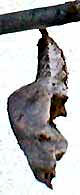
In contrast, here we still have butterflies galore. In fact, while I was away my Natchez neighbor Karen sent a picture of a butterfly chrysalis she'd found dangling from a nail jutting from a barn wall. You'll remember that a chrysalis (pronounced KRISS-uh-liss) is the resting stage formed by a caterpillar before it metamorphoses into a butterfly. You can see Karen's picture at www.backyardnature.net/pix/gfritpup.jpg
From that chrysalis emerged an orangish butterfly of the species most commonly seen flitting about my remaining morning glories right now, the Gulf Fritillary, AGRAULIS VANILLAE. If you look at Karen's picture you'll see that the chrysalis is curved and warty in a curious way, with mottled brown colors. This wonderful camouflage causes the chrysalis to look like one of the abundant dried-up leaves lying all over the place at this time of year. The whole thing is about 1-1/8 inch long (28 mm).
*****
SWEATING
On Sunday morning western Kentucky had its first heavy frost. Maybe one consequence of that cold weather was that I returned to the Natchez area with a cold. Those of you who have read my Newsletters since the beginning know that my being in less than perfect health is unusual. Not being around people these years, I haven't suffered from people's infirmities.
Back when I was around people a lot I did get a few colds, and I developed a strategy for dealing with them. I would:
I believe in that last step because I know that when a body develops fever, the increased body heat destroys or slows the growth of many pathogenic microbes. Also, sweating is known to rid the body of toxins.
So, Thursday and Friday nights I dressed up, got into my sleeping bag, and put my therapy into action. Of course I sweated copiously both nights, but by Saturday morning my strength was returning, and I'd prevented a nasty head-cold from entering my chest. In my opinion, I simply nipped that cold in the bud.
Not only did my therapy overcome the cold, but on both mornings after my night sleep-treatments, I felt uncommonly rested, and placid -- at peace with the world. I had forgotten that heavy sweating can also calm and clear the mind. I am convinced that a good sweating can make you feel better not only physically but also psychically.
Of course I'm hardly alone in recognizing the value of copious sweating. Think of American Indian sweat lodges, Finnish saunas, Russian banias, Jewish shvitzes and Turkish hammans. When you reflect on all the mature cultures that have come to the conclusion that sweating can not only be healthy but improve your state of mind, you just have to regret that our own culture has forgotten this and many other wisdoms.
There's a nice essay providing technical explanations of how and why the body reacts so positively to steam/sweating therapy at www.keidel.com/resource/wellness/steamtherapy.htm
An interesting account of a traditional Navajo sweat- lodge ceremony is given here.
*****
WINGED MIGRATION
Now I am going to do something very nice for you -- I'll tell you about the documentary film called "Winged Migration." A couple of weeks ago I viewed a DVD copy of that film with my friends in California and I must say that it's surely the most beautiful, inspirational, bird-oriented film I've ever seen.
To make the film a crew of French ornithologists and filmmakers raised ducks, geese and other kinds of birds from eggs and trained them to allow photographers to fly with them as the birds flew. This is not the film about a fellow in the US who trained geese to follow him in his ultralight plane, and which frequently has been shown on TV. The filming for "Winged Migration" took places in about 40 countries and with a good variety of bird species.
You can read more about the film, available in DVD, VHS and other formats, by clicking on the Amazon.com link at the bottom of my bird-migration page at www.backyardnature.net/birdmgrt.htm
*****
NATCHEZ NATURALIST NEWSLETTER -- THE BOOK...
Craig W. Gill, Editor-in-Chief at University Press of Mississippi, has invited me to submit a formal proposal for a book. The book will consist of excerpts from Newsletters issued during my years of living in the woods near Natchez. He is suggesting a book of 60,000 to 80,000 words, and illustrated with my own black-ink drawings.
I'll be editing the text so that where in the Newsletters I referred readers to Internet addresses, in the book I'll provide drawings. The book -- IF the proposal is accepted and eventually published -- will consist of twelve chapters, each chapter containing writings issued during a specific month. The first chapter will be of January writings, and Chapter 12 of December writings.
I've begun the editing, discarding about two-thirds of available text, leaving only what I regard as the most evocative and interesting passages. Really it's overwhelming to see this distillation of my years of observations and meditations at Natchez. I think there's a possibility that this can be quite a successful book, and one read far beyond Adams County, Mississippi.
At this early stage in the project, I can use your help:
I invite everyone who eventually might buy one or more signed copies of this book, or even arrange book- signings or speaking engagements where books can be sold, to send a short email to me stating your interest in doing so. Nothing will be binding, of course. In your letter, you might say what you have liked about the Newsletters, and let us know where you are -- sign it with something like "JL in Jackson, MS" or "Fred in Oregon."
I'll print out your emails and submit them with my formal proposal, to show Craig that there's interest in such a book. Of course, the more emails I can include, the better. IF a book results, it will probably be published two or three years from now. This is a slow process. I'll keep you updated on the project.
Please send your emails to book@backyardnature.net
Thanks.
*****
Best wishes to all Newsletter readers
Jim Conrad