
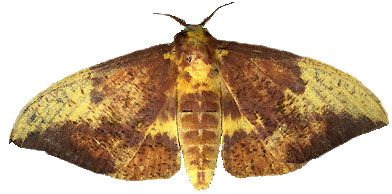
What is the difference between a moth and a butterfly? Sometimes it's easy to decide which one you have, but other times, without looking very closely, it's hard.
Like the Imperial Moth, Eacles imperialis, shown above, when moths are at rest usually but not always they
Some moths have
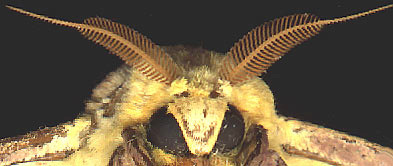
Beyond that, we have to speak in more general terms. For example, in general, butterflies are more seen during the day, while moths usually fly at night. But there are lots of exceptions.
Moths tend to be thicker and hairier than butterflies, but many exceptions exist. Overall, moths don't flit about from flower to flower as lightly as butterflies, but rather seem more serious, get right to the job... but not always.
It goes on and on like this, with general impressions about the differenes, but with many exceptions. In the end, sometimes, unless you want to get really technical, it may be too hard to say. Just laugh and shake your head, and be glad that Nature doesn't always follow the rules we humans think we have to have.
MOTH IDENTIFICATION
Unless you are trying to identify one of the larger and fancier moth species, moth identification is usually harder and less certain that butterfly identification. That's because there are more kinds of moth than butterflies, and many moth species are small, fairly unspectacular, brownish or grayish ones. You can see what I mean by taking a glance at our Moth Families Page. When you see all those names, remember that they are families, some of them with many genera, and many of those genera having many species!
Most field guides with moths in them are for "butterflies and moths," which means that butterflies are the main subject, but some of the more common moths are included. Moth fanciers in eastern North America are lucky that A Field Guide to Moths of Eastern North America exists.
Our own Moths of Ontario page is a good one on which to get a feeling for the appearance of species in various North American moth families. If you have a moth to identify, see if you can find it, or something like it, on that page. If you can't find your exact species, maybe it's clear which family it belongs to, and then you can do a Google image search with the keywords being the name of that family and your state or province.
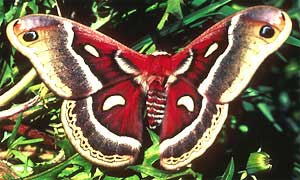
You might practice this approach by identifying the moth shown above. Can you figure out its family?
It's a great help in moth identification if you have a checklist of the species found in your area. Field guides with distribution maps for each species help the identification process enormously. Also, in the US, check out the Moths by State website. If you are in Maine, for instance, you shouldn't have to try to distinguish your moth from a look-alike species in Louisiana.
WAYS MOTHS PROTECT THEMSELVES
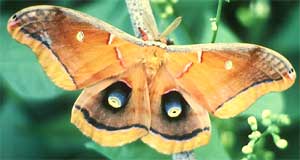
Moths protect themselves from predators in some interesting ways. For example, can you figure out how the Polyphemus Moth, Antheraea polyphemus, illustrated above, might cause a hungry bird to go away? Notice how this moth's hindwings are adorned with what appears to be eyes glaring at us. Well, if you were a bird about to pounce on the poor Polyphemus, and the Polyphemus opened its wings and those big yellow eyes were suddenly staring at you, wouldn't you think twice about gobbling it up?
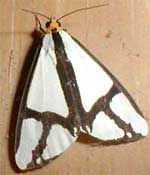
The moth at the left, with the curious name of "The Neighbor," Haploa contigua, isn't very colorful, but its bold wing patterns take advantage of a special camouflage technique known as disruptive patterning. In disruptive patterning, the outline of an animal is broken up or blurred, making it hard for a predator to know what it is seeing. Is "The Neighbor" one black and white insect, or six white insects on a black background? Or maybe it's not an insect at all. The moment of confusion disruptive patterning can bring about may be all the time an organism needs to escape being eaten!
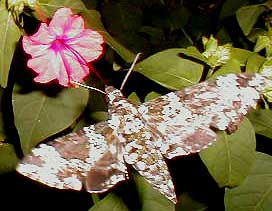 Another way for a moth to confuse its predators is for
its camouflage to blend it in with its environment. The Rustic Sphinx, Manduca rustica, at the right is clearly visible to us, but just imagine how hard it would be to see it if it were quietly perched on a brown tree trunk thickly covered with gray lichen! In the picture, notice the moth's long proboscis sticking into the flower's throat, being used like a straw to suck up the flower's sweet nectar. This species is found from the southern US south through Central America to Uruguay in South America.
Another way for a moth to confuse its predators is for
its camouflage to blend it in with its environment. The Rustic Sphinx, Manduca rustica, at the right is clearly visible to us, but just imagine how hard it would be to see it if it were quietly perched on a brown tree trunk thickly covered with gray lichen! In the picture, notice the moth's long proboscis sticking into the flower's throat, being used like a straw to suck up the flower's sweet nectar. This species is found from the southern US south through Central America to Uruguay in South America.
THE GIANT SILK MOTHS
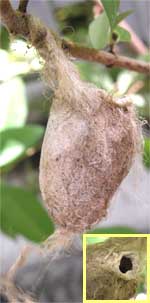 The above Polyphemus Moth is a member of Giant Silk Moth Family, the Satrniidae, and that's a moth family you should know. This family is famous for its very large, showy moths -- with wingspreads up to about 6 inches across (15 cm). Caterpillars in this family often bear spines or tubercles, and are so large that their silken cocoons are sometimes confused with hummingbird nests. At the right you see such a cocoon "not much larger than an extra large chicken hen's egg," according to Maureen, who sent us the picture from West Palm Beach, Florida. The adult moth has already emerged from the cocoon, as you can see by the exit hole at the top of the cocoon, shown in the inset at the picture's lower right. I think this is the cocoon of a Polyphemus Moth.