PLANTS | ANIMALS | ECOLOGY | FUNGI | GEOLOGY | GARDENING | TOOLS
MEXICAN PLANTS & ANIMALS HOME

Excerpts from Jim Conrad's
Naturalist Newsletter
from the May 12, 2007 Newsletter issued from Sierra Gorda Biosphere Reserve, QUERÉTARO, MÉXICO
THE RUE IN DON GONZALO'S EAR
The other day Don Gonzalo's helper, Silvester, was watering plants as I walked by. Smiling broadly he stopped me, plucked a sprig from a tender-looking, bluish green herb being watered, rolled up the sprig (a penetrating medicinal odor suffused the air during the demonstration), stuffed it into his ear, and told me that this is how people around here cure earaches.
You can see the earache herb below:
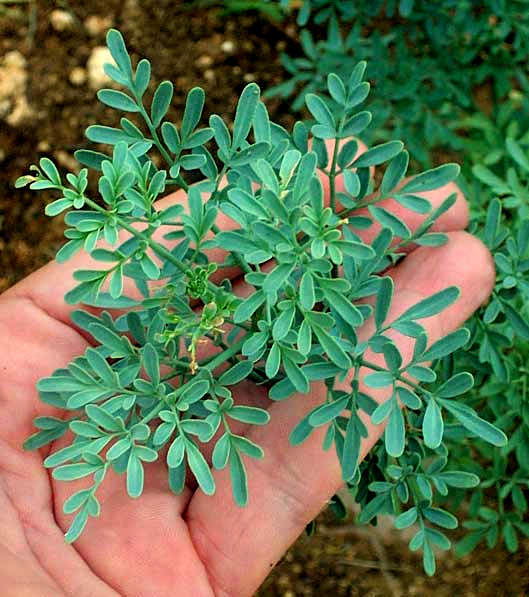
Don Gonzalo and Silvester call the plant Ruda. In English it's Rue, and in Latin RUTA GRAVEOLENS. It's a member of the Citrus Family, the Rutaceae. Originally it's from southern Europe but it's planted in gardens worldwide, and often the plant escapes or persists.
When I was gathering information for the Medicinal Plants page of my Traditional Mexican Markets Website, I found that Rue is one of the most powerful plants in the traditional Mexican pharmacopoeia. The first thing I learned about it was that it is used to induce menstruation and to abort unwanted fetuses.
I also learned early that the tender-looking little plant is so powerful that it's dangerous. A warning at the Floridata.Com website reads:
Some people are allergic to rue and get a skin rash from handling the plant. Especially on hot days, just brushing against rue can cause water blisters and blotchy skin, much like poison ivy. For some people, ingestion causes increased photosensitivity and can lead to severe sunburn. Ingesting large amounts of rue can cause violent stomach pain, vomiting, and convulsions. Pregnant women should never ingest rue.
That site also informs us that the Rue leaf was the model for the Suit of Clubs in playing cards.
Why would the Rue leaf be honored with such a position on playing cards? Surely it's because in earlier times Rue was so recognized as powerful medicine that it also acquired renown for its magical properties. It was used as a defense against witches. Michelangelo and Leonardo da Vinci are said to have eaten rue to enhance their creativity and eyesight. Rue symbolized regret, sorrow and repentance, and Catholics put sprigs of it in holy water sprinkled on worshippers.
Is Rue really an effective medicinal herb? Don Gonzalo says it makes a good-tasting tea with no side-effects, so one wonders.
But, at the {now defunct} HerbMed.Org website we read that "Treatment of 15 patients with intracranial tumors, using Ruta 6 from Ruta graveolens and Ca3(PO4)2 showed that 6 of the 7 glioma patients had complete regression of tumors and thus in combination they are used in brain cancers, particularly glioma."
Googling the keywords "'ruta graveolens' medicinal" I get 101,000 returns.
Whatever the case, I'm glad Rue is growing near my casita, just in case I ever get an earache.
from the March 28, 2010 Newsletter issued from Hacienda Chichen Resort beside Chichén Itzá Ruins, central Yucatán, MÉXICO
RUE FLOWERS
Our Rue is flowering now and its blossom is so pretty and interesting that it's worth looking at, shown below:
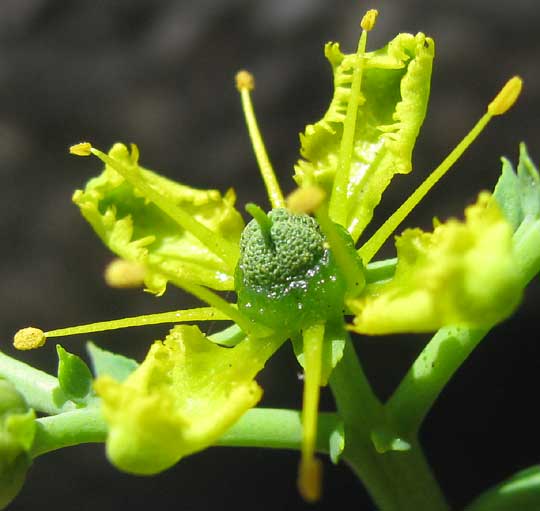
The Rue flower has a fairly simple design. If you need a refresher class in basic flower anatomy you can go to our "Standard Blossom Page" and relate the parts of our "Standard Blossom" to the above Rue flower, which is about ½-inch across (1.5 cm).
Rue flowers bear four sepals and four petals. They depart from our "Standard Blossom" by their stamen number usually being double the number of petals, so there are eight stamens shown in the picture. The yellow petals are a little unusual because their margins are fringed.
The most distinctive, unusual feature of this flower is its female structure. In the picture the grainy- surfaced, green thing in the blossom's center is the ovary, which later will mature into the fruit. The green, fingerlike thing poking from the ovary's top is the style, at the top of which is a hardly visible stigma or stigmatic zone, where pollen grains germinate.
The green, gelatinous-looking mass below the ovary is special. It's an "annular disk," and when you see flowers with the ovary perched on such a conspicuous annular disk, with stamens arising below the disk, and the plant's herbage is fragrant, often spicy, then you need to think "Citrus Family" -- the family harboring oranges, lemons, grapefruits, kumquats and many other important plants, as well as our Rue. If you happen to have an orange or lemon tree flowering now, you might see if you can locate the annular disks in the flowers of your own Citrus Family member.
Knowing that Rue belongs in the Citrus Family, the ovary's roughly pitted surface makes sense. For, isn't that exactly the kind of gland-rich texture you see on an orange or lemon?