PLANTS | ANIMALS | ECOLOGY | FUNGI | GEOLOGY | GARDENING | TOOLS
MEXICAN PLANTS & ANIMALS HOME

Excerpts from Jim Conrad's
Naturalist Newsletter
from the June 29, 2007 Newsletter issued from Sierra Gorda Biosphere Reserve, QUERÉTARO, MÉXICO
SPINES ON SPINES ON SPINES
Wandering on the scrubby slopes here you don't want to lose your balance and grab at the stem shown below:
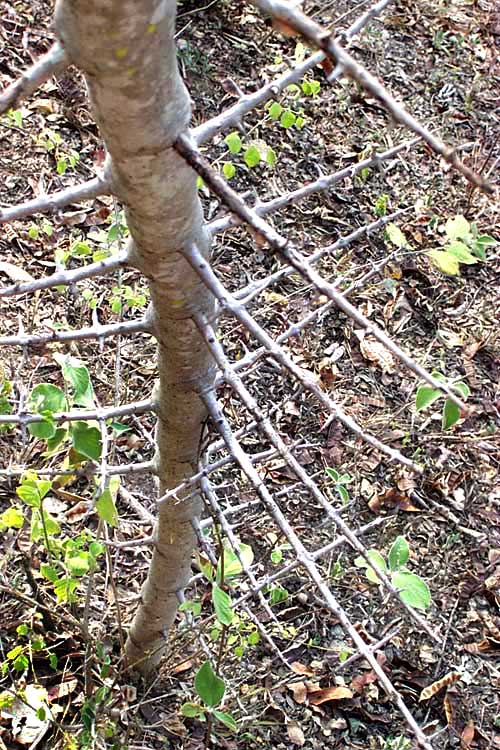
Not only does the stem shown there possess spines on spines on spines, but also the final spines are curved so that anything that gets punctured will probably get ripped, too. This is one of the most aggressively spiny stems I've ever seen. But spininess isn't this plant's only distinction: It's also a perfect example of a "half tree, half vine" state.
If you follow the spiny stem in the picture upward you'll see that soon itz branches soon start leaning into neighboring trees, and eventually become so slender and lithe that they really are nothing more than vines. Below, you can see a viny, leafy branch-tip:
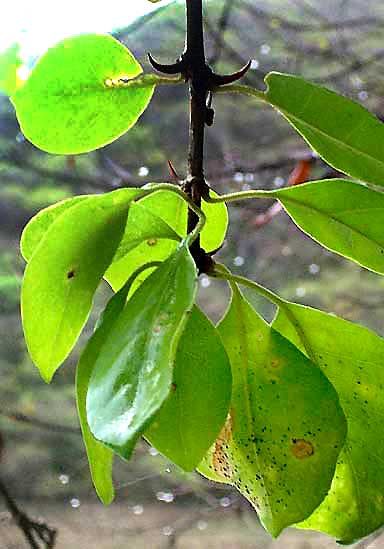
The plant is PISONIA ACULEATA, a member of the Four-o'clock Family, the Nyctaginaceae, along not only with Four-o'clocks but also Bougainvilleas. Of course in English it's known as Cat-claw and Devil's-claw, but the name that seems to appear most in the literature is "Pull-back-and-hold." It's also known as Catchbirdtree, for reasons I hate to think about.
The species is nearly "pantropical" -- native throughout the New World's tropics but introduced in many other places. In the US it reaches southern Texas and southern Florida.
from the February 26, 2017 Newsletter issued from Rancho Regenesis in the woods ±4kms west of Ek Balam Ruins; elevation ~40m (~130 ft), N20.876°, W88.170°; north-central Yucatán, MÉXICO
PULL-BACK-AND-HOLD FLOWERING
This week a slender branch of Pull-back-and-hold caught my eye because it was adorned with yellow clusters of flowers, as shown below:
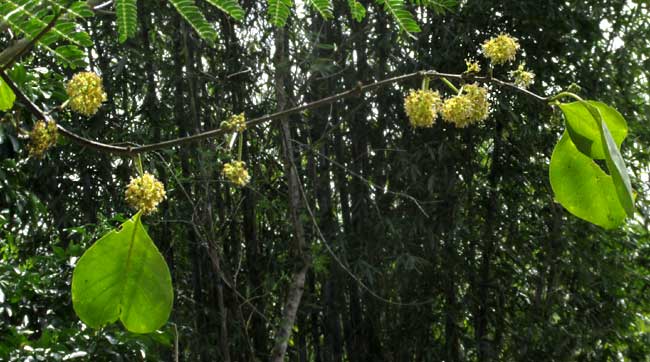
I didn't recognize this as our old friend Pull-back-and-hold until I noticed a sidebranch bearing the signature "cat-claw" spines, shown below:
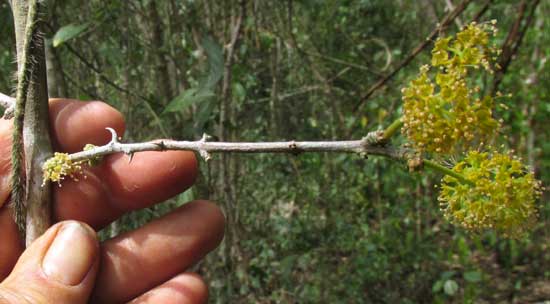
This was the first time I'd noticed the species' flowers, so I took a good look at them. The small, yellow blossoms are arranged in branching panicles, seen below:
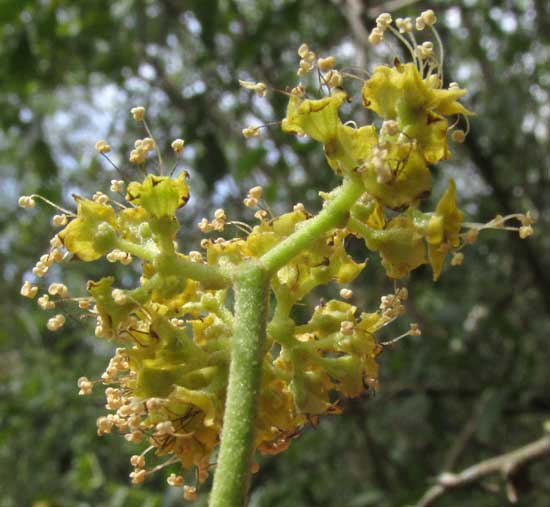
Below, a flower is shown up close, its white stamens arising from below the blossom's ovary:
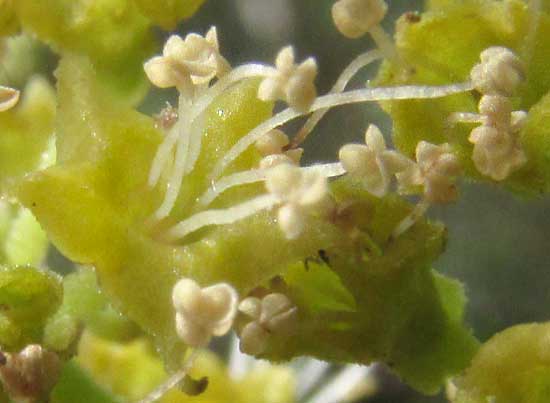
An important field mark helping us to figure out which plant family Pull-back-and-hold belongs to is that the blossoms don't form the usual green, bowl-like calyx below a colorful corolla. These flowers seem to display only the yellow corolla, though those in the know tell us that actually what we're seeing is a calyx modified to look like a corolla, and that the blossoms really produce no corollas at all.
When I see a fair-sized flower with a calyx modified to look like a corolla, I know that a good bet is that the plant is a member of the Four-O'Clock Family, the Nyctaginaceae, in which we also find Bougainvilleas, maybe the most-planted ornamental bushy vine in all the world's tropics.
from the March 13, 2011 Newsletter issued from Hacienda Chichen Resort beside Chichén Itzá Ruins, central Yucatán, MÉXICO
PULL-BACK-AND-HOLDS FRUITING
Pull-Back-and-Holds nowadays are laden with overlapping, spherical clusters of club-shaped fruits, as shown below:
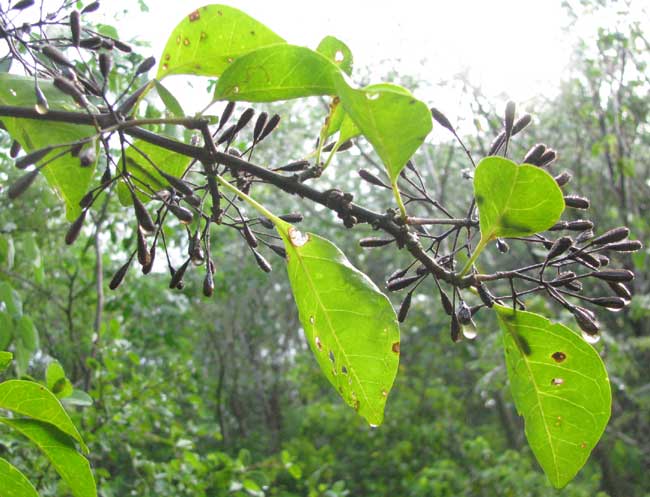
Three fruits sticking in my hairs are shown below:
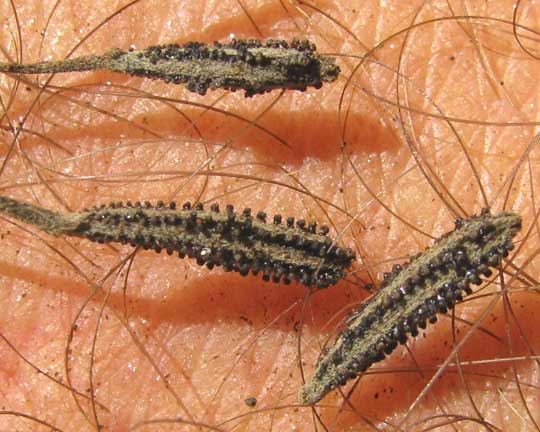
The special thing about the fruits is that that they bristle with stalked, sticky glands. The fruits stick to you as with glue. A botanist writing on the Internet says that even on fifty-year-old herbarium specimens the fruits remain sticky. It's reported that birds can become entangled in the sticky fruit-orbs, though it's hard to imagine an adaptive advantage that might offer the plant.
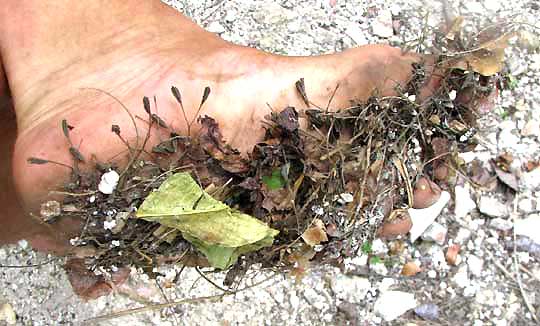
While photographing the above fruits I began noticing a certain fuzziness about the bottoms of my feet. In what is surely the first picture in human history of the phenomenon of Pull-Back-and-Hold fruits sticking to the bottom of a human foot, you can see what I felt below: