PLANTS | ANIMALS | ECOLOGY | FUNGI | GEOLOGY | GARDENING | TOOLS
MEXICAN PLANTS & ANIMALS HOME

Excerpts from Jim Conrad's
Naturalist Newsletter
from the August 10, 2007 Newsletter issued from Sierra Gorda Biosphere Reserve, QUERÉTARO, MÉXICO
DATE PALMS ALONG THE REFORMA
Last Saturday in Mexico City I hiked the tree-lined, 7.5-mile long (12 km) Paseo de la Reforma both ways. One reason I'd do that is because despite its being such a busy thoroughfare it's lined on both sides by trees, as you can see in the skyscraper-taken photo at https://en.wikipedia.org/wiki/Image:Torre_Mayor_005.jpg.
There's a good variety of trees, too. There are eucalyptuses, pines, cottonwoods, Sweetgums, ashes, junipers, pepper trees (genus Schinus) and more. Particularly I enjoyed the palms, one of which you can see below:
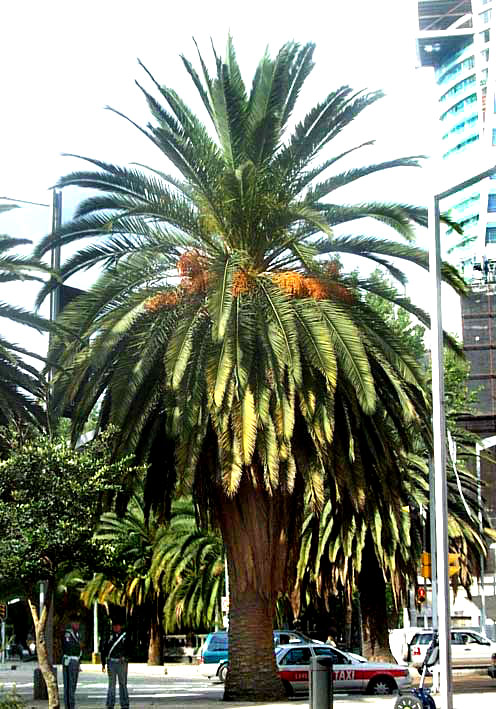
That's the Canary Island Date Palm, PHOENIX CANARIENSIS, a true native of the Canary Islands off the Atlantic coast of North Africa. It's such a beautiful and hardy tree -- able to survive dry spells, cold snaps, and apparently air pollution -- that it's planted in tropical and semitropical areas worldwide, including along streets in California and Florida.
Being in the genus Phoenix it's a "real" date palm, but it's not THE Date Palm, which is Phoenix dactylifera. The Canary Island Date Palm does produce edible dates but they're so small and their flesh is so thin that few bother to eat them. Phoenix canariensis can grow up to 60 feet tall, though usually what you see is only half that size.
In the photograph the diffuse, orangish, brushlike items among the tree's fronds are maturing fruit clusters. The fruits are only about 3/4-inch long, compared to a date, which might get two inches long.
Besides having smaller fruits, Canary Island Date Palms differ from "real" Date Palms in that Date Palms sprout from their bases. Unless someone is cutting the extra sprouts back, Date Palms appear in clusters. Canary Island Date Palms, in contrast, arise on solitary trunks.
Date palms as a group are fairly easy to distinguish from other palm kinds. First, their fronds are featherlike, instead of fanlike, as in the palmettos. After noticing that, the only other feature to look for is to see that the fronds' lower leaflets, or pinnae, are represented by stiff, long spines instead of regular soft, wide blades. The spines are substantial, hard and sharp, so when you see them there's no doubt about it.
from the May 2, 2010 Newsletter issued from Hacienda Chichen Resort beside Chichén Itzá Ruins, central Yucatán, MÉXICO
A DATE PALM'S SPINY LOWER PINNAE
Another tree along Mérida's Paseo de Montejo catching my attention was indeed a palm, the Canary Island Date Palm, PHOENIX CANARIENSIS, much planted in gentile parts of big towns all across Mexico and the rest of the world's tropics and subtropics. It really is a native of the Canary Islands.
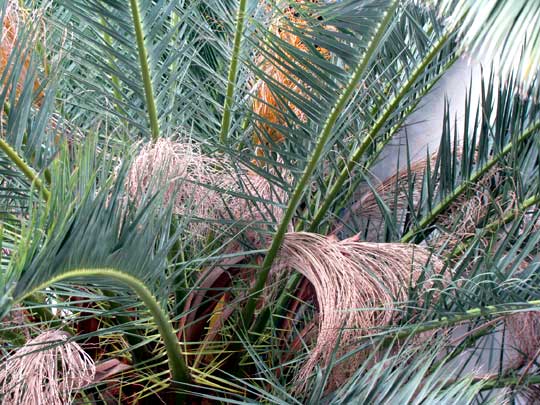
The genus Phoenix's various species usually can be identified fairly quickly by noticing that their large fronds are "pinnately compound," like a big feather, and the fronds' lower pinnae -- the frond divisions next to the trunk -- are spiny. A picture showing several frond bases with very stiff, sharp, lower pinnae among inflorescences of male flowers is shown below: