PLANTS | ANIMALS | ECOLOGY | FUNGI | GEOLOGY | GARDENING | TOOLS
MEXICAN PLANTS & ANIMALS HOME

Adapted from Jim Conrad's online book A Birding Trip through Mexico, This excerpt from "The Beach at Mazatlán" in southern Sinaloa state
MAGNIFICENT FRIGATEBIRD
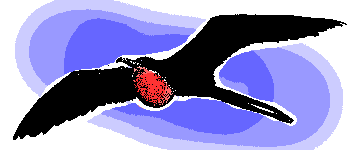
Now what should fly by but a Magnificent Frigatebird. This species has a pretty interesting trans-species behavior, too. Magnificent Frigatebirds are kleptoparasites.
When Magnificent Frigatebirds come across members of other bird species who have have managed to acquire some food, the frigatebirds are likely to chase the other species down and rob it of its food. The robbing process is more than a quick exchange of a fish, though.
In the early 1990's, J.L. Osorno and others studied Magnificent Frigatebirds on Isla Isabel, or Isabel Island, off the coast of the Mexican state of Nayarit, just south of here. Isla Isabel is home to a great many Blue-footed Boobies, which are goose-size seabirds a little like gulls, but with much larger beaks and narrower wings -- and the adults really do have large, bright-blue, webbed feet, as well as bluish bills. On Isla Isabel these boobies, then, were the frigatebirds' main victims. In other places it might be gulls and terns.
Blue-footed Boobies have wingspreads of 163 centimeters (64 inches), but Magnificent Frigatebird wingspreads are even larger, spanning 229 centimeters (90 inches). Clearly, when a frigatebird attacks a booby, it's a thing to see. Typical attacks consist of the victim being caught by the wing or tail and then the frigatebird forces its victim to regurgitate whatever happens to have accumulated in its crop.
One of the most interesting observations made by Osorno and his group was that frigatebird success in actually obtaining food was very low. Of 1,553 attacks, or chases, initiated by frigatebirds on Blue-footed Boobies, in only ninety-one cases did the victims actually end up regurgitating food, and in those cases only fifty-eight times did the frigatebirds actually get the food being regurgitated. That's less than a four-percent success rate.
Because longer chases provided proportionally higher success rates for the frigatebirds, Osorno thought that possibly the frigatebirds were evaluating their targets before the attacks began. Specifically, maybe the frigatebirds could see from a distance how full their potential victims' crops were. The larger the crops appeared, the longer the frigatebirds were willing to keep up the chase.