PLANTS | ANIMALS | ECOLOGY | FUNGI | GEOLOGY | GARDENING | TOOLS
MEXICAN PLANTS & ANIMALS HOME

Excerpts from Jim Conrad's
Naturalist Newsletter
from the April 30, 2017 Newsletter issued from Rancho Regenesis in the woods ±4kms west of Ek Balam Ruins; elevation ~40m (~130 ft), N20.876°, W88.170°; north-central Yucatán, MÉXICO
GULF COAST TOAD ORGY
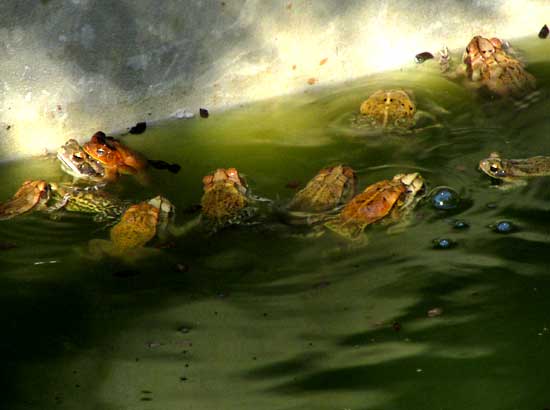
Last week one afternoon our critically hot, dry, late-dry-season weather was interrupted by a much appreciated 3mm shower (1/8th inch), and the next afternoon by a 4mm one. The morning after the second shower, the little cement-lined pond near the new well abounded with mating Gulf Coast Toads, BUFO VALLICEPS, a few of which are seen below:
Some bored-looking orgy participants up close are pictured below:
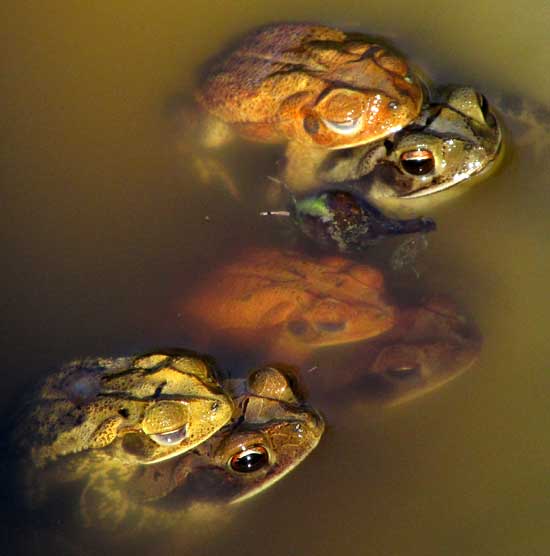
A single mating couple are seen
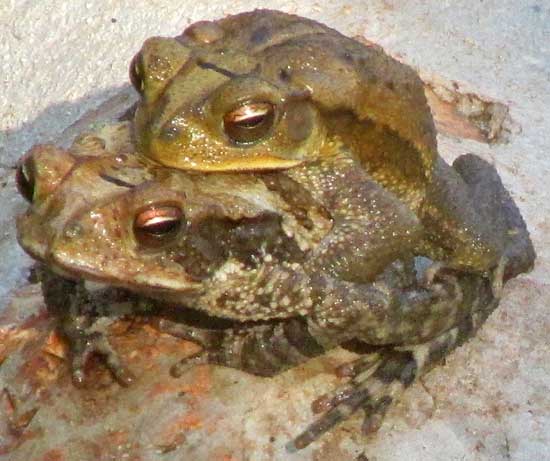
The above pictures show females with smaller males on their backs, in the frog/toad reproduction process known as "amplexus." Male frogs and toads don't bear penises, so during aplexus the male rides atop the female grasping her trunk with his forelimbs, and when the female eventually discharges eggs, usually into the water, the male sheds his sperm over the eggs. It's "external fertilization."
Besides males in this species being considerably smaller than females, you might also notice the striking color differences not only between males and females but also between individuals of the same sex. In the past this has caused confusion with identification, so I'm glad to see at last just how much variation there is.
from the May 7, 2017 Newsletter issued from Rancho Regenesis in the woods ±4kms west of Ek Balam Ruins; elevation ~40m (~130 ft), N20.876°, W88.170°; north-central Yucatán, MÉXICO
ORGY UPDATE #1
Last week we looked at an orgy of Gulf Coast Toads in one of our ponds, and prophesied that too many tadpoles and then too many toads would result. This week on a visit to the same pond no toads were encountered but the pond's edges were busy with thousands of little black tadpoles, a tiny portion of which is shown below:
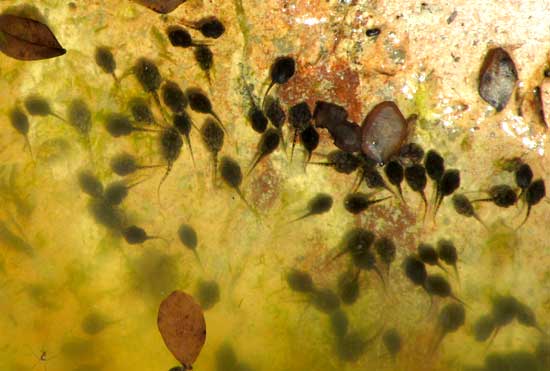
So far the tadpoles don't seem to be suffering from overpopulation, except for the mid-day low oxygen content of their water, which they can deal with by clustering at the pond's edge and gulping air, as shown in the photo. Also, young tadpoles are vegetarian, and you can see that the pond's water and the white cement floor are greenish with algae, which the tadpoles eat.
However, as tadpoles grow, their bodies slowly metamorphose toward carnivorousness, so this story is not yet at its end.
from the May 14, 2017 Newsletter issued from Rancho Regenesis in the woods ±4kms west of Ek Balam Ruins; elevation ~40m (~130 ft), N20.876°, W88.170°; north-central Yucatán, MÉXICO
ORGY UPDATE #2
This week the first tadpoles developed legs, as shown below:
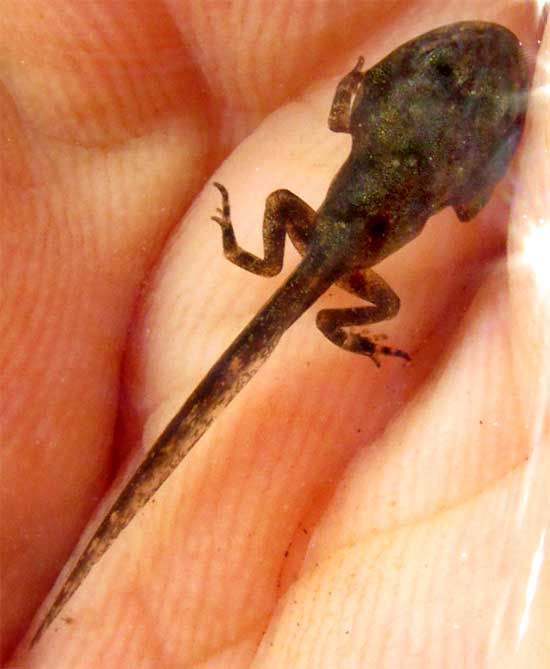
This and other legged tadpoles in the pond are actually a little smaller than their legless siblings. You can judge how small this one is by the lines in the palm of my hand. I'm guessing that as the tadpoles' bodies metamorphose, part of their flesh is broken down to provide building materials for the legs and other new parts. This tadpole's legs already were functional enough for it to crawl across the surface of my palm, though in the pond it remained in the water instead of climbing onto a log. It's interesting that even at this very early stage of development the toad's legs and feet already show the alternating dark and pale bands that will ornament the adult.
So far numbers don't seem to be decreasing. As the tadpoles metamorphose from being vegetarian to carnivores, I would guess that they may be feeding more and more on aquatic invertebrates such as copepods and mosquito larvae.
from the May 21, 2017 Newsletter issued from Rancho Regenesis in the woods ±4kms west of Ek Balam Ruins; elevation ~40m (~130 ft), N20.876°, W88.170°; north-central Yucatán, MÉXICO
ORGY UPDATE #3
Last week the first tadpoles began appearing with tiny, spindly legs. This week, those individuals are more toad than tadpole, their legs much enlarged as their tails seem to shrink, and already they're spending considerable time outside the water, like the one shown below:
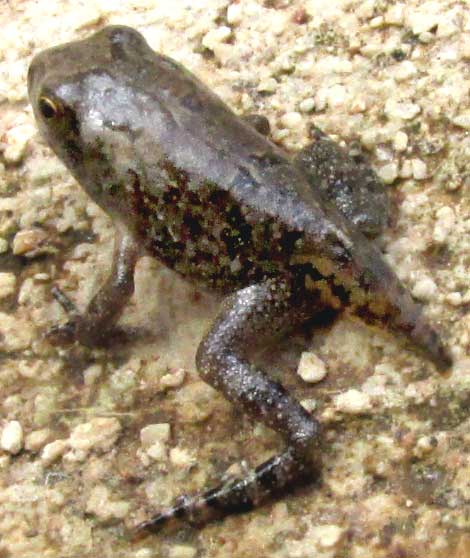
Probably this is the last "Too Many Toads" update because for irrigation the pond has been mostly drained and refilled, the vast majority of tadpoles seen earlier being poured with the water onto crops. Also, last weekend the dry season ended with 67mm of rainfall (2.6inches), after which another orgy took place, this time with other species besides Gulf Coast Toads participating.
This second orgy may have been even more rambunctious than the first, the number of eggs being produced really impressive, as shown below:
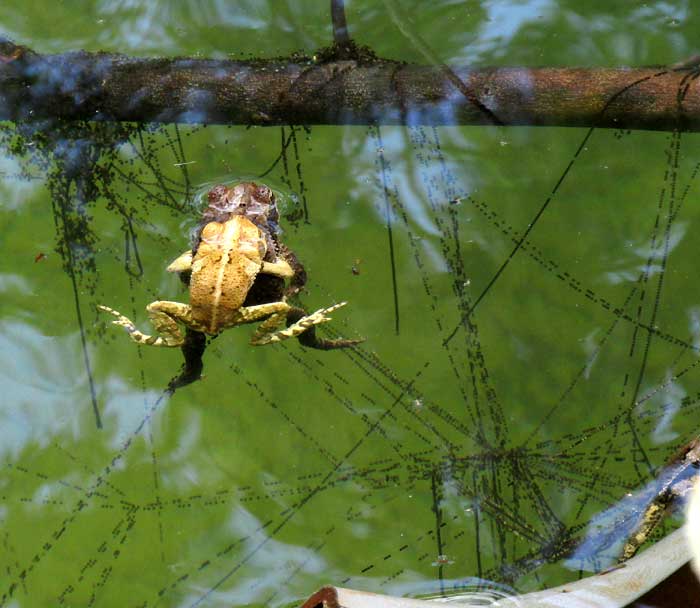
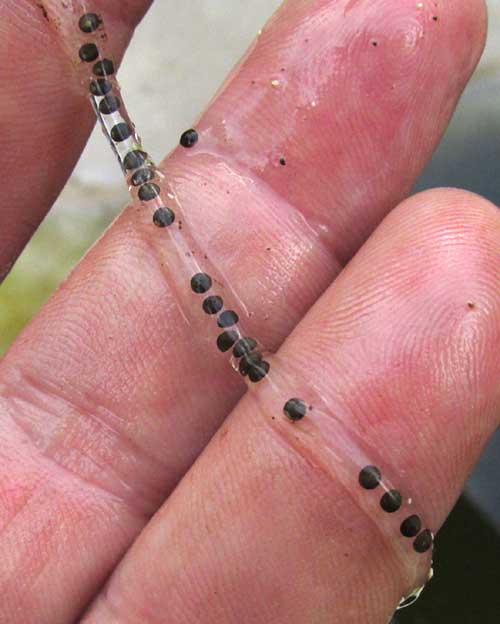
In that picture, the slender strands of black, beadlike items are gelatinous strings of toad eggs. A close-up showing individual eggs embedded in gelatin is shown below:
from the March 18, 2018 Newsletter issued from Rancho Regenesis in the woods ±4kms west of Ek Balam Ruins; elevation ~40m (~130 ft), N20.876°, W88.170°; north-central Yucatán, MÉXICO
GULF COAST TOADS AFTER A SURPRISE RAIN
Here March often passes without a single rain, but last Monday we received 48mm, nearly two inches, and Tuesday morning the toads were calling. So far, we've documented Gulf Coast Toads doing all sorts of things, but Tuesday morning I got some new shots enlarging on our feeling for this species.
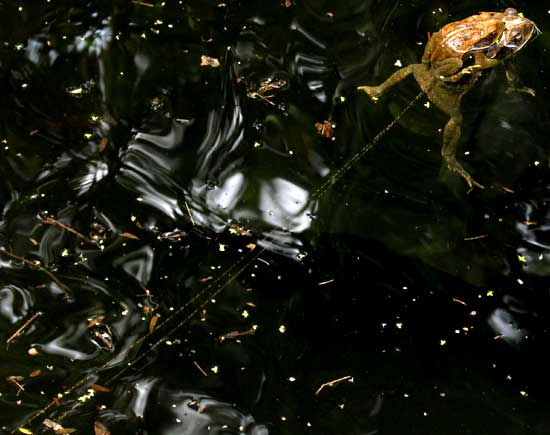
For example, we've seen how these mating toads produce long, slender, beadlike, gelatinous strings of eggs. Tuesday I saw the strings issuing from the female's body, with the male atop her, presumably blessing the emerging eggs with clouds of sperm during the toad-sex process known as amplexus. That's shown below:
Also, I got to see a male calling, his vocal pouch ballooning below his broad mouth, shown below:
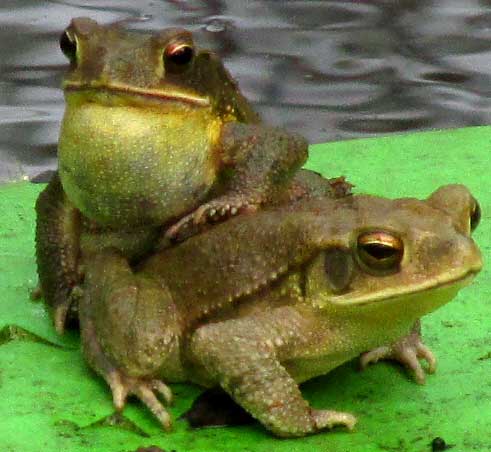
Moments before that picture was taken, the toad shown on the bottom was atop the male now atop him. They're both males and both were so psyched up for amplexus that they were mounting anything that moved. One even briefly mounted a surfacing mud turtle's head.
from the July 11, 2010 Newsletter issued from Hacienda Chichen Resort beside Chichén Itzá Ruins, central Yucatán, MÉXICO
TOAD AMONG THE BANANAS
During the dry season, all around the Hacienda grounds, we scatter black plastic troughs filled with water for wild animals. Now that the rains have begun they're not really needed, but nobody has bothered to take them up. The other day as I passed such a tray in the banana plantation something was rippling its water so I took a look. You can see the ripple-maker below:
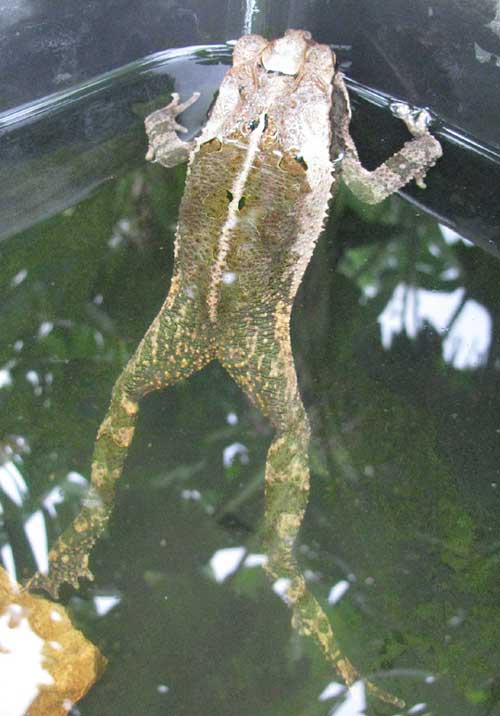
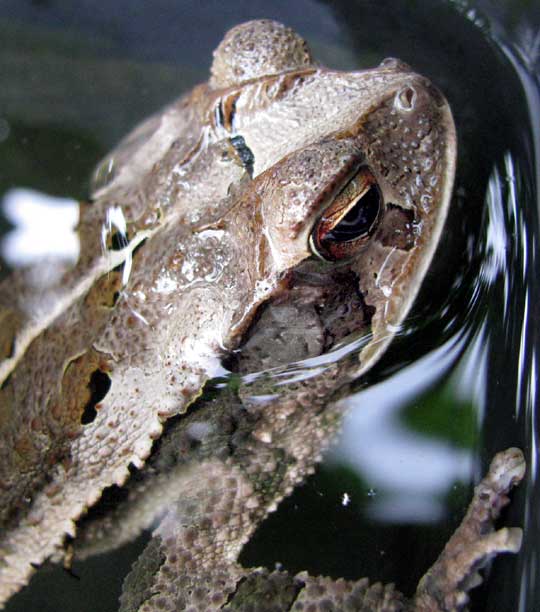
That's a Gulf Coast Toad, BUFO VALLICEPS, about the size of a smallish Bullfrog. Jonathan Campbell in Amphibians and Reptiles of Northern Guatemala, the Yucatán, and Belize reports that this species' dorsal (back) coloration is highly variable, and may be orangish, tan, yellowish tan, reddish brown, brown, or pale gray. I think that our frog's apparent greenness is mostly caused by algae in the water. The only other large toad it could be confused with here is the much larger Giant or Cane Toad, whose parotoid glands -- tumorlike bulges behind the eyes -- are proportionally much larger. You can see our Gulf Coast Toad's head below:
I hear lots of frogs and toads calling at night, especially after rains. Back during the dry season it was easy to believe that we had no frogs around here, but now what a pleasure to hear all their different calls filtering between the hut's pole walls as night comes on.
from the August 28, 2011 Newsletter issued from Mayan Beach Garden Inn 20 kms north of Mahahual; Caribbean coastal beach and mangroves, ~N18.89°, ~W87.64°; Quintana Roo state, MÉXICO At dawn, beneath the light that had burned all night outside the dining room, a toad sat waiting for moths disoriented by the light to crash to the ground beaten and exhausted. It was the classic spot for toads wanting an easy meal. You can see this toad above. That's a Gulf Coast Toad, BUFO VALLICEPS. We've often met them, but they vary in appearance, so it's a good idea to add this image to our various shots.
GULF COAST TOAD BENEATH THE NIGHTLIGHT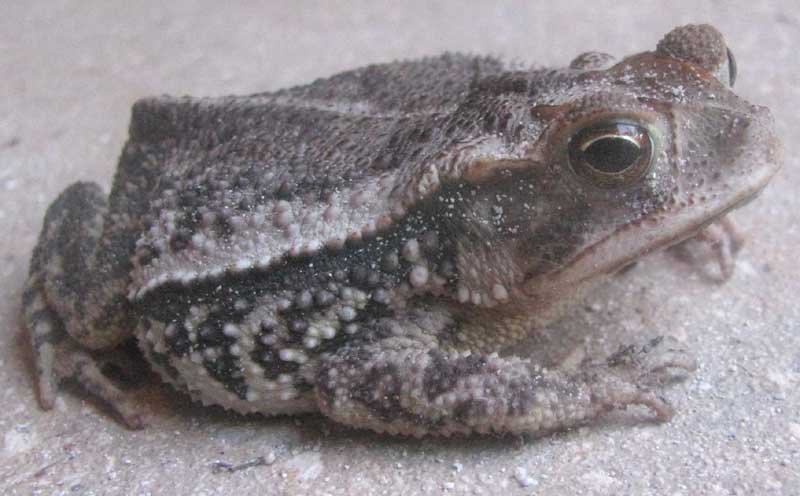
from the July 9, 2017 Newsletter issued from Rancho Regenesis in the woods ±4kms west of Ek Balam Ruins; elevation ~40m (~130 ft), N20.876°, W88.170°; north-central Yucatán, MÉXICO
GULF COAST TOAD PAROTOID GLANDS
Gulf Coast Toads are so variable in coloration that sometimes you just wonder if you really have one. For instance, in this area we also have Giant Toads, which are much larger than Gulf Coast ones, but what if you have an immature Giant?
This week when an unusually yellowish toad turned up beneath the dogs' watering trough I wondered that very thing, and just couldn't be sure it wasn't an immature Giant Toad until I considered the parotoid glands. Parotoid glands are bulging poison glands found behind the eyes. Below, you can see this week's toad's parotoid gland clearly labeled:
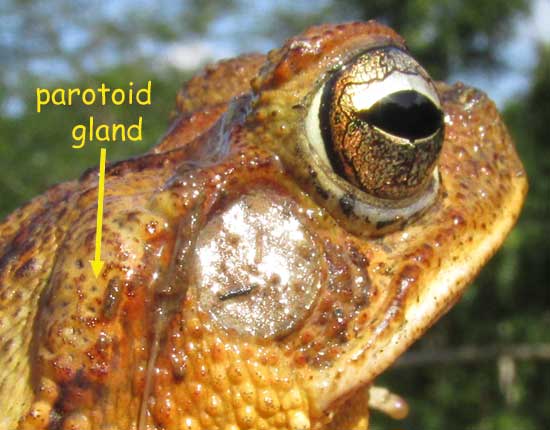
In that picture the yellow arrow points to the center of a bulge that looks like a kidney bean inserted beneath the skin; that's the parotoid gland. The shiny, flat, circular thing between the gland and the eye is the toad's eardrum, or "tympanic membrane." Keeping in mind the size of the parotoid gland relative to the rest of the head, and its shape, you might look at our picture of a Giant Toad at www.backyardnature.net/mexnat/canetoad.htm
The Giant Toad's parotoid gland is nearly as large as the head itself, and is much larger at the top than the bottom.
So, yes, the toad beneath the dogs' watering trough, despite its unusual yellowness, was just another Gulf Coast Toad, an abundant species around here, and one that's been calling during the evenings all this week because of regular afternoon rains.