PLANTS | ANIMALS | ECOLOGY | FUNGI | GEOLOGY | GARDENING | TOOLS
MEXICAN PLANTS & ANIMALS HOME

Excerpts from Jim Conrad's
Naturalist Newsletter
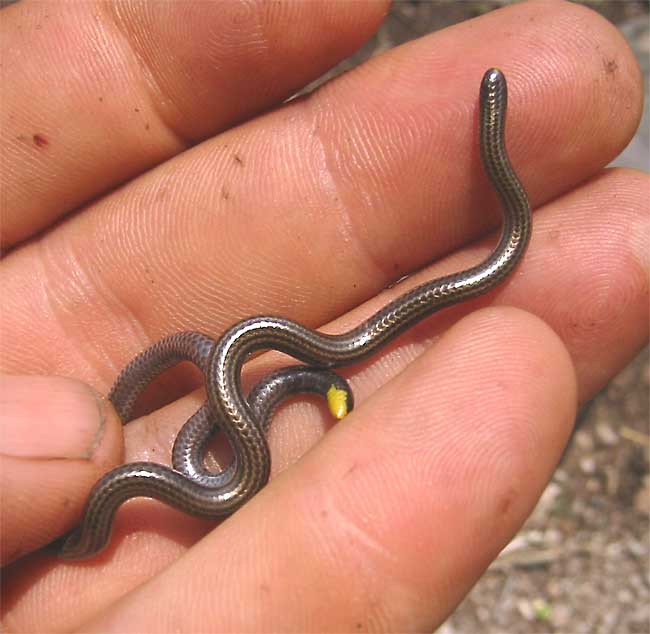
from the May 19, 2008 Newsletter issued from near Vicente Carranza in the hot, arid Central Valley of Mexico's Southernmost State, CHIAPAS
A BLACK BLIND SNAKE
The next day Leuccio came to me with a plastic Coke bottle holding the little critter shown in my hand at the top of this page.
That's a snake. The head is at the top, the yellow-spotted end being the tip of the tail. The yellow spot might cause predators to attack the snake's tail instead of his head.
Leptotyphlops species are non-venomous, blind snakes found throughout North and South America, Africa and southwestern Asia, with about 86 species being recognized. Otherwise our species seems to be little known.
By the way, my impression is that with the arrival of the wet season snakes are becoming easier to see and species other than Speckled Racers are emerging.
from the April 11, 2010 Newsletter issued from Hacienda Chichen Resort beside Chichén Itzá Ruins; limestone bedrock; elevation ~39m (~128ft), N20.675°, W88.569°; central Yucatán state, MÉXICO
THREAD SNAKE THREADING A CRACK
Returning from my banana-buying hike to Pisté I was gathering wool with my unfocused eyes scanning just the next couple of feet before me, my view consisting of cracked asphalt at the highway's very edge. Then somehow a crack didn't seem right. I got on my hands and knees and looked closer and still couldn't figure out what was going on -- not until I poked at the crack with my finger and an incredibly small, dark snake writhed out of his crack. You can see him below:
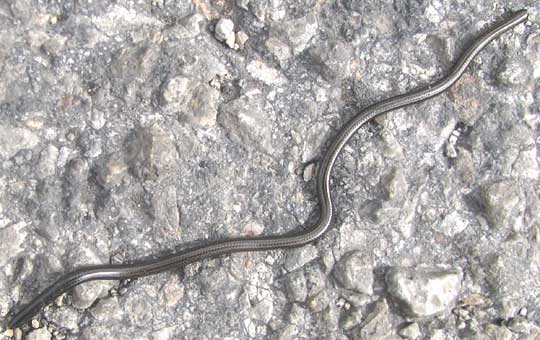
He was about three inches long (7 cm), and when I saw a yellow spot on one of his blunt ends I realized I'd seen such a thing before -- down in Chiapas, and before that here in the Yucatán. Neither time had I been able to figure out for sure what species he was, for even with my handlens details were too tiny to make out. A graduate student in California finally identified the snake as LEPTOTYPHLOPS GOUDOTII (later, genus Epictia, and still later Epictia phenops), in some books called the Goudot's Thread Snake, and in others the Black Worm Snake.
The literature has given me the impression that this species is fairly rare, but having run into it now in several widely separated localities I'm thinking that despite its exotic appearance it must be fairly common. It seems to like disrupted, trashy places, so maybe it's actually becoming more common as time passes.