PLANTS | ANIMALS | ECOLOGY | FUNGI | GEOLOGY | GARDENING | TOOLS
MEXICAN PLANTS & ANIMALS HOME

Adapted from Jim Conrad's online book A Birding Trip through Mexico, This excerpt from "Sierra Mazateca" in northern Oaxaca state
GROOVE-BILLED ANIS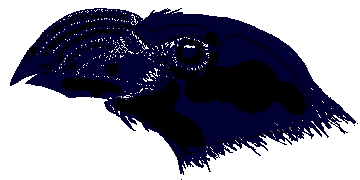 Groove-billed Anis are frequently seen in pastures along the road where they fly low above the ground presenting a somewhat "flattish" silhouette, a bit like a stocky model airplane. Anis are members of the Cuckoo Family. Since that family is famous for having members who slip their eggs into the nests of other species -- they're nest parasites -- you might suspect that anis have non-traditional nesting practices. Anis aren't nest parasites but they do manage to be a bit kinky, for the birds join into social units consisting of one to four monogamous pairs. The unit's eggs are all laid in a single nest and each individual in the unit helps incubate and feed the communal brood. Moreover, it's much more complex than that.
The thing is that the various females lay more eggs than the single communal nest can hold, so they throw one other's eggs out to make room for their own. Young, low-ranked females start laying first and then the older, higher ranked females toss out some of these eggs to make room for their own, which make up most of the clutch. The young females counter by laying more eggs, by prolonging the interval between eggs laid, and by producing a "late egg" as the clutch size nears completion. Since last-laid eggs hatch last, there are natural limits to the lower-ranked females' attempts because the last-born nestling is the smallest and most vulnerable member of the brood.
The main advantage of this communal nesting is thought to be that, since the various females compete among themselves to ensure the success of their own eggs, they increase the overall attention the nest receives, and this reduces risks to the nest, especially that of nocturnal predation.