PLANTS | ANIMALS | ECOLOGY | FUNGI | GEOLOGY | GARDENING | TOOLS
MEXICAN PLANTS & ANIMALS HOME

Excerpts from Jim Conrad's
Naturalist Newsletter
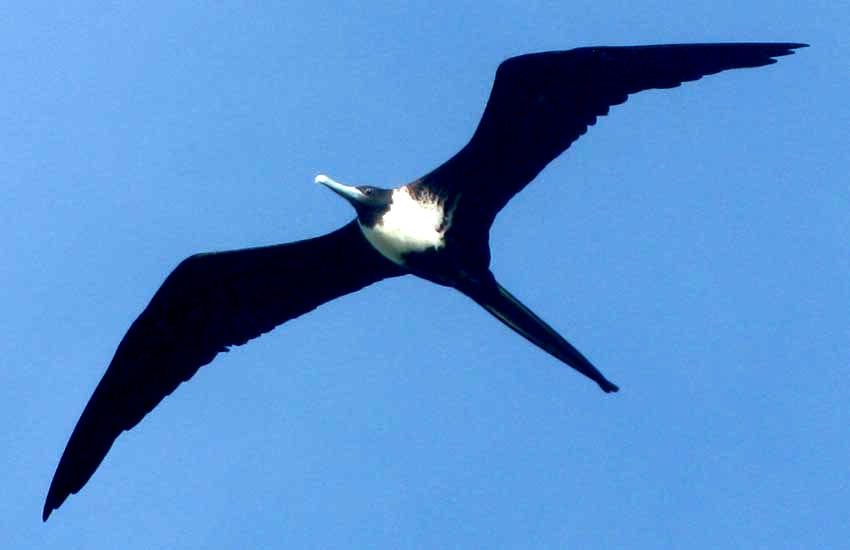
ABOVE: adult female
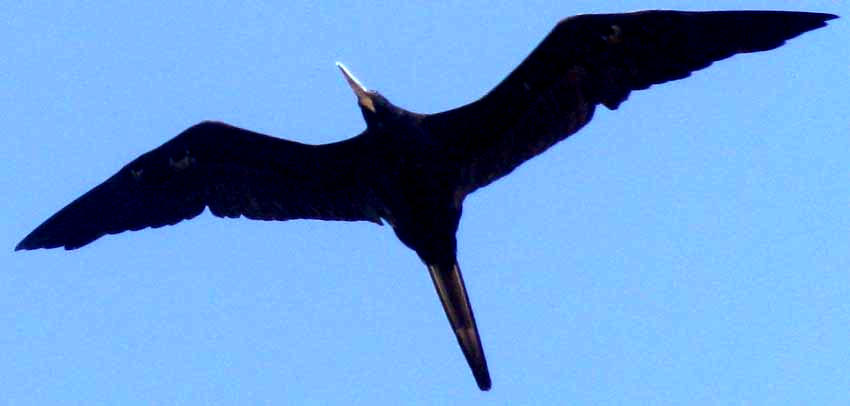
BELOW: adult male
from the July 17, 2011 Newsletter issued from written at Mayan Beach Garden Inn 20 kms north of Mahahual; Caribbean coastal beach and mangroves, ~N18.89°, ~W87.64°; Quintana Roo state, MÉXICO
IMMATURE & FEMALE FRAGATEBIRDS
 Now that migrant birds who nest up North are gone, the most conspicuous bird along the beach is the Magnificent Frigatebird. Nearly always you can see one to several sailing along the beach or hovering over the water's edge. With wingspreads of up to 7-½ feet (2.3m), these are impressive presences! Of all birds on Earth, frigatebirds have the lightest body weight (2-3 lbs, 1.1kg) in relation to their wing area.
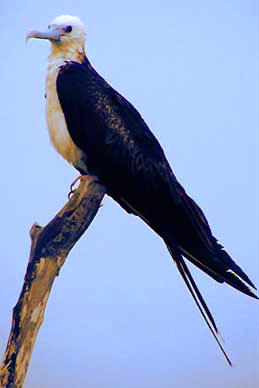
In field guides usually mature males are illustrated inflating their female-attracting, red throat pouches. When visitors see immature and female birds without such pouches, sometimes they're not sure what they're seeing. Nowadays we have many more immatures and females than mature males. A mature female with her black head and broad, white chest band is shown at the top of this page. A mature, completely black-feathered male is below her.
A picture of an immature with a fully white head is shown below.
from the January 18, 2015 Newsletter issued from Río Lagartos, on the Yucatan Peninsula's northern coast (~N21.60°, ~W88.16°), Yucatán state, MÉXICO
FRIGATEBIRDS DRYING THEIR WINGS
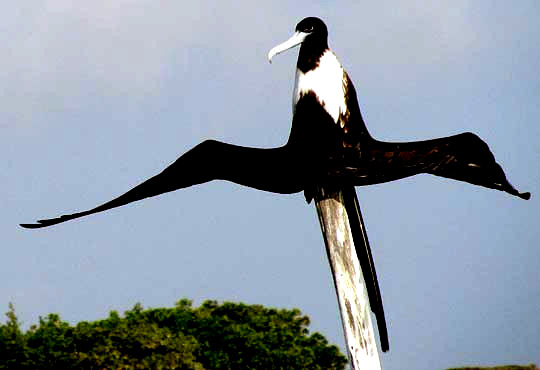
On a sun-filled morning, Magnificent Frigatebirds adorned themselves on a snag, preening and spreading their long, slender wings against the sun, as shown below:
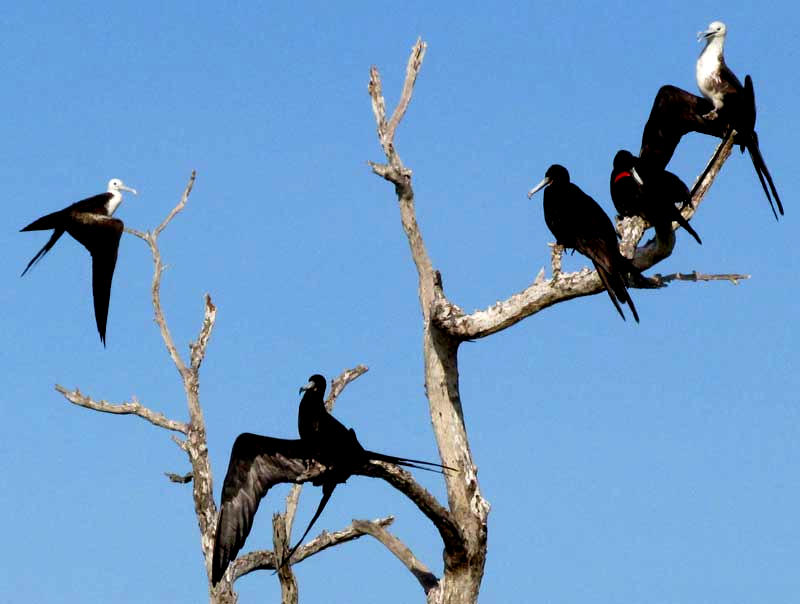
Those with white heads and chests are immatures, while the ones with all-black heads and chests are males. Adult females have black heads and throats but white chests.
from the February 6, 2005 Newsletter issued from Hacienda San Juan near Telchac Pueblo, northwestern Yucatán, México
MAGNIFICENT FRAGATEBIRD
Once while Karen was hunched over a pile of shells I called to her to look into the sky above her. When she did, the look on her face was classic, the transfixed expression of a person seeing something both eerie and beautiful. It was a Magnificent Frigatebird almost stationary some 30 feet above her, hanging like a kite in the stiff breeze. In the midday glare Karen saw a silhouette with narrow, bent wings 90 inches across, and a long, deeply forked tail.
Magnificent Frigatebirds are "kleptoparasites" -- they sometimes chase down birds of other species and steal their food. This may even amount to forcing victims to regurgitate food already eaten.
One study conducted in Mexico found that Magnificent Frigatebird kleptoparasitism is often a two-step affair. A frigatebird's first attack on a potential victim can often be interpreted as "sizing up the victim." If the victim turns out to be a healthy, strong flier, the frigatebird typically breaks off the chase. But if the victim seems vulnerable, a long chase may take place, ending with an exchange of gut content.
But Karen wasn't concerned with any of that, just with the eerie and beautiful silhouette suspended above her, and I do believe that I saw in Karen's face a glimmer of primal recognition of the fact that the world is more surreal and full of the unexpected than on a sunny day we'd ever like to admit.
from the August 31, 2007 Newsletter issued from Hacienda San Juan near Telchac Pueblo, northwestern Yucatán, México
HURRICANE BIRDS
Across the road from Hacienda San Juan, for as far as you can see, the scrub is a real mess. People in town have chopped it to pieces gathering firewood, then Hurricane Isadora tore the land up, and finally last year it was all burned. Now black, barkless skeletons of low-growing trees are heavily festooned with dark green morning glory vines and weedy members of the Cucumber Family. Beneath the stormy sky and with the wind howling through the open remains of the scrub forest, it's as ragged and forlorn feeling as a Charles Dickens cemetery on a dark winter day.
I was deep inside the desolation when a rain shower came sweeping in from the north. I was carrying binoculars and books I didn't want to get wet so I hunkered on the leeward side of an ancient stone fence typical of this area, constructed of rough, white limestone rocks back when such fences were built by men who placed each rock exactly as it was supposed to be, and who considered themselves artisans.
The wind whistled over the wall, morning glory vines lashed against the roiling sky and vertical white sheets of rain swept all around. A certain shoulder-high, rank-smelling wild mint grew there abundantly so with the wind beating all the plants so mercilessly the whole landscape smelled of rain, mud and bitter mint.
You'd think that this would not have been a good time for birding, yet right there behind the stone fence with the rain rampaging around me I looked up and saw a species new for my "Inland Northern Yucatan Bird List." Like huge, black bats with the skin burnt off their wing bones, flying above me were seven Magnificent Frigatebirds, FREGATA MAGNIFICENS, with scissorlike tails and bent wings spreading up to 90 inches across -- 7-½ feet! Of all birds on Earth, frigatebirds have the lightest body weight (2-3 lbs.) in relation to their wing area.
Magnificent Frigatebirds are common along the Gulf of Mexico shore ten miles to the north, but all last winter I never saw them this far inland. Surely they had been driven inland by the wind. They eat fish, jellyfish and crustaceans picked from at or near the sea surface, and rob other seabirds of their catches, but none of that food was here. However, right then the surf to the north was churning so violently that surely there was little chance of a bird snatching a meal. The frigatebirds just sailed aimlessly, their heads always pointing northward, for the rest of the day, and for some days afterward.
Also during the squalls I saw two small, flying ducks trying to hold their own in the wind. They were probably Blue-winged Teal or Lesser Scaup, both overwintering in the marshes just to our north. They were too silhouetted and too far away to be identifiable.
I hope this hurricane has not killed migrating birds running into it after crossing the Gulf of Mexico from the US. Fortunately, most of fall migration is over. In fact, the first bird I saw on my first morning here was a Hooded Warbler, who breeds in eastern North America's deciduous woods, and overwinters here. Yellow-throated Warblers, in summers seen or more likely heard high in pines and sycamores in the eastern US now flit excitedly along the tops of our limestone walls gleaning spiders.
from the August 31, 2007 Newsletter issued from Sierra Gorda Biosphere Reserve, QUERÉTARO, MÉXICO
A HURRICANE-DELIVERED MAGNIFICENT FRAGATEBIRD
When the light began to dim I put the book down and saw circling offshore before me a mature male Magnificent Frigatebird. Magnificent Frigatebirds aren't supposed to occur this far inland. Those of you with me in the Yucatan may recall how Hurricane Wilma blew Magnificent Frigatebirds inland to Hacienda San Juan. Though that was only ten miles south of the beach I thought it was pretty good to see frigatebirds there.
Here in Jalpan we're about 130 miles inland (210 kms) and the Eastern Sierra Madres rise between us and the sea.
Surely Hurricane Dean the previous week had driven the frigatebird here. I've even read that 1988's Hurricane Gilbert blew frigatebirds north into the US as far as Iowa. Still, this frigatebird before me over Jalpan Reservoir was something very special, almost apparitional, just the right thing to see in the magical realism mind the angel story had put me in.
Imagine, on those 7.5-ft.-across wings losing yourself in a stormy night's winds, but this night unlike any you've ever experienced, being carried not only far inland but skywards, all your senses rebelling as you rise and rise up the altiplano's eastern slope, the acrid, chilling odor of pines and junipers diluting the fish smells you live for, and then the winds suddenly plummet on the leeward side, and die, and you circle in a kind of black hollowness, and at dawn the ocean is gone, and you search and search for water and finally find a silvery spot in a deserty valley without sandy beaches and rolling waves, without crabs and jellyfish, without seagulls to rob of their catches, just this calm shininess of saltless reservoir-water...
Sitting there with the book on my lap I figured the storm-buffeted frigatebird before me must have a hunch what García Márquez's disoriented angel felt that day he awoke on his sordid beach, and I lay another flat rock atop the widow's nest to better keep the rain off.
from the May 17, 2015 Newsletter issued from Río Lagartos, on the Yucatan Peninsula's northern coast (~N21.60°, ~W88.16°), Yucatán state, MÉXICO
FRIGATEBIRD BASKING
On flamingo-watching boat trips up the estuary it's normal to see cormorants, Anhingas and other birds facing the sun while spreading their wings. None of these sun baskers looks weirder than the Magnificent Frigatebirds, who seem somehow to shift their long, slender, bent wings to the back of their bodies, giving them an eerie, un-birdlike appearance, as shown below: