PLANTS | ANIMALS | ECOLOGY | FUNGI | GEOLOGY | GARDENING | TOOLS
MEXICAN PLANTS & ANIMALS HOME

Excerpts from Jim Conrad's
Naturalist Newsletter
from the April 28, 2008 Newsletter issued from Mexico's Southernmost State, CHIAPAS
FRANGIPANIS
A common but spectacularly flowering small tree gracing many yards and streets in this area is the fragrantly blossomed Frangipani, genus PLUMERIA, flowers shown emerging from thick, fleshy branches shown below:
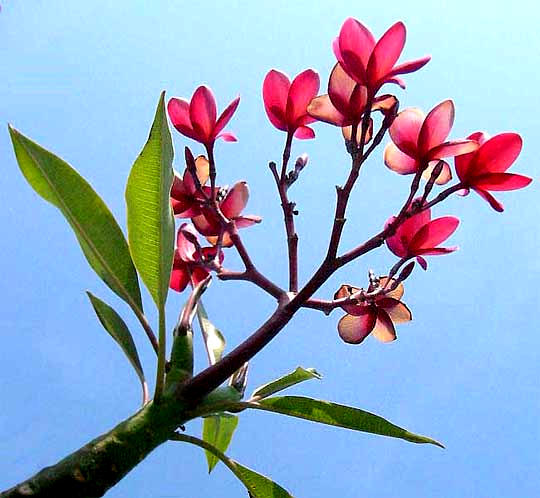
Several frangipani species are found in the wild from Mexico and the West Indies to northern South America. Some species produce several flower-color variations. One variety especially favored in this area bears white flowers with yellow centers.
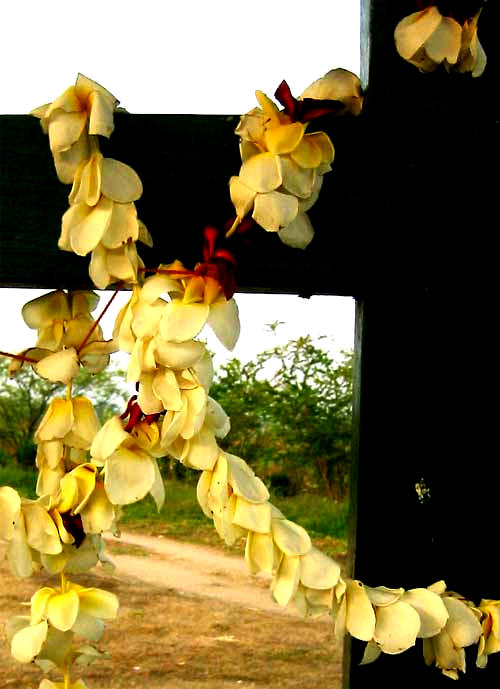
Late this week a celebration began that will end on May 3rd, when believers will climb Yalem Chem Hill above Venustiano Carranza and pray for rain. At 28 de Junio's little church they adorned the blue, wooden cross with garlands of frangipani blossoms of the white-with-yellow-center kind, as shown below:
Frangipanis are members of the Dogbane Family, the Apocynaceae, in which we also find mandevillas, oleanders and periwinkles. Plants in that family typically exude milky sap when wounded, and that's the case with frangipanis which "bleed" white latex copiously. Plantas Medicinales de Mexico reports that the white sap has been used to cure wounds and venereal diseases and to deal with tooth problems, but warns that it makes a "drastic and dangerous purgative."
from the April 28, 2008 Newsletter issued from Mexico's Southernmost State, CHIAPAS
CEREMONIAL USES OF FRANGIPANI FLOWERS
This Friday morning, even before the sun rose above the eastern ridge, when I descended from sleeping in the reserve I found women tending big, bubbling caldrons of boiling water where sweetcorn in the shuck was being boiled, and later headless chickens and turkeys would be dumped, to make plucking their feathers easier. After jogging and fixing breakfast I returned to the church to find the powerfully sweet fragrance of frangipani flowers emanating through the door. Inside I saw the colorful scene you can see below:
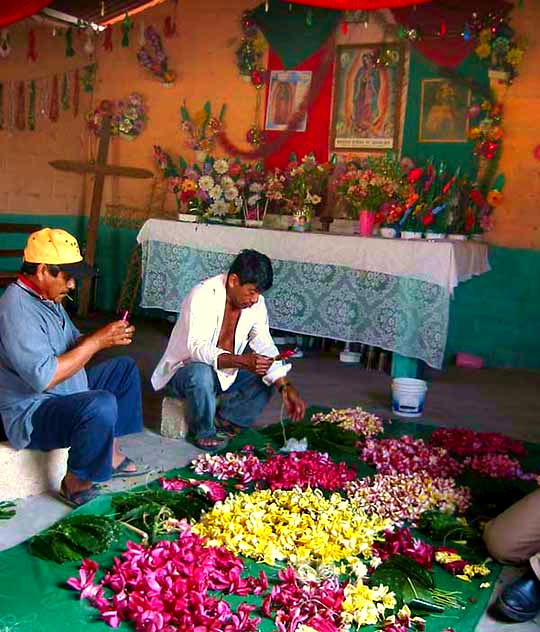
In that picture, below the altar presided over by a large picture of the Virgin of Guadalupe, men sit before piles of Frangipani flowers of various colors very carefully constructing floral "wheels" that later will adorn the Cross. The men had picked the flowers from trees around their "city homes" in Venustiano Carranza.
A partially finished "wheel" can be seen below:
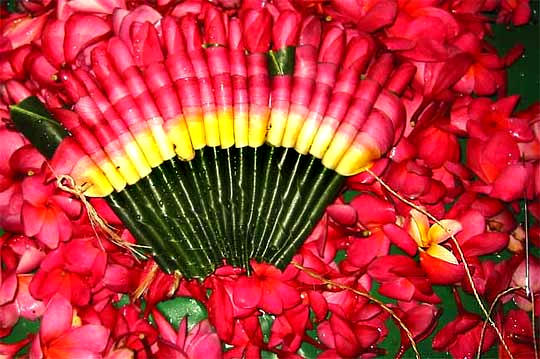
Each ray of the "wheel" consists of several Frangipani flowers rolled a certain way, and chosen for the color needed in that particular spot. Several times I saw all work stop as the men discussed which flower of the thousands before them was best for the particular section of the particular ray of the particular "wheel" someone happened to be working on. All day the men worked as if time were nothing. All important was that every detail of every piece of work be done as perfectly as possible.
While men worked with the flowers, outside women prepared a genuine feast for later. I thought of offering my help with the flowers but seeing how the division of labor was so strict I feared my offer might be out of place. I was wrong. Don Andrés walked up to me, handed me a big needle and thread, a bucketful of Frangipani flowers, and showed me where I could sit stringing floral ropes. I took my place and an observer managed to get a photo of that, shown below.
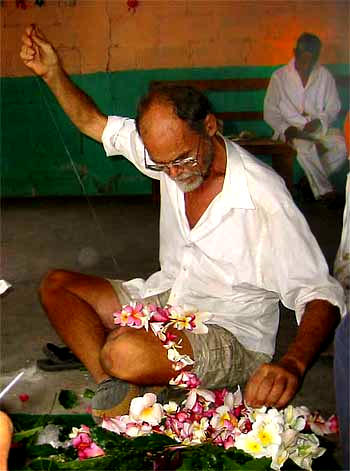
In that photo, behind me an old man sits twisting seasoned fiber extracted from local agave plants into twine used to hold the "wheels" and other things together.
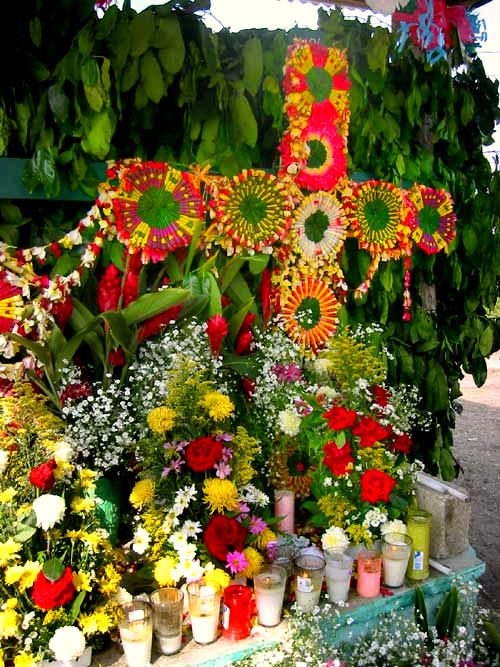
You can see the finished altar, finished "wheels" and ropes of Frangipani flowers adorning their Cross, below:
from the February 21, 2010 Newsletter issued from Hacienda Chichen Resort beside Chichén Itzá Ruins, central Yucatán, MÉXICO
NAZI FRANGIPANIS
We have Frangipanis here, too, and sometimes they're as beautiful as the ones we had in Chiapas. However, this being the dry season and Frangipani being of those trees that loses its leaves in the dry season, our trees now present a completely different side of their character as the did in Chiapas. You can see how below:
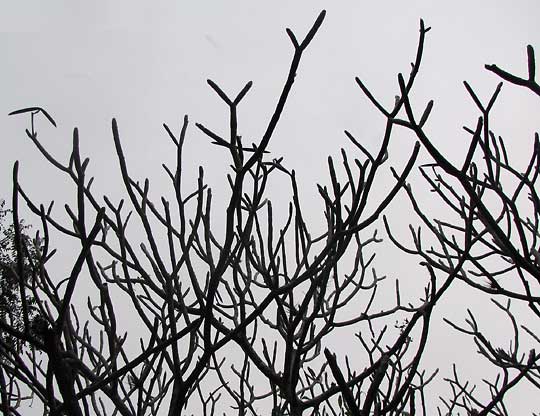
Those are Frangipani's thick, stubby, semi-fleshy, leafless branches poking toward a dull, overcast sky this week. Note the branches' curiously bifurcating manner of branching, where a branch sprouts into a Y, then each arm of the Y sprouts another Y, and then those arms sprout other Ys, on and on. Note the T- shaped fruit emerging from a Y's angle at the far top left. Leafless, the tree seems obsessed with artless regimentation. Looking up through the branches I get the same feeling I once had visiting a museum in Germany featuring "Nazi-sanctioned art."
It's good to know that when the rains return once again a soft gorgeousness will drape these hard- disciplined branches.
from the February 27, 2011 Newsletter issued from Hacienda Chichen Resort beside Chichén Itzá Ruins, central Yucatán, MÉXICO
WHITE-WING DOVE EATING FRANGIPANI SEEDS
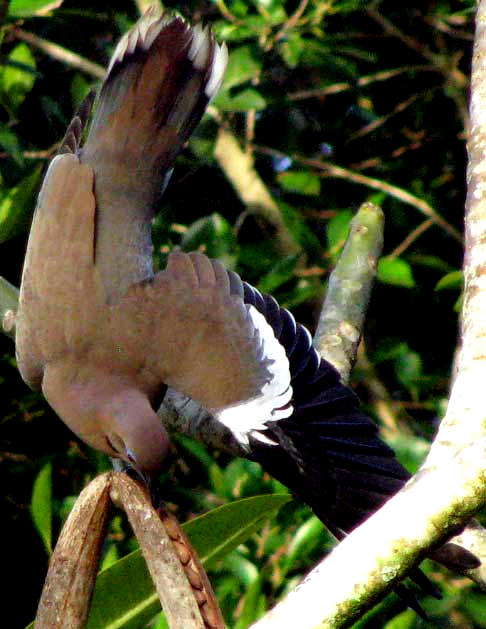
Some bird species are persnickety, maybe eating just a narrow range of foods, or foraging at a certain level in trees. White-winged Doves are more generalist and opportunistic. You see them foraging on the ground, eating fruits in trees and even hanging out in Pisté's garbage dump. A picture showing one tugging a seed from a leathery, splitting Frangipani fruit is shown below.
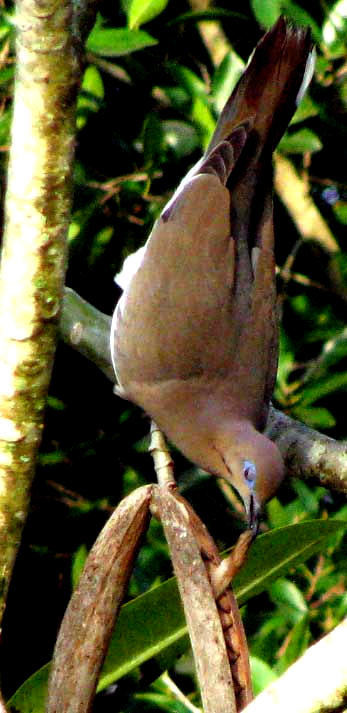
Something interesting about that picture is that getting the seed out was tricky for the bird. Before the successful extraction documented in the picture, several times the bird had lost his balance and tipped from his perch. You can see the very moment of such a crash, a wing vainly groping for support where there is none at the bottom of this page
Besides being generalist and opportunistic, my impression is that White-winged Doves are especially resolute about what they set out to do.
from the February 27, 2011 Newsletter issued from Hacienda Chichen Resort beside Chichén Itzá Ruins, central Yucatán, MÉXICO
FRANGIPANI FRUITS OPENING
You can see some Frangipani seeds and a split pod below:
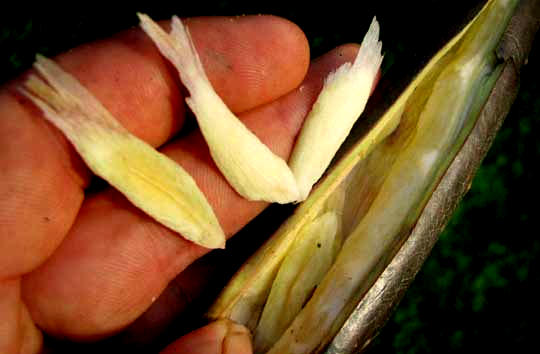
That term "pod" is a rather general one. A pod is just a dry fruit that splits to release seeds. The pod can have one or many splits. A more technical term for the Frangipani's brown, leathery fruit is "follicle," which to a botanist refers to a dry fruit that splits only on the fruit's front suture, and is derived from a simple pistil, the pistil consisting of a flower's ovary, necklike style, and pollen-receiving stigma.
The whitish seeds are winged at their bases, the papery wings helping with wind dispersal of the seeds.