PLANTS | ANIMALS | ECOLOGY | FUNGI | GEOLOGY | GARDENING | TOOLS
MEXICAN PLANTS & ANIMALS HOME

Adapted from Jim Conrad's Naturalist Newsletter of October 8, 2007, an on-the-road edition with notes made during a visit to Nevado de Toluca Volcano, México State, MÉXICO
THREE VARIATIONS ON AN ERYNGO THEME
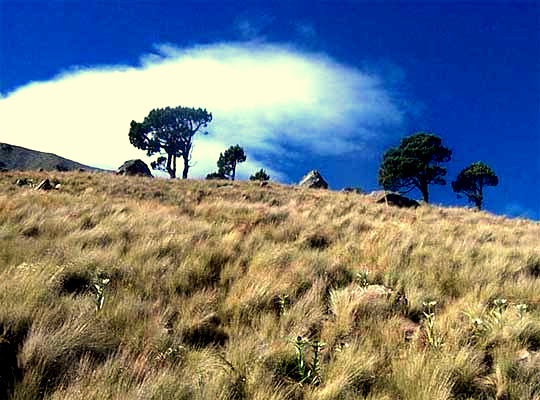
In the picture above you can see a few scattered thistlelike plants scattered among the clumpgrasses. Those plants can be called eryngoes, which is a general term for species of the genus Eryngium, which is placed in the Parsley Family, the Umbelliferae. Over 200 eryngo species are known, and they're most abundant in the Mediterranean area.
You can see a close-up of three fruiting heads the size of my hand with outstretched fingers, on knee-high plants growing beside my tent at the second camp, the one above the tree line and with pink boulders, below.
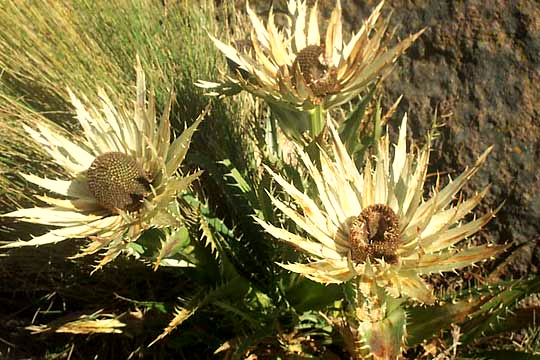
In Oscar Sanchez Sanchez's La Flora del Valle de Mexico that plant keys out to ERYNGIUM MONOCEPHALUM. The Latin name translates to "One-headed Eryngo." Eryngium monocephalum displays the basic features that make a plant an eryngo.
First, many tiny flowers are clustered into oval heads subtended by conspicuous "involucral bracts." The whole assemblage thus looks like a single blossom, similar to how it is in the Composite Family (sunflowers and daisies) and among teasels.
Also, eryngoes are nearly always spiny and with rigid leaves almost like those of yuccas and agaves.
So, those features constitute the basic eryngo theme: the head of flowers, the spininess, and the stiff leaves.
The "One-headed Eryngo" was abundant above the tree line. Below the tree line the one-headed species fairly disappeared, but in disturbed soil, especially in grassy areas, a dwarf eryngo species appeared, entire plants usually being no larger than the One-headed's single head. You can see the dwarf species below:
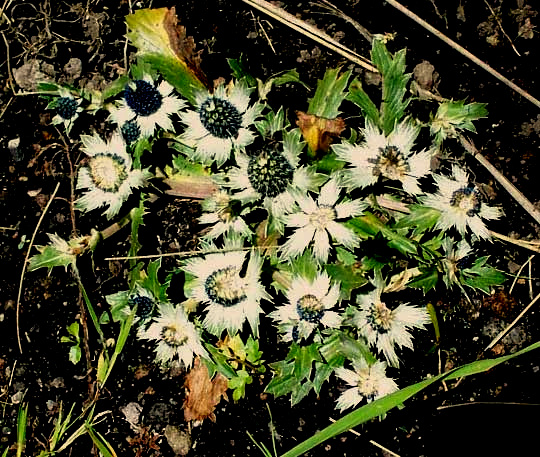
Despite the huge difference in sizes, note that the dwarf species still possesses all the basic eryngo features: Tiny flowers in heads, spininess, and stiff leaves. The dwarf species keys out to ERYNGIUM CARLINAE.
On my last night in the park I camped near the entrance road, so low in elevation that oaks appeared among the pines. There in a much lusher, wildflower-rich vegetation the two above eryngoes were absent but very common was the robust, head-high species you can see below:
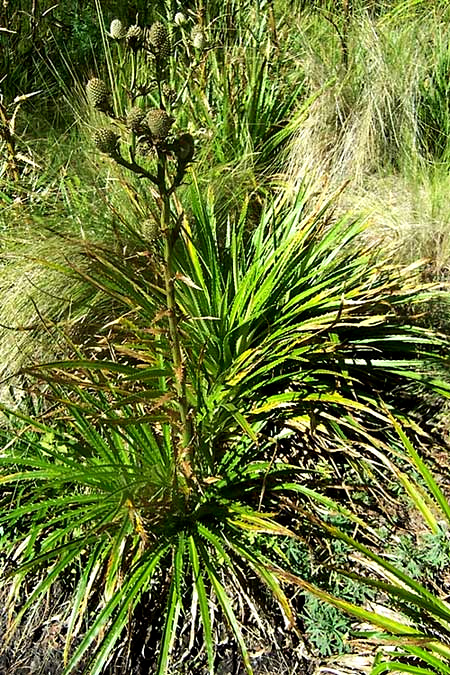
In this species, which I key out to ERYNGIUM COLUMNARE, the involucral bracts are very small relative to the head size, it's much taller than the other species, and each stem bears several heads. Yet, all the features making it an eryngo are still there, despite the huge outward differences.
For me, this kind of "variation on a theme" is one of the most aesthetically pleasing features of Nature. In some taxonomic groups the variations are almost overwhelming -- think of all the variations on the wood-warbler theme, on the aster and goldenrod themes, on the theme of quartz in all its forms, and of snowflakes and stars, and of all the personalities the human species comes in...
I have often thought that a Bach fugue and a walk in the woods are almost the same thing.