PLANTS | ANIMALS | ECOLOGY | FUNGI | GEOLOGY | GARDENING | TOOLS
MEXICAN PLANTS & ANIMALS HOME

Excerpts from Jim Conrad's
Naturalist Newsletter
from the July 6, 2007 Newsletter issued from Jalpan, Sierra Gorda Biosphere Reserve, Querétaro, MÉXICO
PLANTING CORN
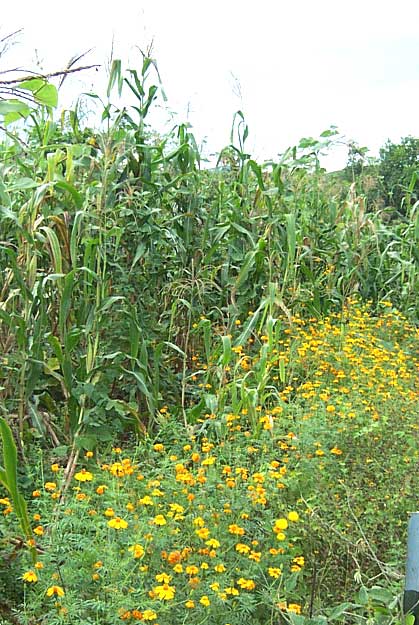
Last Tuesday afternoon I took a walk along the reservoir, partly to catch a cool breeze but also just to admire the towering thunderheads mushrooming up above the mountains all around. When I got to the Reserve's entrance gate I saw that our neighbor was planting corn, what many call maize. Some of you may recall a picture I took of this very cornfield last October showing how marigolds grew beside very tall cornstalks. That picture still resides at www.backyardnature.net/n/06/061023m.jpg.
The two men sowing the seeds Tuesday were hot and tired, and seemed curious about me, so I struck up a conversation, hoping to learn about their corn- planting techniques.
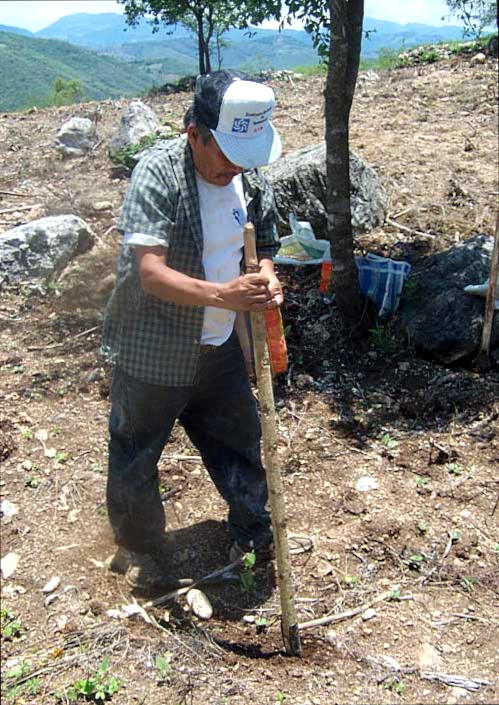
The cornfield had been cleared a couple of months ago, then three or four weeks ago they'd laboriously turned up the soil. I know it was laborious work because the soil here is so stony that all soil-turning has to be done by hand. Last Tuesday each man had a pole with a chisel-like attachment at its end, poking holes into the soil, where the seeds were dropped. You can see the older man making a hole below:
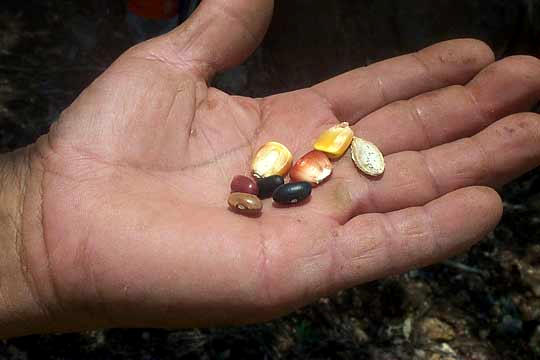
That good man was kind enough to show me the seeds he was planting. He held out his heavily calloused hand and in his palm there lay three grains of variously colored corn, four beans of three colors, and a squash seed. A kind of electric shock flashed through my system, a shock of recognition that I was in the presence of something transcendent, a kind of distillation of knowledge and experience surviving from the dim past. I asked the old man for a picture of that hand and by pure luck I got what may be the prettiest hand-picture I've ever seen. It's below:
I realize that the men were using traditional methods only because they didn't have money for pesticides and fertilizers. Probably with them it's the same way it was with my own family when I was a kid on the Kentucky farm. We couldn't afford a tobacco-setting machine so we planted all our tobacco plants in holes made by wooden hand-pegs whittled from catalpa-tree branches, and we didn't like it when people told us how interesting our pegs were. I suspect that the men Tuesday were even ashamed to be seen planting their corn traditionally instead of having a tractor with a plough come in.
When I walked by the field later I saw something else worth reporting: The men had crumbled marigold blossoms all along the field's edge. The marigolds that last October I'd thought might be native plants gone weedy -- marigolds are native Mexican plants -- had been sown there. Of course marigolds are known for their ability to repel insect pests. Northerners would do well to plant marigold fences around their gardens just as shown in last October's picture.
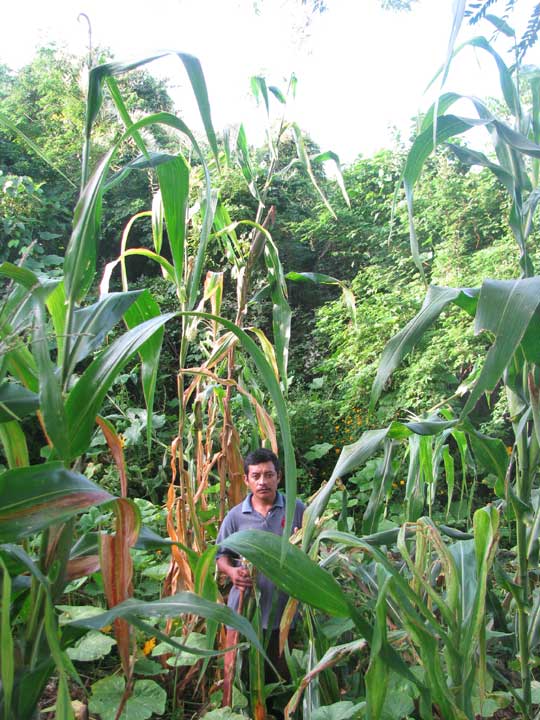
from the October 31, 2010 Newsletter issued from Hacienda Chichen Resort beside Chichén Itzá Ruins, central Yucatán, MÉXICO Above you see Luis standing in his milpa, or traditional cornfield. The picture tells two interesting stories. First, as any North American farmer can tell you, that's mighty tall corn, about twice the height of what's grown up North. Notice the purplish ear of corn on the stalk at the left of Luis, about eight feet high (2.4m). Since Luis is about 5'2", that corn stands over 13 feet tall (4 m). By the way, notice the squash vines with their orange-yellow blossoms carpeting the milpa floor. Elsewhere bean vines twine up the stalks. In the Mexican uplands we've seen that kernels of traditional corn, ZEA MAYS, planted by indigenous people typically is colored -- especially reddish to very dark purple. Luis tells me that in the Yucatán maíz criollo -- the Mayas' traditionally planted corn -- is predominantly yellow or white. The yellow usually is preferred because it contains more oil than the white, he says, and thus is softer and makes better tortillas. The second informative feature of our photo is Luis's face. Usually Luis is a smiley person but here he's just entered the milpa in early morning and his face is registering disgust because during the night a big Coatimundi had ravaged his crop, robbing all his best ears. Now, there's a difference between the names Coati and Coatimundi. Coatis are like Raccoons with long, slender snouts and tails. A Coatimundi is a mature male Coati roaming about looking for females. Regular Coatis are social, slender, rather graceful critters. The hormone-dazed Coatimundi is much larger and plodding, hardly seeming the same species at all. Luis's big Coatimundi the previous night had climbed one cornstalk after another, rode the stalk down until it broke, and then ate just enough of the corn ear to ruin it before heading to the next stalk. In the picture, there's a splintered, broken stalk in front of and to the right of Luis. Coatis have been only part of Luis's animal problem this year. As the corn seedlings were first sprouting Melodious Blackbirds came plucking at the tender shoots. Later Yucatan Jays tore into developing ears, and it seems that when the big Coatimundi isn't in the milpa, Raccoons are. Rabbits have been working hard on the beans, and I haven't had the heart to ask who's been gnawing into his watermelons. All milpas have such animal problems, but here it's especially frustrating for Luis because we don't want him to shoot the critters. He says he understands, but from the look on his face in that picture I'm not sure he does.
LUIS'S TALL, COATI-RAVAGED CORN
from the September 19, 2017 Newsletter issued from Rancho Regenesis in the woods ±4kms west of Ek Balam Ruins; elevation ~40m (~130 ft), N20.876°, W88.170°; north-central Yucatán, MÉXICO
GOOD-SMELLING CORNFIELDS
Nowadays the local cornfields are flowering, and the fields smell good, like tender fresh corn, just sweeter and mellower. The farmers say the fragrance is from the corn ears forming, or maybe the pollen from the male flowers.
Below, you can see a cornstalk's big inflorescence, or tassel, of male flowers:
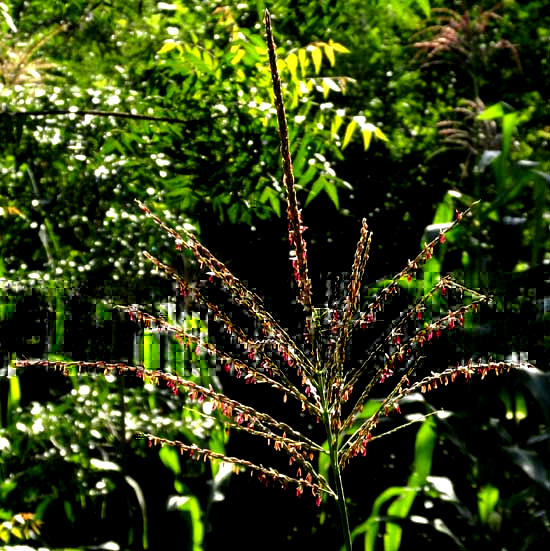
The unisexual male flowers are even handsomer up close, as you can see below:
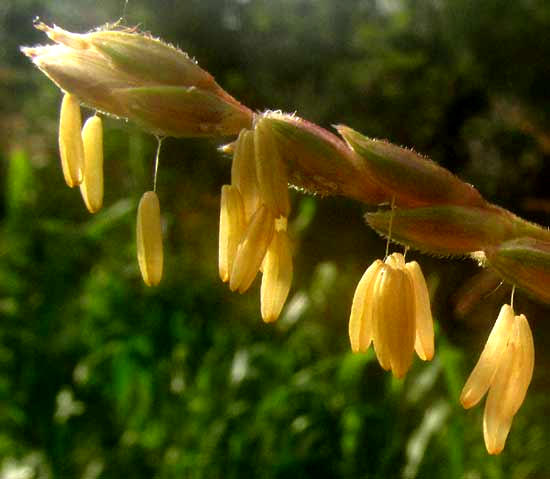
In that picture the yellowish-white items dangling like bananas on threads are the pollen-filled anthers. Each of the threads -- the stamens' filaments -- arise from inside a floret inside a spikelet. If it's time for corn's male flowers to produce pollen, then there must be female flowers nearby to receive the pollen. If you search along the stalk, in the angles along the stem where the long, hairy blades of corn arise, you can see the "silks" arising from the future ear of corn, shown below:
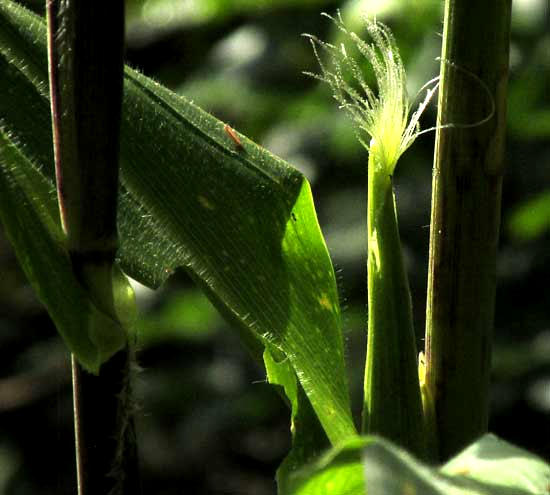
The immature ear of corn is an inflorescence of unisexual female flowers. Each silk is style, a style being a kind of neck between the ovary and the stigma or stigmatic area where pollen is supposed to land. When a pollen grain germinates, it sends a root-like tube with the male sex germ down through the style to the future grain of corn, which is the ovary. For such a microscopic sex germ, that's an incredible journey to the female germ inside the future grain of corn way down below, enshrouded with the future corn husks.
It's all quite beautiful, and it's so excellent that such delicious, homey fragrance fills the air when it's all happening.