PLANTS | ANIMALS | ECOLOGY | FUNGI | GEOLOGY | GARDENING | TOOLS
MEXICAN PLANTS & ANIMALS HOME

Excerpts from Jim Conrad's
Naturalist Newsletter
from the May 12, 2007 Newsletter issued from Sierra Gorda Biosphere Reserve, QUERÉTARO, MÉXICO
"NIGHT-BLOOMING CEREUS" IN FLOWERS
You can see the "Night-blooming Cereus" I'm talking about, growing next to a sidewalk in downtown Jalpan, below:
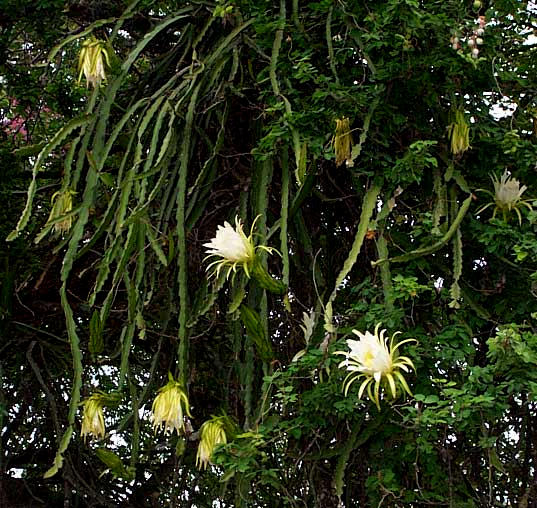
"Night-blooming Cereus" is in quotation marks because several cacti go by that name. Ours is HYLOCEREUS UNDATUS. It's native from Mexico to northern South America, but is naturalized in tropical and subtropical zones worldwide. One reason for the plant's popularity is its foot-long, fragrant, beautiful blossoms -- among the largest in the Cactus Family -- but also it's grown for its edible fruits. You even see the species growing wild in southern Florida, though it's unclear whether those plants are persisting vegetatively, or actually reproducing by seeds.
If you have a "Night-blooming Cereus" that doesn't look like the Hylocereus undatus in my picture, you might compare your plant with the following species, all with huge, white blossoms, and all known as "Night-blooming Cereuses":
from the June 28, 2015 Newsletter issued from Río Lagartos, on the north-central coast of Yucatán, MÉXICO
NIGHT-BLOOMING CEREUS BLOOMING
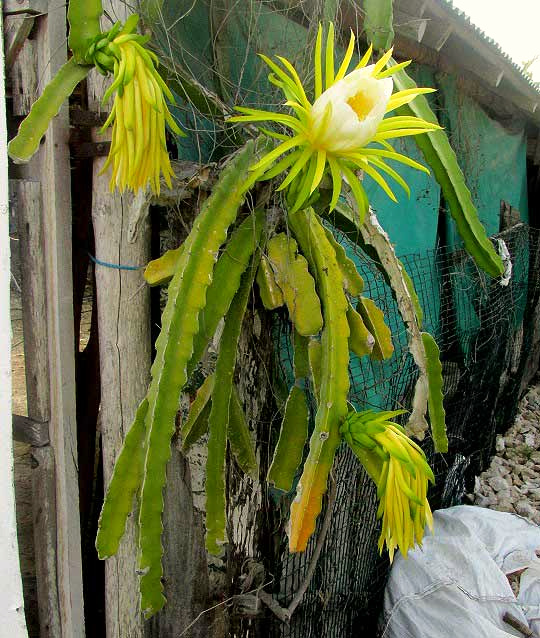
Over the years in several locations we've seen the climbing cactus known as the Night-blooming Cereus, and admired its spectacular flowers and large, edible fruits -- commercially sold as dragonfruits. So far, however, I've been unable to get a close-up look at the flowers when they were open. That situation was rectified this week because in Río Lagartos Night-blooming Cereus cacti commonly grow on people's walls, fences, and up into their yard trees. And this week a fence-dwelling one flowered right across the street from where I'm staying, as shown below:
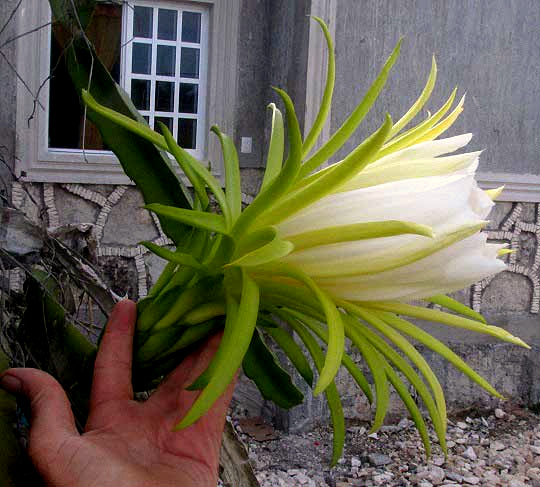
Below, you can get a feeling for the size of that incredible blossom compared to my hand:
A look into the flower, showing very many large stamens inserted on the flower's walls and directed inwards so that any entering bat or oversized moth has to brush against them is shown below:
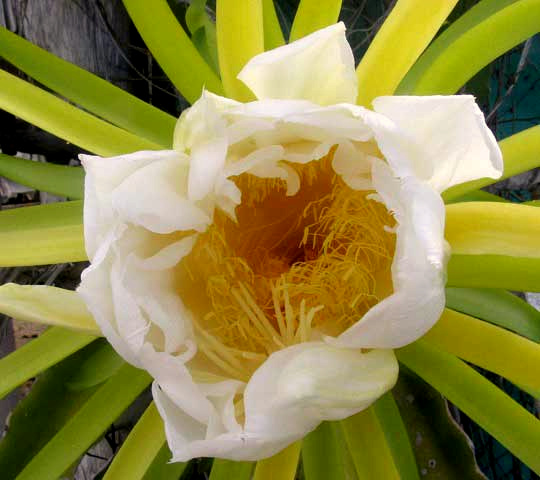
Our Night-blooming Cereus -- other species go by the same English name -- is HYLOCEREUS UNDATUS. Though it's thought to be native to the American tropics, it's true nativity is unknown, having been propagated in so many countries that it's hard to say where it began. In the central Yucatan we've seen it high in trees flowering and fruiting as if it were very much at home, but here along the arid northern coast I find it only cultivated.
from the May 7, 2017 Newsletter issued from Rancho Regenesis in the woods ±4kms west of Ek Balam Ruins; elevation ~40m (~130 ft), N20.876°, W88.170°; north-central Yucatán, MÉXICO
LOOKING INTO A NIGHT-BLOOMING CEREUS FLOWER
We've seen that one spectacular feature of this cactus is its large, beautiful, perfumy flowers, which blossom for only one night. This week I paid special attention to a flower's pollination strategy. A pollinator's view into the flower's throat is shown below:
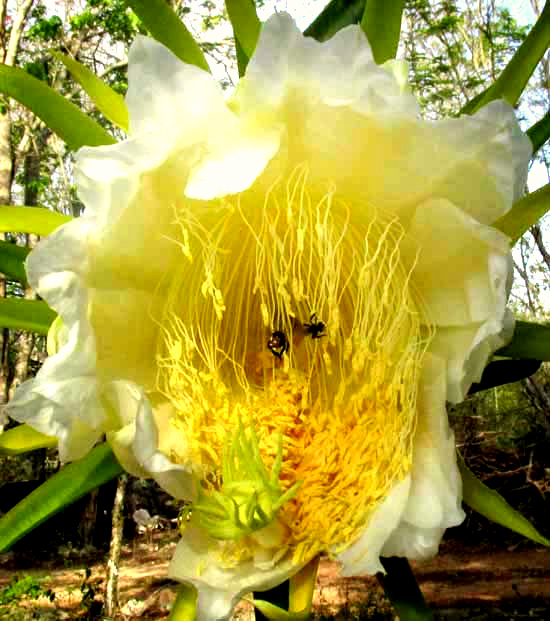
The numerous yellow items looking like tiny frankfurters dangling on slender filaments are the flower's male parts, the stamens. Notice how some hang from the corolla's "ceiling," while most mass on the "floor." A couple of tiny native bees gather pollen from the hanging ones. Are these small bees pollinating the flower? I don't believe they are the blossom's main pollination agent because the flower's greenish stigma extends beyond the stamens where probably the small bees seldom would land, and the stigma is the female part where pollinators are supposed to deposit their pollen. In he picture, the many-lobed stigma looks like an upside-down, greenish octopus emerging from beneath the stamen bunch on the floor. A better view of the stigma shown from the side is provided below:
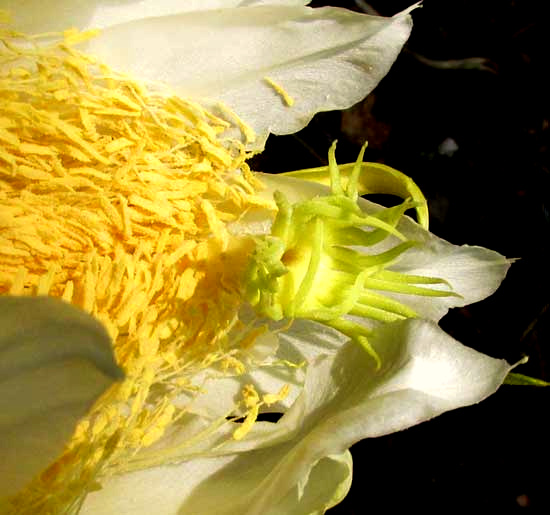
This looks like a classic bat-pollinated flower. Evidence supporting that idea include that the blossom opens at night, is the right size for a bat, and one can visualize how a bat might pollinate this flower. The approaching bat first touches the greenish stigma with its chest, which bears pollen from another flower, so from the first the flower gets pollinated. Then the bat scrambles over the bed of stamens and through the diffuse curtain of dangling stamens, getting doused with pollen grains to be carried elsewhere, and finally the bat receives its reward of nectar at the flower's back.
If this night-blooming blossom were pollinated by nocturnal moths, the corolla would narrow to a tube through which the moth's straw-like proboscis can be inserted, but a bat could never squeeze through.
from the June 13, 2010 Newsletter issued from Hacienda Chichen Resort beside Chichén Itzá Ruins, central Yucatán, MÉXICO
HYLOCEREUS CACTUS BLOOMING & FRUITING
As if it weren't enough to have gloriously blooming Acanthocereus cactuses this week, our
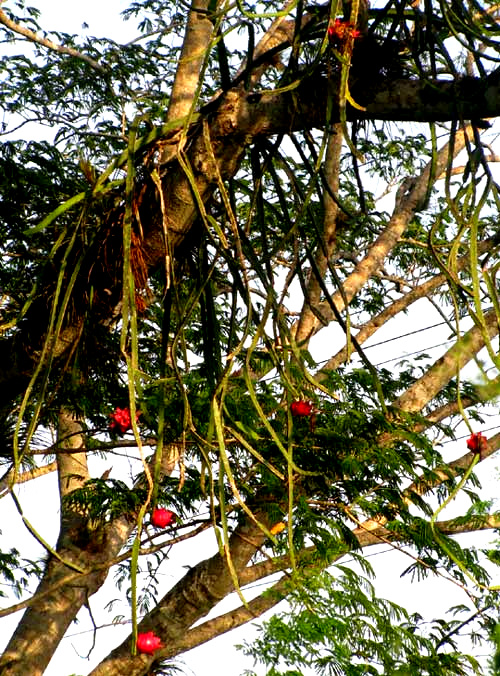
"Night-Blooming Cereus" species that grows epiphytically on trees, HYLOCEREUS UNDATUS, also put on a show, both flowering and fruiting. You can see a nice thicket of them dangling from a big Piich tree, the slender, three- angled stems bearing softball-size, crimson fruits, below:
A close-up of a fruit, rather like a red artichoke, is shown below:
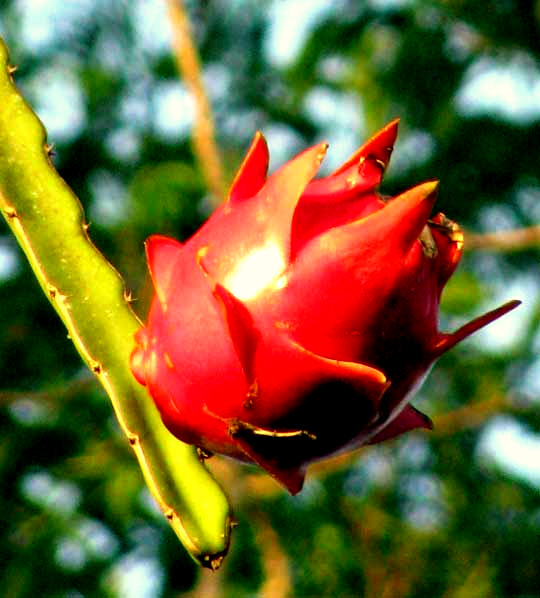
You may have seen fruits like that in supermarkets up north as well as in traditional markets here. In the North they're often marketed as "dragonfruits." Cut open, inside they're mostly a white, sweet pulp in which many small, dark seeds are embedded. Sometimes here in the Yucatan you see dragonfruit plantations. You can see what the fruits look like in supermarkets as well as when they're grown commercially on Wikipedia's page about them, where they're called pitayas, at https://en.wikipedia.org/wiki/Pitaya.
Here I've found numerous flowers of this species about to flower or recently flowered, but so far I've missed them on their "big night."
from the August 21, 2016 Newsletter issued from Hacienda Chichen Resort beside Chichén Itzá Ruins; limestone bedrock; elevation ~39m (~128ft), N20.675°, W88.569°; central Yucatán state, MÉXICO
MATURING PITAYA/ DRAGONFRUITS
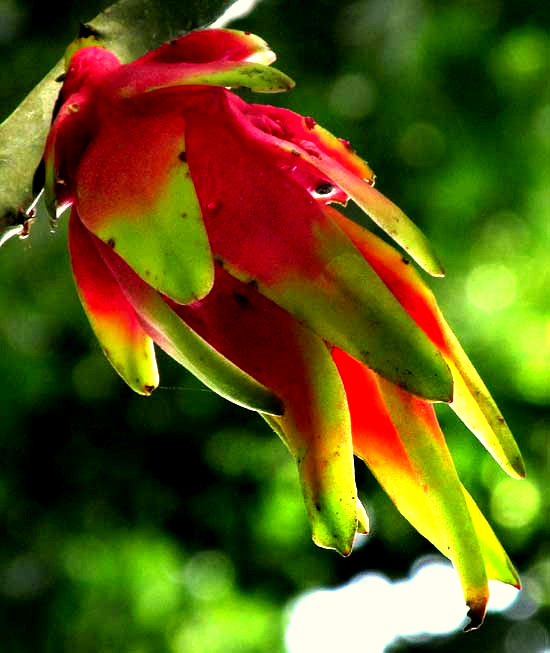
On a slender branch of Night-blooming Cereus cactus dangling from a tall Habim tree near the Hacienda's parking lot, there's an apple-size growth looking a little like an exotic, headless bird bearing gaudily red, greenish-yellow tipped feathers, as shown below:
from the September 6, 2018 Newsletter issued from Rancho Regenesis in the woods ±4kms west of Ek Balam Ruins; elevation ~40m (~130 ft), N~20.876°, W~88.170°; central Yucatán, MÉXICO
DRAGON FRUITS RIPE
This week our wild-growing, tree-top dwelling plants are producing pinkish-red, softball-size fruits, as shown below:
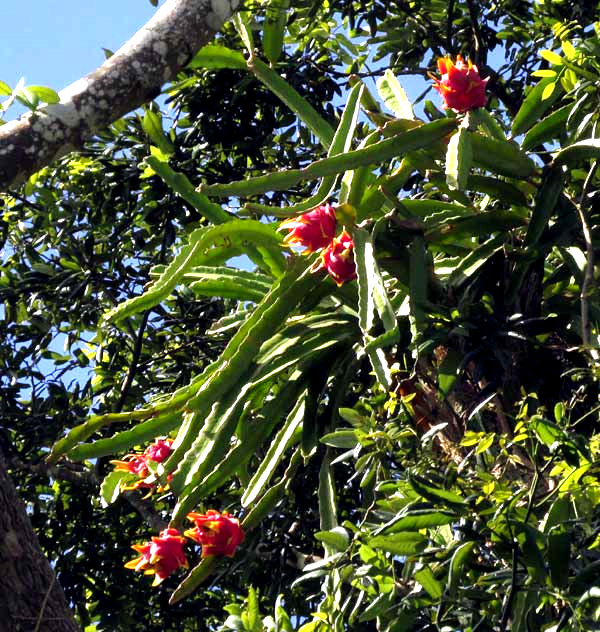
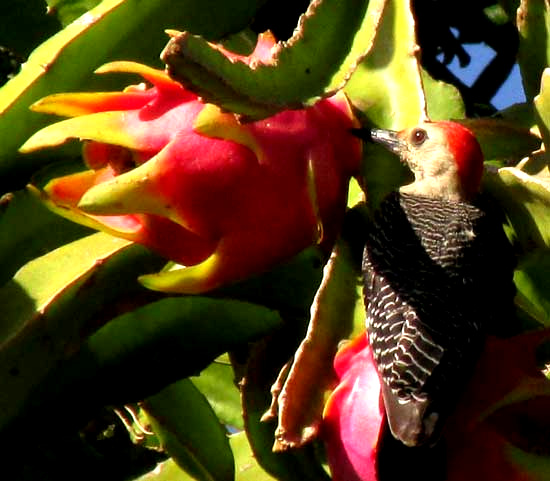
The species is common in the woods here, but this is the first time we've harvested any fruit. Normally a stink-bug-like insect lays eggs in the developing ovaries, the bug's hatched larvae eat the ovaries' insides, and no fruit develops. Our Maya workers say it's because the plants we can get to are those low down where there's too much shade. In the treetops, the egg-laying bugs don't destroy the fruits. That's not to say that the fruits have it easy up there, for birds like to eat them, as the Golden-fronted Woodpecker is doing below:
So, Juan, our best tree-climbing Maya worker, this week presented me with the fruit he's shown holding, below:
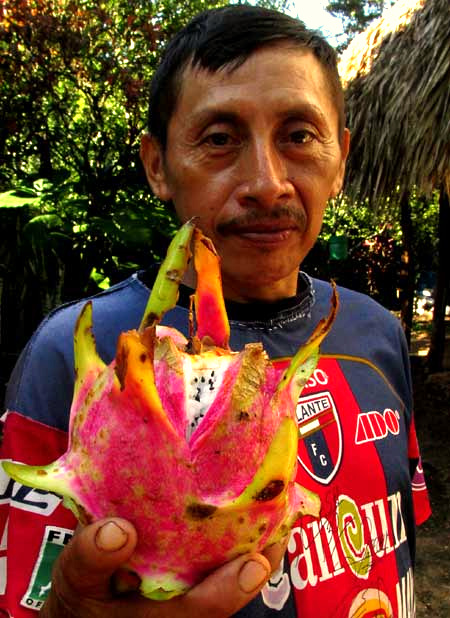
Notice that that fruit is splitting at its top, revealing it's pulpy white interior in which many tiny, black seeds are embedded. This often happens with ripe fruits receiving too much watering. The day before, it'd rained 42mm (1-2/3inch). Below, you can see the fruit's juicy, sweet, very tasty interior:
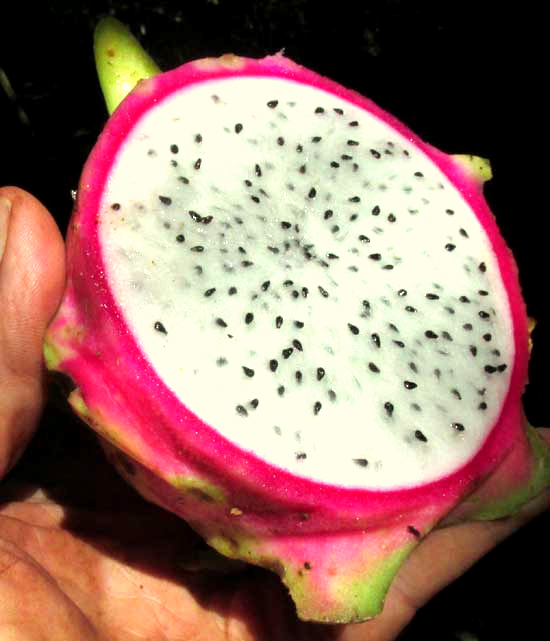
During my early days in the US I never saw anything like this, but tourists tell me that now in supermarkets up there this fruit can be bought under the name of dragon fruit. European tourists tell me it's even sold over there. Here people also eat it, calling it pitaya, but throughout Mexico I've found people using that name for just about any edible cactus fruit, except for the famous, much eaten Nopal, whose fruits are called tunas.
I've seen dragon fruit plantations in the Yucatan where epiphytic, dragon-fruit-producing Hylocereus undatus cactus stems were grafted onto another cactus species firmly rooted in the ground, serving as rootstock. That way, the crop could be irrigated, and the fruits themselves could be collected like grapes dangling from an overhead trellis. I bet dragon fruits become even more popular because they taste good -- can be eaten with a spoon directly from the red-skin bowl resulting from cutting the fruit in half, plus their skin is so leathery and covered with stiff bracts that the fruits can endure a little jostling during shipping.
from the February 7, 2010 Newsletter issued from Hacienda Chichen Resort beside Chichén Itzá Ruins, central Yucatán, MÉXICO
A CACTUS SEEDLING
At dusk I sat beside a forest trail as low-slanting sunlight penetrated deeply into the forest on the trail's east side. During such special, fleeting lighting situations I always hope to see a tinamous walking across the floor or maybe a Kinkajou leaving his aerial den for the night, but that day nothing really memorable happened. One thing that did happen, however, was that a large bromeliad, a Tillandsia fasciculata, for no apparent reason lost its grip on its tree branch and fell crashing through the understory to wedge in a forking branch not ten feet from me. You can see our Tillandsia fasciculatas at www.backyardnature.net/yucatan/tilland1.htm.
Bromeliads and orchids are always falling like that. After storms the ground might be covered with thousands of them. They may live awhile where they land, maybe even a few years if they end up where the right kind of air circulates the way they need it, for, as we emphasized in the next section, they manufacture their own food. They use the trees they're on merely as perches.
When I find such orphaned epiphytes I carry them back to Hacienda Chichen and mount them where I think they'll thrive, and in places where visitors can get a good luck at them. Thus when I left my observation spot that afternoon I retrieved the fallen bromeliad.
It was about the size of a medium dog, bearing a basketball-size wad of thick, spaghetti-like aerial roots. And sprouting out of the blackish wad of aerial roots there was a seedling so young it still consisted mostly of its two cotyledons -- those two "first leaves" that appear on many non-grass plants (the class Dicotyledonae) when they first emerge from their seed. The seedling was about as tall as the middle link of a girl's middle finger.
Usually it's hard to impossible for me to know the identity of a seedling still in its cotyledon stage, but this time it was easy, as you can see below:
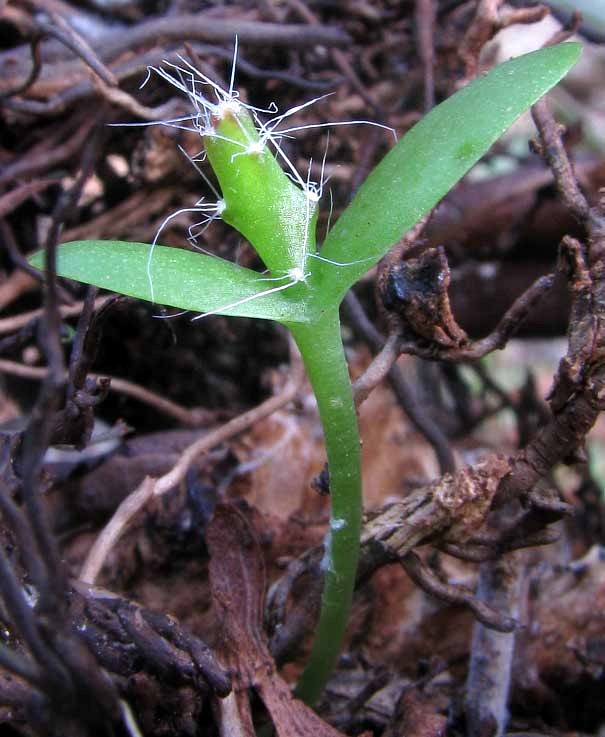
With that incipient roundish stem and the clusters of immature spines, what could this be but a cactus? The common epiphytic cactus in this area is one of several epiphytic cactus species known as "Night-blooming Cereus" and known locally as the Pitaya. It's HYLOCEREUS UNDATAS, the same species whose baseball- size, red, highly edible fruits sometimes appear in Northern markets under the name of dragonfruit.
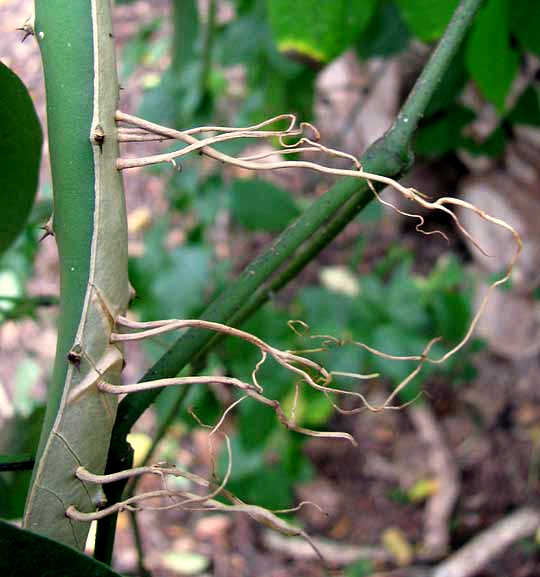
Above you see a young, slender stem section of the Pitaya showing white aerial roots searching for support and finding nothing. Note how the stem is triangular in cross section, and bears short, stubby clusters of spines.
In young woods which 20 or so years ago were ranchland you don't find Pitayas but in older forest here the species is very common. Here, I'm told, they'll flower when the rainy season gets underway in June. Then during the night they'll produce foot-long (30 cm), white, wondrously fragrant blossoms.