PLANTS | ANIMALS | ECOLOGY | FUNGI | GEOLOGY | GARDENING | TOOLS
MEXICAN PLANTS & ANIMALS HOME

Excerpts from Jim Conrad's
Naturalist Newsletter
Issued August 16, 2019 from near Tepakán, north-central Yucatán state; elevation ~9m (~30 ft), N21.053°, W89.052°; MÉXICO
THE CEIBA'S BIGNESS
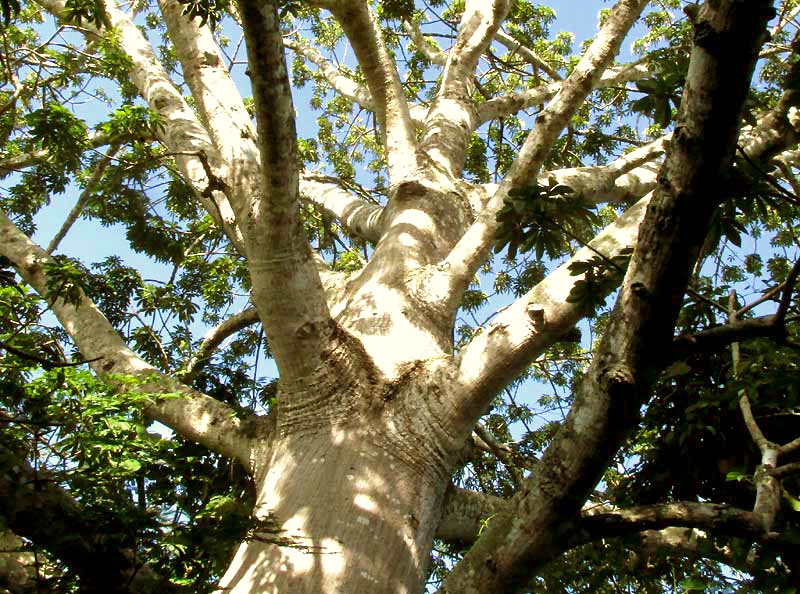
Each morning I pass beneath the big Ceibe, CEIBA PENTANDRA, shown above. Surely it's the most impressive presence for miles around. Ceibas are one of the American Tropics' giant trees, reaching 40m tall (130ft). Even when the trees are fairly young, 20 years or so, already their trunks and primary branches have swollen and started looking impressive. The trunks can be 3m (10ft) in diameter. Often Ceibas are buttressed at their bases -- wall-like outgrowths of the trunk spreading outward from the base -- giving the tree stability.
The ancient Maya considered the Ceiba to be sacred. From the 1998 treatment of Ceiba pentandra in the Flora de Veracruz, I translate author Sergio Anendaño Reyes as saying that "The Maya considered it as the origin of human life. Also they associated trees with abundant fruits with good harvests. Mythologically, it's said that the xtabay, a malignant being in the form of a woman, hides in its big trunk."
from the December 27, 2009 Newsletter issued from Hacienda Chichen Resort beside Chichén Itzá Ruins, central Yucatán, MÉXICO
CEIBA SPINES & LEAVES
So far I've not focused on the remarkable spines adorning the young Ceiba trunk, so this is a good time to show that, for a young tree with exemplary spines grows near my room, as shown below:
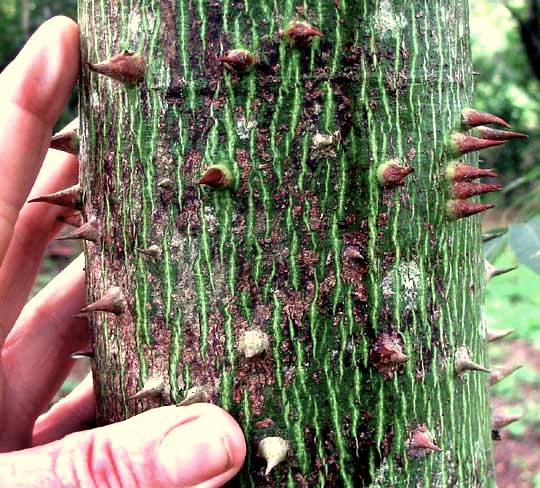
As the tree matures the spines disappear. A mature Ceiba's bark is gray and smooth like an elephant's skin.
Here it's not dry enough yet for our Ceibas to lose their leaves, so now you can see typical Ceiba leaves below.
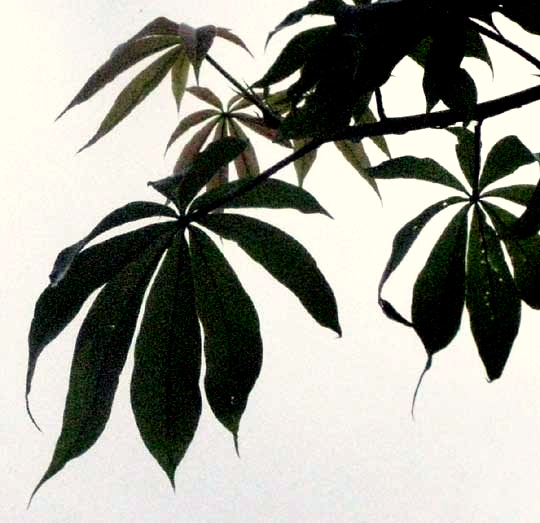
They're classic "digitally compound" leaves, leaves divided into separate segments that arise from a common point at the petiole's top, like a hand's "digits."
from the March 24, 2007 Newsletter Issued from Sierra Gorda Biosphere Reserve Headquarters in Jalpan, Querétaro, MÉXICO
BUD-BURSTING CEIBAS
A number of trees and shrubs who have lost their leaves for the dry season now are issuing new sprouts. This creates an interesting sensation when you move up and down slopes. Sometimes you'll be among evergreen oaks with leathery, faded, bug-eaten, dusty leaves and you'll feel like you're in late summer. Then you turn a corner and maybe that slope will be dotted with flowering peach trees as if it were early spring up North.
One completely leafless tree along my reservoir walk has been particularly noticeable this week because of its stems' terminal buds turning silvery and enlarging drastically. You can see what that looks like below:
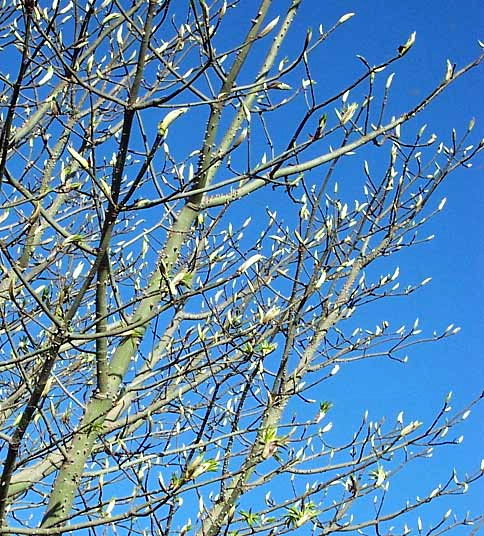
That's a Ceiba tree, Ceiba, CEIBA PENTANDRA
from the March 14, 2010 Newsletter issued from Hacienda Chichen Resort beside Chichén Itzá Ruins, central Yucatán, MÉXICO
CEIBAS FLOWERING
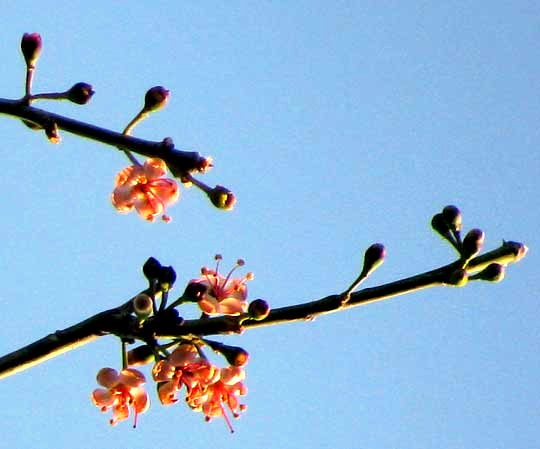
Some of our Ceibas, mostly leafless now because of the dry season, are flowering now. Each rose-colored blossom has five petals about an inch long. You can see some flowers emerging from their large, rounded, stalked buds arising from thick, stiff branches below:
Below, you can see some of the Ceiba flower's distinguishing features.
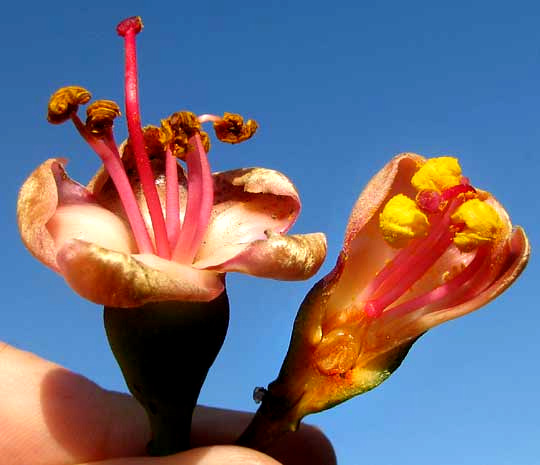
Note how the petals are mantled outside with velvety, white-woolly hairs. The stamens are unusual. They're connected at their bases into a cylinder around the ovary, but the cylinder shortly divides into five typical-looking, pink filaments -- the stamens' "stems." Each filament bears two or three yellow, twisting, one-celled anthers. In most other kinds of flower a filament bears only one anther, but the anther usually is divided into two cells, which split at maturity to release the pollen.
The female part of the flower is fairly normal looking, though, once the ovary matures into the fruit, its ovules end up as seeds embedded in cotton- like fiber often known as kapok.
from the February 27, 2011 Newsletter issued from Hacienda Chichen Resort beside Chichén Itzá Ruins, central Yucatán, MÉXICO
OVAL FRUITS ON TREES
Here in the heart of the dry season many trees are completely leafless, though sometimes they bear flowers or fruits. Two of our largest, most common and conspicuous tree species nowadays are heavily laden with oval, nutlike fruits.
One is the Cedro, the second is the Ceiba, shown below:
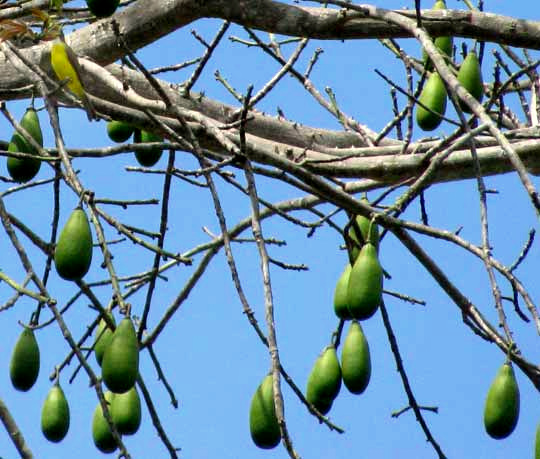
In the upper, left corner, there's a Social Flycatcher, so you can see that Ceiba fruits are about the bird's size. Cedro fruits are maybe one-fifth the size.
from the January 23, 2005 Newsletter issued from Komchén Reserve near Dzemul, northwestern Yucatan, MÉXICO
BUZZING IN THE KITCHEN CEIBA
Each morning this week just when it grew light enough to see things, something magical has been happening. Up in the big Ceiba tree (SAY-bah), CEIBA PENTANDRA, near the thatch-roofed kitchen, there's been a deep buzzing. "Deep buzzing" is too anemic a word to describe that sound. It's a buzzing heard more in the chest than the ears. The dogs sit up, cock their heads and look around, their faces asking if they need to start barking.
It's honeybees, thousands of them, and I'm not really sure why their buzzing is so powerful so early. Maybe it's because at dawn the winds haven't begun blowing yet, or maybe it's because this big Ceiba, so amazingly full of silver-dollar-size, pinkish blossoms, promises such abundant nectar and pollen that a hive dreams all night of what's to come at dawn and, like a child on Christmas morning, just can't wait.
If tropical America has a mystical tree, it must be the Ceiba. The ancient Maya conceived of a great Ceiba at the Earth's center connecting the terrestrial world to the spirit-world. Even slash-and-burn farmers often spare Ceibas as they cut all the forest around them. In climates with much more rain than ours, Ceibas grow to enormous sizes, producing broad, spreading crowns. Where soil is mushy the trunks develope flaring buttresses like rocket fins. Every tropical naturalist has a picture of himself or herself standing among a giant Ceiba's butresses.
Because we're deep into the dry season, and Ceibas are one species dropping their leaves when the dry season begins, our Ceibas now look like huge Flowering-Peach trees -- naked limbs loaded with gorgeous pink flowers. And bees are only part of the wildlife visiting them. Lots of beetles and bugs buzz around the flowers, and many kinds of birds come for the nectar or the insects associated with the nectar, depending on the bird species.
Deep in the dry season there's not much blossoming now, so the Ceibas' enormous bouquet-offerings must be life- saving for many, a kind of absolutely-necessary link in the chain of blossomings that throughout the year sustain life. What a gift these Ceibas are to us all.
As early, orangish, dawn sunlight slants in from the east illuminating the giant tree's pink blossoms and the blue sky arches over all, how pretty among the pink-bouquet limbs are the orange and black orioles, and the blue and black jays... And all this buzzing, the buzzing, the deep, meaningful, happy-sounding buzzing...
from the April 3, 2011 Newsletter issued from Hacienda Chichen Resort beside Chichén Itzá Ruins, central Yucatán, MÉXICO
CEIBA FUZZ
Nowadays visitors entering Hacienda Chichen's reception area are greeted with a sign saying "Please pardon the fuzz... " Then it's explained that our big Ceiba trees are dropping their abundant seeds enmeshed in fluffy fuzz, that the fuzz looks bad in the swimming pool, but we're constantly cleaning the water, and the fuzz isn't harmful.
Now the Ceiba fruits' husks are splitting, revealing masses of cotton-like material in which seeds are embedded, seen below:
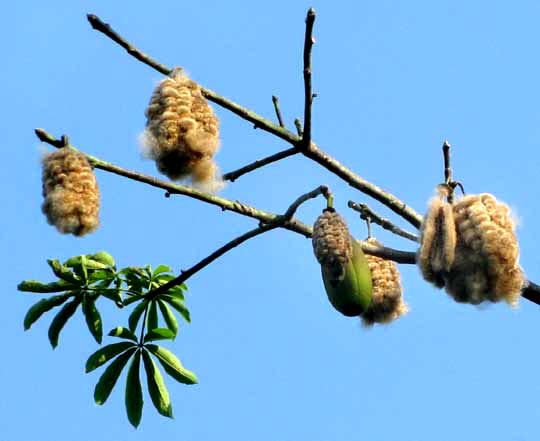
Years ago Ceiba cotton was gathered and sold commercially under the name of kapok, for use as stuffing.
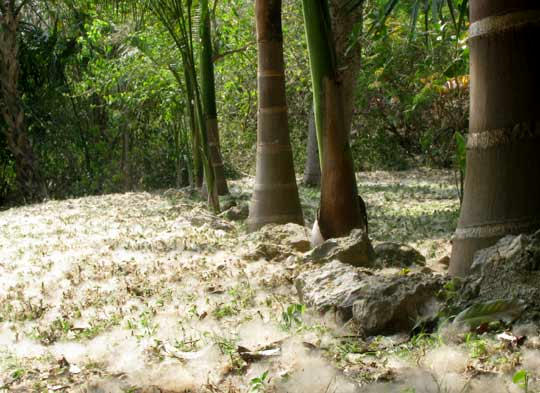
This fuzz is being produced in prodigious amounts. You can see it covering the lawn like snow below:
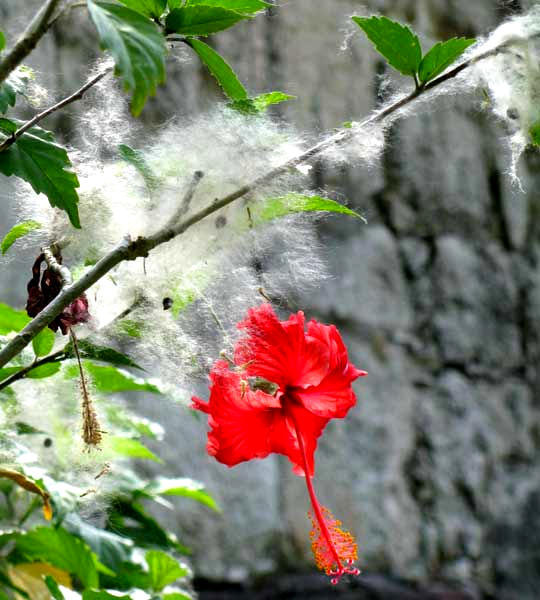
Sometimes, like snow, it makes pretty arrangements, as below:
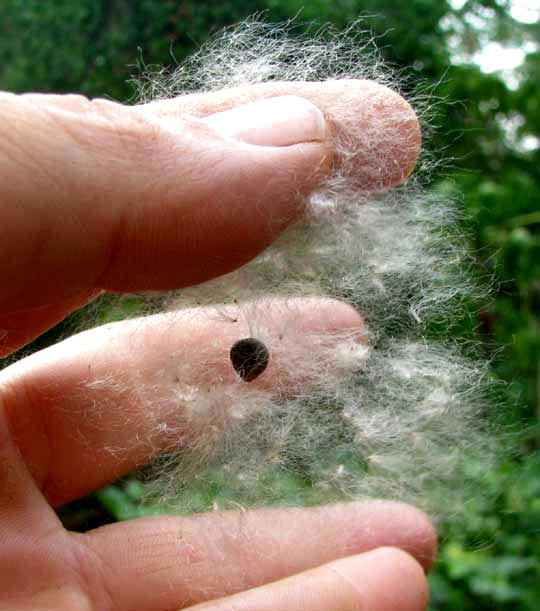
The fuzz enables the Ceibas' seeds to disseminate by wind. Unlike, say, a milkweed seed with its parachute firmly attached atop the seed, Ceiba seeds appear to be merely suspended inside loose gatherings of fuzz, as shown by a fuzz mass descended from the sky below:
 .
.
Such an extravagance of Ceiba seeds is a bother to some but a blessing to others, as you can see below:
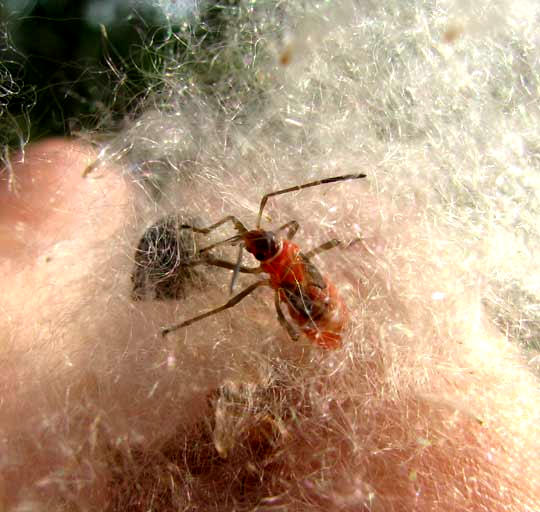
That shows some kind of bug nymph with its proboscis inserted into a Ceiba seed, dining on the good stuff inside.