PLANTS | ANIMALS | ECOLOGY | FUNGI | GEOLOGY | GARDENING | TOOLS
MEXICAN PLANTS & ANIMALS HOME

Excerpts from Jim Conrad's
NATURALIST Newsletter
from the January 5, 2011 Newsletter issued from written at Mayan Beach Garden Inn 20 kms north of Mahahual; Caribbean coastal beach and mangroves, ~N18.89°, ~W87.64°; Quintana Roo state, MÉXICO
SQUEALING BLACK HAWK
A Common Black Hawk, BUTEOGALLUS ANTHRACINUS, has soared past the hotel two or three times since I've been here but it never tarried for a picture. Last Tuesday morning one landed on a dead snag at the edge of the mangroves and showed no interest in flying as I approached to about 20 feet. That's him below:
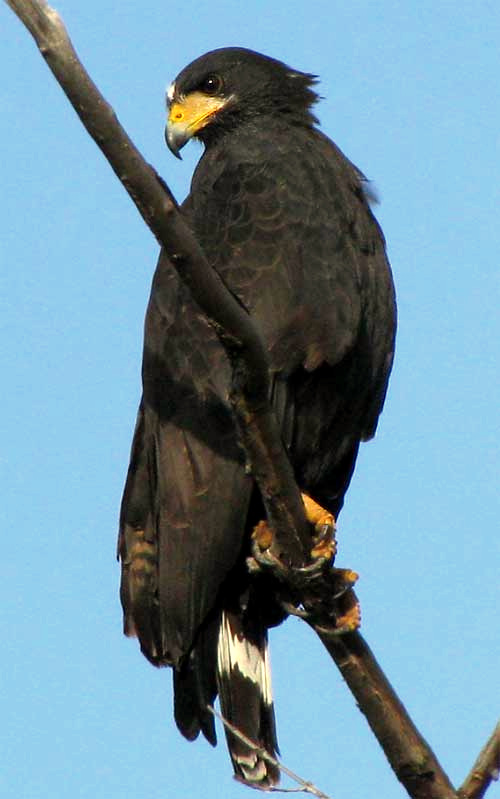
He perched on his snag a solid half hour, several times issuing a sharp squeal sounding like a squeaky toy squeezed rapidly for about five seconds, reaching a crescendo of loudness in the middle.
Common Black Hawks are a bit smaller than Red-tailed Hawks, with wingspreads averaging about 46 inches compared to the Red-tailed's ±50. Another similar, broad-winged, yellow-legged black hawk in the same genus occurs here, the Great Black Hawk. In this area when you see a black hawk you just need to keep in mind that the Great wears white speckles on his upper legs but the Common doesn't.
Common Black Hawks occur throughout Mexico's non-desert lowlands, especially near mangroves, and extend southward into northern South America.
from the May 8, 2011 Newsletter issued from written at Mayan Beach Garden Inn 20 kms north of Mahahual; Caribbean coastal beach and mangroves, ~N18.89°, ~W87.64°; Quintana Roo state, MÉXICO
HAWK NEST
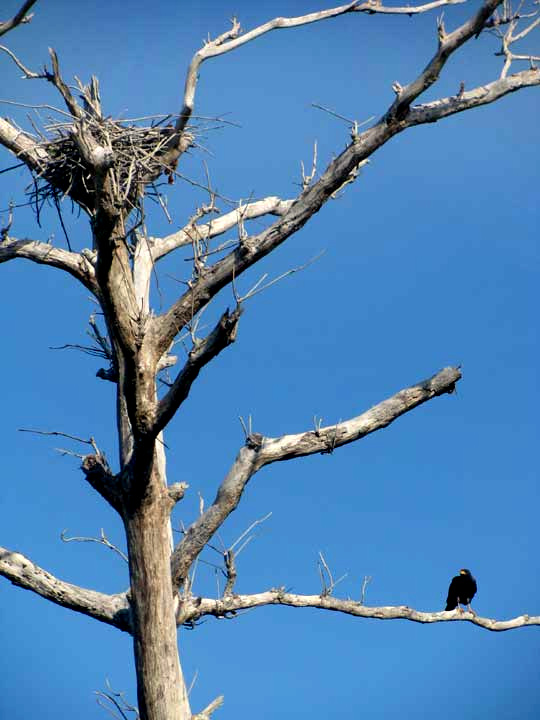
Right up the road a dead tree holds the nest of a Common Black Hawk. You can see the male near the nest below:
The incubating female peering over the nest's edge is shown below:
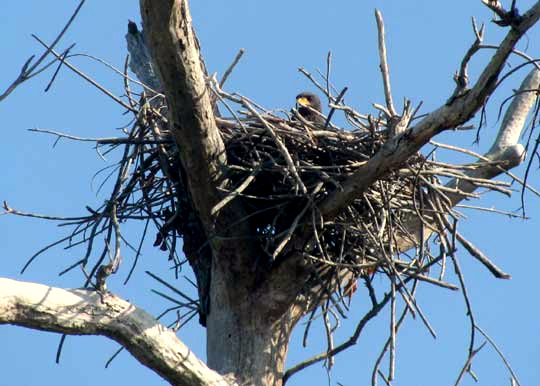
This is a classic stick nest. Common Black Hawks are often seen here next to the mangroves.
from the June 19, 2011 Newsletter issued from written at Mayan Beach Garden Inn 20 kms north of Mahahual; Caribbean coastal beach and mangroves, ~N18.89°, ~W87.64°; Quintana Roo state, MÉXICO
BLACK HAWK NEST UPDATE
About 18 days ago the mother began spending more time perched on the nest's rim than sitting inside it. I assumed then that the egg or eggs had hatched, though I couldn't see what was inside. This week I got my first glimpse of a fuzzy, white nestling head. You can see the nestling peering over the nest's edge and the watchful mother perched nearby below:
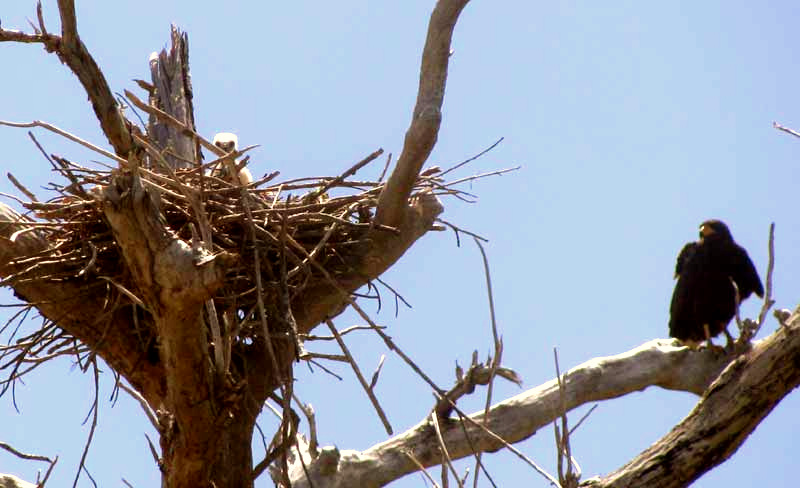
So far I've just seen one nestling. Howell says that nests usually contain one to three eggs.
from the July 3, 2011 Newsletter issued from written at Mayan Beach Garden Inn 20 kms north of Mahahual; Caribbean coastal beach and mangroves, ~N18.89°, ~W87.64°; Quintana Roo state, MÉXICO
HAWK NEST UPDATE
Since our last picture of the nestling Common Black Hawk taken two weeks ago, dark feathers have begun emerging through the white fuzz that covered him earlier, and of course he's grown a lot. You can see a funny picture, Mama hawk seeming to be laying the law down while the nestling isn't paying much attention, below:
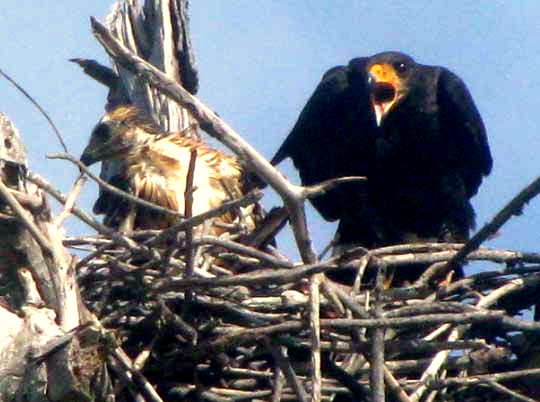
Actually I think the mother was yelling at me. A while back a tourist stood too long below the nest snapping pictures as she screamed and when the tourist didn't go away she began swooping at him until he left.
So far I've still seen only one nestling in the nest. Both parents continue to be very attentive, one of them always close to the nest watching.
from the July 10, 2011 Newsletter issued from written at Mayan Beach Garden Inn 20 kms north of Mahahual; Caribbean coastal beach and mangroves, ~N18.89°, ~W87.64°; Quintana Roo state, MÉXICO
NEST GAZE
Nowadays most folks traveling the beach road slow at the bend so they can see the Black Hawk nest we've been watching since early May. Now the single nestling is growing explosively, dark feathers mostly having replaced the white fuzz. The nestling is fast losing his adolescent awkwardness. He climbs to the nest's edge and for the longest time just gazes out over the scrubby woods below, and the ocean just beyond. You can see him in his favorite viewing position below:
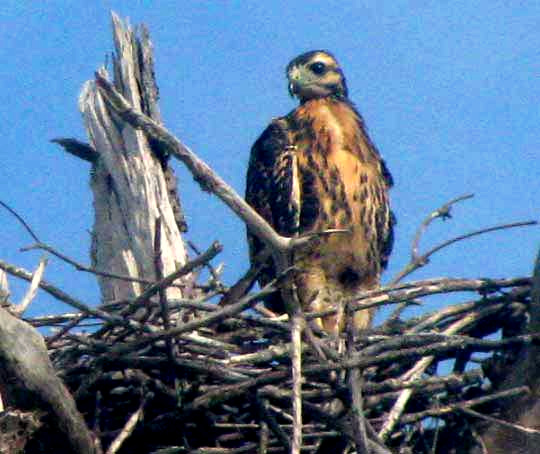
Nowadays at dawn usually towering cumulus clouds rise on the horizon all around, often coming ashore as slate-gray showers that majestically move around us or hit us head-on, and nearly every afternoon massive storms form not far inland, their low thunder rolling across the mangrove as they move away from us.
I can only imagine how this dramatic, ever-changing ceiling affects our bird's mental conception of what the world is like. How would it feel to be that nestling, intuitively knowing that before long he'll be part of that sky, circling and looking down with an acuity of vision and mental fixation we humans can't imagine?
Whatever is going on in the mind of that nestling, until it fledges there's not much more to do than to perch at the nest's edge watching clouds and gazing toward the sea.
from the July 17, 2011 Newsletter issued from written at Mayan Beach Garden Inn 20 kms north of Mahahual; Caribbean coastal beach and mangroves, ~N18.89°, ~W87.64°; Quintana Roo state, MÉXICO
HAWK NEST FINALE
Early this week the Common Black Hawk nestling who spent so much of the previous week at the nest's edge gazing toward the horizon, no longer was there. I thought maybe for some reason he was cowering inside the nest where I couldn't see him, but neither has he shown up since then.
Usually one of the adults can be spotted perching nearby, out in the mangroves, so I'm guessing that the nestling now is a fledgling being watched over by the adult, and has spent this week down in the mangrove scrub continuing his explosive growth and education.
I'll let you know if someday Black Hawk in mature plumage comes sailing about.
from the July 31, 2011 Newsletter issued from written at Mayan Beach Garden Inn 20 kms north of Mahahual; Caribbean coastal beach and mangroves, ~N18.89°, ~W87.64°; Quintana Roo state, MÉXICO
BLACK HAWK FLEDGLING UPDATE
The Common Black Hawk nestling we last saw around July 10th finally turned up again this Wednesday, July 27th. Between those dates I never saw him at all, though often out in the mangroves one of the adults would be perched not seeming to be doing much besides watching, so I've guessed that the adult was watching the fledgling down in the mangrove tangle too low for me to see.
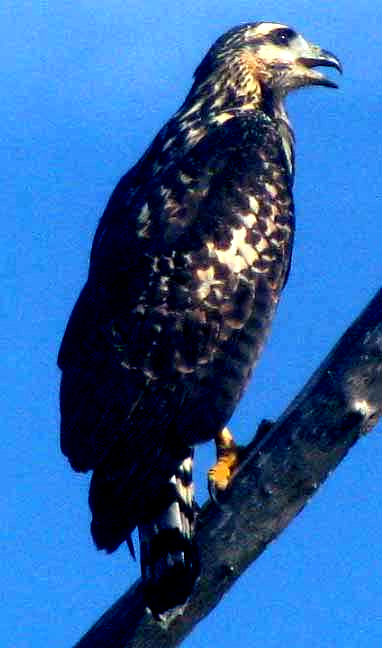
On Wednesday the fledgling swooped across the road right in front of me while the adult perched high in a dead tree in clear view not far away. The fledgling landed near the old nest tree and seemed curious about me. The adult kept calling with what sounded like a fat man's hardy-har laugh expressed completely in squeaky whistles. The fledgling also whistled, but only in short phrases, with what anthropomorphically seemed to me a questioning tone addressed to the adult. Speaking of anthropomorphism, to me the picture of the kid looks as if he's smiling good-naturedly as he calls back to his mom. You can see what you think below:
from the June 2, 2007 Newsletter issued from Sierra Gorda Biosphere Reserve, QUERÉTARO, MÉXICO
SQUEALING BLACK HAWK
Last weekend I camped beyond the far end of the reservoir, a bit up the main arroyo feeding the lake. Early Sunday morning when just enough light filtered into the narrow valley for birds to start flying up and down the intermittent stream I sat cross-legged in my tent's door gazing across a green pool of water. I'd pegged the tent beneath a big Mexican Sycamore where I had a good view up and down the stream, which was strewn with white, rounded, hippopotamus-size limestone boulders.
I'd chosen the spot hoping to see wildlife visiting the pool to drink. During the night I'd heard lots of frogs and something knocking rocks about, but that was about it -- except for the sharp, excited-sounding whistles near my tent at dusk the previous day and first thing that morning. The whistles had reminded me of Woodchuck warning calls, so I'd figured it was some kind of mammal with a den in the rocky ledge behind my tent annoyed by my presence.
At the corner of my vision suddenly there was quick movement, a splash, and by the time I'd focused on the action I saw about 30 feet away a large, black hawk carrying something heavy in his talons. Apparently the thing being carried weighed too much to fly far with, for the hawk landed with it at the water's edge. The binoculars told the story: A Common Black Hawk had just plucked something looking like a Giant Toad from the stream.
What a view I had, the tent serving perfectly as a wildlife blind. The hawk was all black except for two conspicuous white bands on his tail, a brightly yellow, curved beak, and exceptionally long, yellow legs. The whistles I heard were just short, agitated-sounding outbursts.
That poor toad! The hawk perched atop it apparently puncturing and repuncturing its body with his talons. Several times a minute, with a brief fluttering of wings, the hawk would jump straight up, raising the toad six inches or so, and I interpreted this as the hawk trying to gain better purchase on his prey, thus probably making new holes in him. After every three to five jumps the hawk would bend forward and cut at the toad with his big, curved beak, sometimes seeming to carve out chunks which he'd swallow. This went on a good 15 minutes.
Up until this time I wasn't 100% sure that the prey was actually a Giant Toad, so now I emerged from the tent and began inching closer. The hawk would have none of this. He flew off, dropping the toad with a heavy plop onto the limestone bed. Reaching the toad and confirming my identification, I was amazed to find him still capable of righting himself and gamely trying to make it to water. When I drew close he took in air, bloating his body considerably. I've read that Giant Toads do this to make themselves too large for certain predators' mouths, but now I wondered whether another advantage might not be to separate the skin from vulnerable organs inside, by lots of air.
The hawk was perched nearby casually with one yellow leg drawn up into his black chest feathers, glaring at me, so I left the scene, hoping I'd not irretrievably disrupted an important moment in the local ecosystem's workings.
from the November 6, 2011 Newsletter, material gathered at Mayan Beach Garden Inn 20 kms north of Mahahual; Caribbean coastal beach and mangroves, ~N18.89°, ~W87.64°; Quintana Roo state, MÉXICO
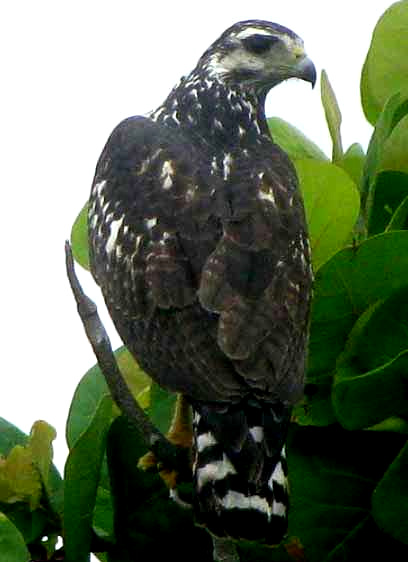
JUVENILE BLACK HAWK AT AGE 4½ MONTHS
Last Sunday on my last day at Mayan Beach Garden our hawk happened to appear, giving us a good view of what a Common Black Hawk looks like at 4½ months. See his newly darkened plumage and handsomely striped tail below:
from the November 16, 2014 Newsletter issued from Río Lagartos, on the Yucatan Peninsula's northern coast (~N21.60°, ~W88.16°), Yucatán state, MÉXICO
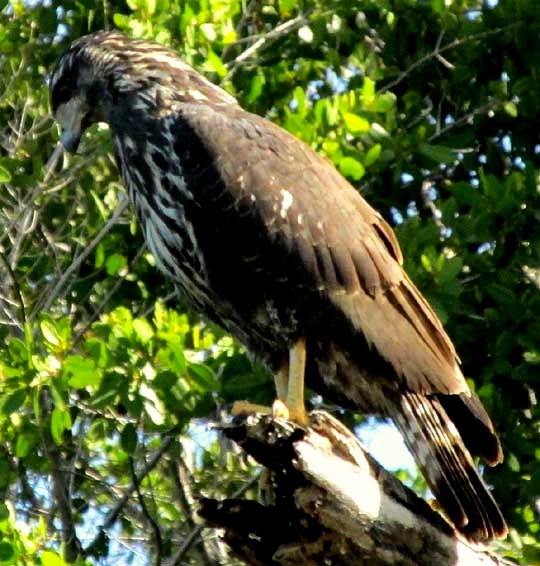
IMMATURE BLACK HAWK
Common Black Hawks are common here. On boat tours up the estuary normally half a dozen or more are spotted along shore. If we're carrying tourists looking for picture-taking opportunities, sometimes the guide carries along a dead fish to be thrown into the water when we approach a Black Hawk. The hawk usually swoops down, grabs the fish in its talons and carries it back to a perch. If you time it just right you can get a great picture. So far I've always been too early or too late for the classic hawk-snatches-fish picture, but my time will come, and you'll see the results. Meanwhile, I did get a decent picture of an immature Black Hawk eyeing a potential meal in the water just below his perch, shown below:
from the January 25, 2015 Newsletter issued from Río Lagartos, on the Yucatan Peninsula's northern coast (~N21.60°, ~W88.16°), Yucatán state, MÉXICO
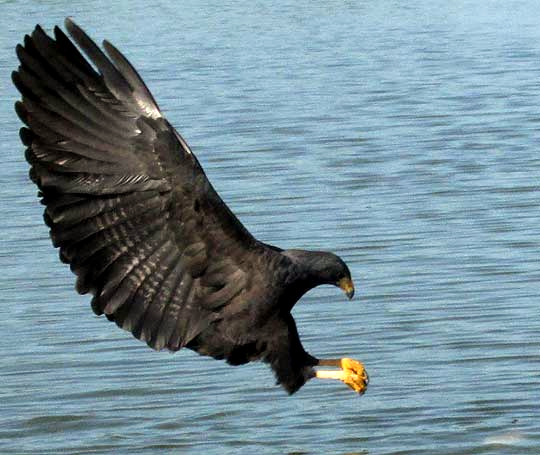
BLACK HAW SNATCHES A FISH
When flamingo-tour guides use dead fish to entice wildlife into picture-taking range, the main customer is the Common Black Hawk. Many times I've tried to capture that precise moment when the hawk snatches the fish from the water but always I've snapped the picture a little too early or too late. This week I almost got it right, just a fraction of a second before the hawk got his fish. Below, you can see the moment, with the victim fish a silvery blur at the picture's lower right:
Distribution maps show Common Black Hawks as occurring all along the Yucatan's coasts, but absent from the interior, though the larger and rarer Great Back Hawk does occur there. I read that our Common Blacks run after crabs on beaches, though I've not seen that behavior. On a typical boat ride up the estuary you might see five to ten Common Blacks conspicuously perching atop Red Mangrove trees right at the water's edge.