PLANTS | ANIMALS | ECOLOGY | FUNGI | GEOLOGY | GARDENING | TOOLS
MEXICAN PLANTS & ANIMALS HOME

Adapted from Jim Conrad's Naturalist Newsletter of October 8, 2007, with notes from a field trip to Nevado de Toluca Volcano ±16 air-kms south of Toluca, elev. ±3,800 m (±12,500 feet), not far below the treeline, Mexico State, MÉXICO
A LATE-BLOOMING BEARDTONGUE
The feeling of the upper elevations was that of late fall. I hadn't expected that, but it pleased me, for it's been a long time since I've experienced it, and it's one of my favorite moods. It's a bit after the first killing frost, but not quite yet full-fledged winter. At that season sunlight is a blessing. Wind chills menacingly on the body's shadow side, but somehow pleases with its uncompromising wildness.
One very common and conspicuous wildflower abundantly flowering even at this season was the one shown below:
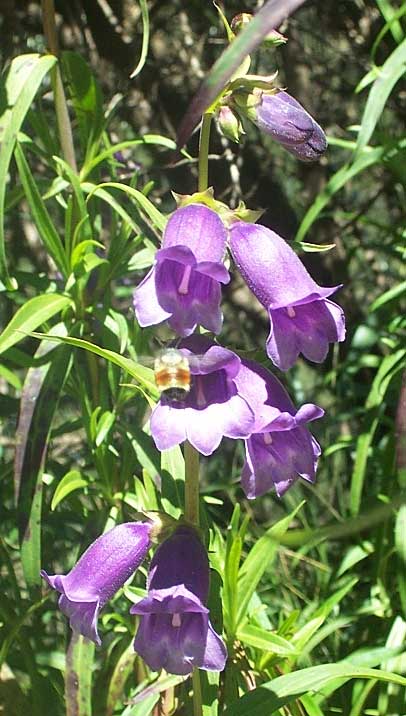
That's one of many species of "beardtongue," possibly PENSTEMON GENTIANOIDES. Beardtongues get their name from the fact that one of each flower's five stamens develops into a sterile, match-stick-like thing called a staminode, and in many Penstemon species that staminode bears a "beard" of long hairs.
In the above picture you can see the stiff, pale staminode lying near the corolla tube's floor, and you can also see that it is beardless -- a beardless beardtongue. You can also see a high-elevation bee that just happened to zip into the middle blossom the moment I snapped the picture.
My Manual of Cultivated Plants says that this species, sometimes named Penstemon hartwegii, is often hybridized with P. cobaea to form a flower-garden favorite known under the trade name of Penstemon gloxinoides.