PLANTS | ANIMALS | ECOLOGY | FUNGI | GEOLOGY | GARDENING | TOOLS
MEXICAN PLANTS & ANIMALS HOME

Excerpts from Jim Conrad's
Naturalist Newsletter
from the April 7, 2008 Newsletter issued from the Central Valley of Mexico's Southernmost State, CHIAPAS,
STRIPED BASILISKS
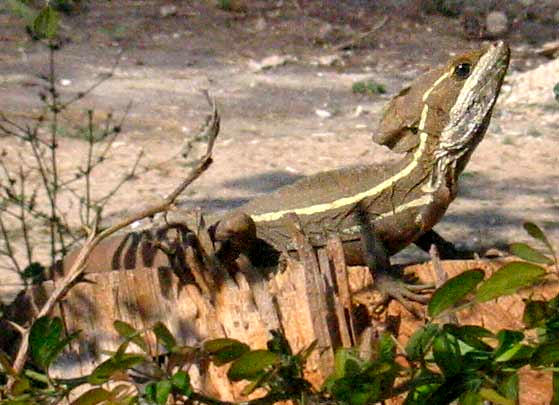
One of our most common and certainly the most striking of our lizards is the Striped Basilisk, BASILISCUS VITTATUS. Each morning as I pass to and from the reserve a certain 15-inch male suns himself atop the stump of a Guamuch tree next to a peacefully flowing, shaded canal. That's him above.
Basilisks have their own lizard family. There's the Iguana Family, the Anole Family, the Racerunner Family, the Skink Family, etc. They're all "lizards," but important differences separate the families. Basilisks are immediately recognizable because the males, at least, bear amazing crests, casques or helmets atop their heads, plus all basilisks possess extremely long legs and tails. Locally our Striped Basilisks are called "Teleches" but in Tuxtla just to the west they're called "Nacahuas."
By whatever name this species is one of the best-known of all lizards from here to northern South America. That's because it's so often seen running across roads and other open areas. And by running I mean that it rears up on its hind legs, holds its front legs up like arms, and with its chin pointed at the sky it looks more like a cartoon caricature of a running lizard than what we'd expect a real running lizard to look like.
Striped Basilisks nearly always remain close to water. When they need to escape to a far bank they do so simply by running across the water's surface! This is possible because of well-developed fringes on the sides of their hind toes. Normally the fringes stay folded but when the lizards dash across water they open up, providing the animals' feet with more surface area to press against the water and hold them up. I've heard irreverent gringos call Striped Basilisks "Jesus Lizards" because of their water- walking disposition. Often instead of running atop the water they dive below it. These are truly water- adapted lizards.
Striped Basilisks pay for their popularity, however. Campbell's Amphibians & Reptiles of Northern Guatemala, the Yucatán & Belize reports that they fall prey to a large variety of animals, especially snakes, and that only about 2% of hatchlings survive for two years.
Striped Basilisks feed mostly on insects but also on fallen fruits.
from the April 7, 2008 Newsletter issued from the Central Valley of Mexico's Southernmost State, CHIAPAS,
A FEMALE STRIPED BASILISK
We've already met a male Striped Basilisk with its slender, very long tail, very long legs and flaplike crest atop its head. Saturday I got a good picture of a female, shown below:
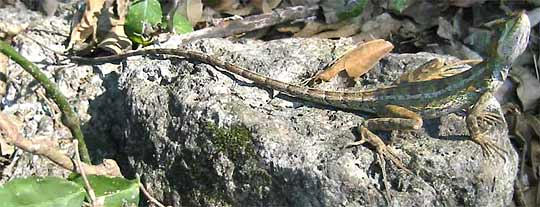
I'm glad to have a female's picture because the species is sexually dimorphic -- males look different from females. You can see that the female lacks the male's crest and his conspicuous, yellowish, solid line running from the eye down the sides and tail, plus the female's back is checkered instead of plain. This female in the picture is about a foot long.
You can also see the very long back legs and toes characteristic of basilisks, features hidden in my picture of the male. Those expansive feet enable furiously running basilisks to run across water.
from the September 15, 2008 Newsletter issued from Sabacché, Yucatan, MEXICO
A DIFFERENT-LOOKING STRIPED BASILISK
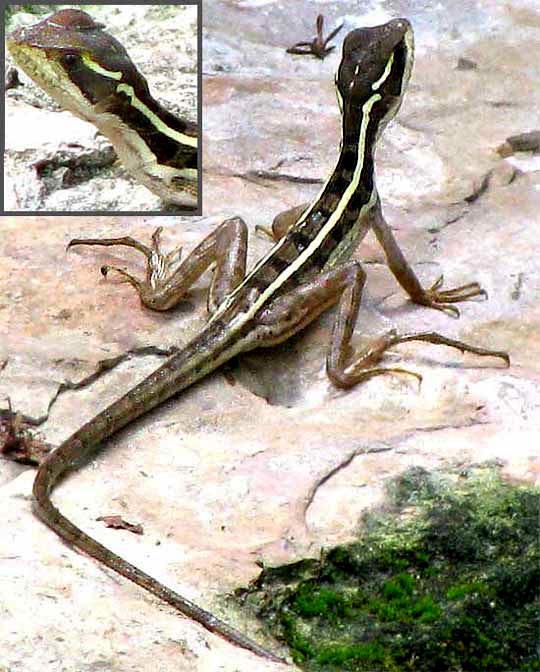
Above you can see a visitor to the cesspool behind my casita who lacks the adult male's crest, yet it's not as mottled as the female. Campbell's Amphibians and Reptiles of Northern Guatemala, the Yucatán, and Belize says little about the immature Striped Basilisk's appearance, but I'm guessing that my cesspool friend is an immature male, mainly because the white line along his side is so vivid, which doesn't seem to be the case with females.
Cesspool is wet in the picture because as I was photographing him (the inset at the upper left) suddenly he spotted prey and shot off his perch into the pool. Striped Basilisks can dive under water as well as run across it. Cesspool ran across the water's surface and stationed himself on the opposite bank before I could refocus my eyes. In the picture a dead wasp lies just beyond Cesspool's head, so maybe that was the prey he'd gone after, only too late deciding he didn't want to swallow it.
from the March 28, 2010 Newsletter issued from Hacienda Chichen Resort beside Chichén Itzá Ruins, central Yucatán, MÉXICO
A FEMALE WITH A BIG CREST
We've met fairly common, fast-running, long-toed Striped Basilisks, BASILISCUS VITTATUS, in several places, and photographed the sexually dimorphic species in various stages of maturity. Still, early one morning this week when I spotted one calmly basking in the day's first rays of sunlight, at first I thought I was seeing a different species. It was larger than I'm accustomed to seeing -- about 15 inches (38 cm) -- and the crest looked different from what I've seen on mature males. You can this below:
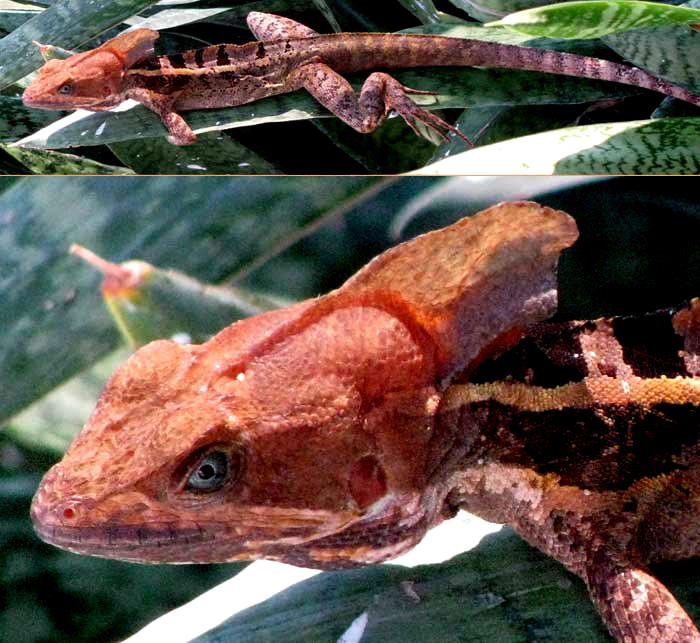
Those pictures are tilted on their sides. Actually the critter had her nose skyward, for she'd climbed to the tip of a hip-high Mother-in-law's Tongue.
Jonathan Campbell in Amphibians and Reptiles of Northern Guatemala, the Yucatán, and Belize writes that "Just after first light, but before sunup, they jump abruptly from their perches to the ground, usually hitting the ground running, and dash off to the nearest cover." Probably that's what happened here.
They're incredibly fast, often seen running upright across roads, their very long, broadly spread toes just a blur. I've seen them run across water. My friend Bibiano says they can run atop the canopy of a bunch of weeds or shrubs as if it were open ground. In Maya Bibiano calls them Tolók.
from the July 18, 2010 Newsletter issued from Hacienda Chichen Resort beside Chichén Itzá Ruins, central Yucatán, MÉXICO
BASILISK LAYING EGGS
Monday at about 3 PM I stepped from my hut door and there about eight feet away was what's shown below:
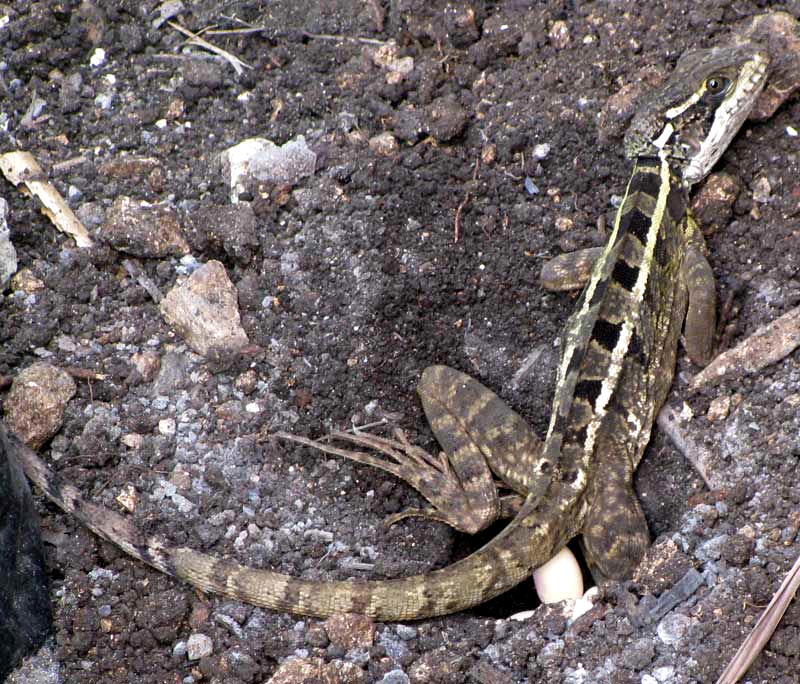
It was a Striped Basilisk, BASILISCUS VITTATUS, about 1-½ feet long (45 cm) laying an egg in a freshly dug nest. Our much larger Black Iguanas often let me get this close but basilisks usually run away at this distance. This lizard obviously didn't want to abandon her open nest so she just froze there as I reached for my camera and steadied it with a pole. The moment I snapped the picture and took a step nearer for a closer shot, however, she scrambled away in a blur. You can see the nest exactly as she left it below:
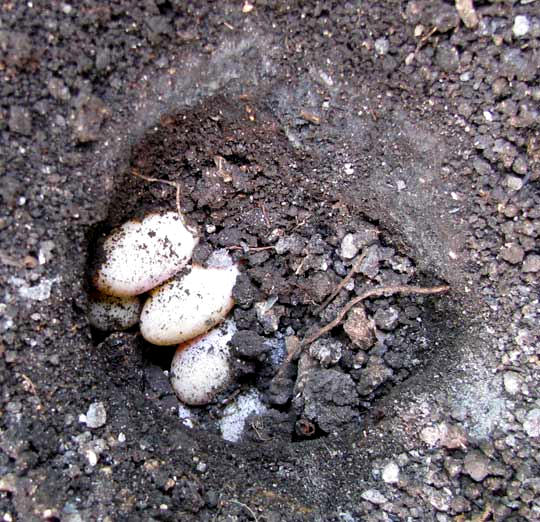
Though she'd chosen a spot strewn with a thin layer of loose soil, when I ran my finger around the nest's rim I found that the ground just below the loose soil was hard packed. How did she dig such a neat hole in such hard ground? After I'd been away for about half an hour I returned to find the nest filled with earth and so well camouflaged that really I couldn't decide exactly where it had been.
Jonathan Campbell reports that Striped Basilisk eggs are 2/3 inch long (17mm) by 0.4 inch (11 mm and that the average number of eggs per nest is about four. Five are visible in the picture and by the way they're stacked you almost suspect a sixth below. Campbell says that the gestation period is 50-55 days, so around September 1 I should start looking for baby basilisks. However, Campbell also reports that it's estimated that only about two percent of a nest's hatchlings survive for two years. In captivity they've lived for five years and eleven months.
from the May 29, 2016 Newsletter issued from Hacienda Chichen Resort beside Chichén Itzá Ruins; limestone bedrock; elevation ~39m (~128ft), N20.675°, W88.569°; central Yucatán state, MÉXICO
BASILISK LAYING EGGS, #2
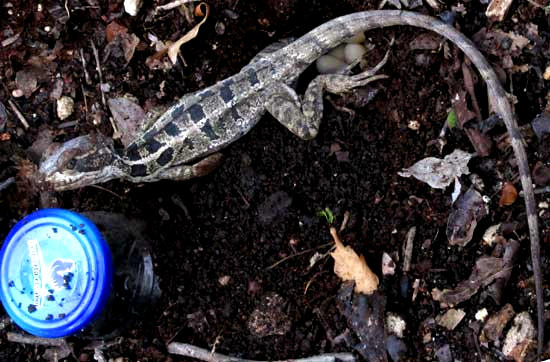
One morning this week I was bent over looking for sprouts of recently sowed Cilantro seeds when suddenly I realized that at arm's length a 1½ ft long (45 cm) Striped Basilisk, as shown below:
A close-up of the eggs is seen below:
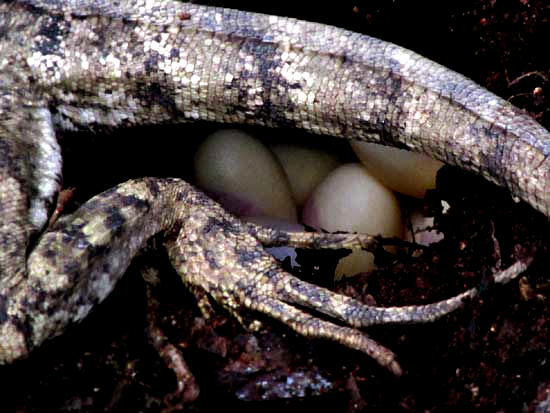
The blue-topped bottle enters the picture only because it had contained the Cilantro seeds, I'd neglected to store it away and, apparently, the basilisk liked it. The point to notice in the picture is that beneath the basilisk's rear end there are eggs. I'd interrupted a critical moment in the basilisk's life, so I immediately withdrew, and for the next hour or so from inside the hut watched her move loose dirt over the eggs and squirm and scratch the dirt's surface until the litter atop the eggs looked exactly like that covering the rest of the bed. The temperature was approaching 100 degrees, and I admired her stamina. Most of the time she worked with her mouth open, apparently to encourage cooling by evaporation of moisture from her mouth and lung linings.
An interesting feature about this egg-laying is that our July 18th, 2010 Newsletter also featured an article entitled "Basilisk Laying Eggs," with pictures very similar to the ones provided this week. Moreover, the 2010 nest was located about a yard (1m) from the present nest's location. I just wonder whether there's been a continuous use of this location as a nesting site over the years, and if there's some relation between the 2010 basilisk and this year's -- or maybe even the same individual?
from the December 11, 2011 Newsletter issued from Hacienda Chichen Resort beside Chichén Itzá Ruins, central Yucatán, MÉXICO
INSIDE A BASILISK'S MOUTH
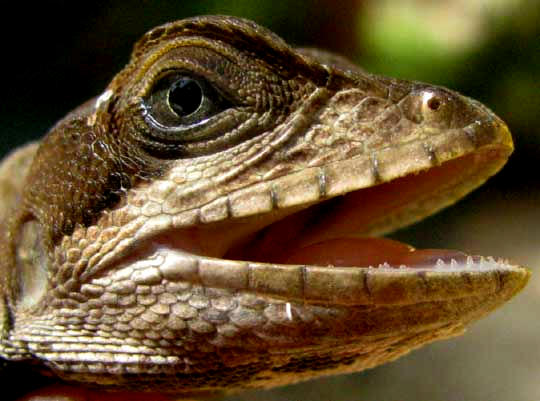
A young Striped Basilisk turned up in the gift shop banging against a window trying to escape, so I was called to carry him outside. It was an immature one, with its crest just beginning to develop. Once he was secured in my hand he gamely gaped open his mouth, threatening to bite. He'd already bitten as I'd closed my fingers around him, but his teeth were tiny and he was too small to bite down hard, so it hadn't hurt at all. But while I had a basilisk with his mouth open in my hand, it occurred to me to look into his mouth to see if anything interesting was there. You can see exactly what I saw below:
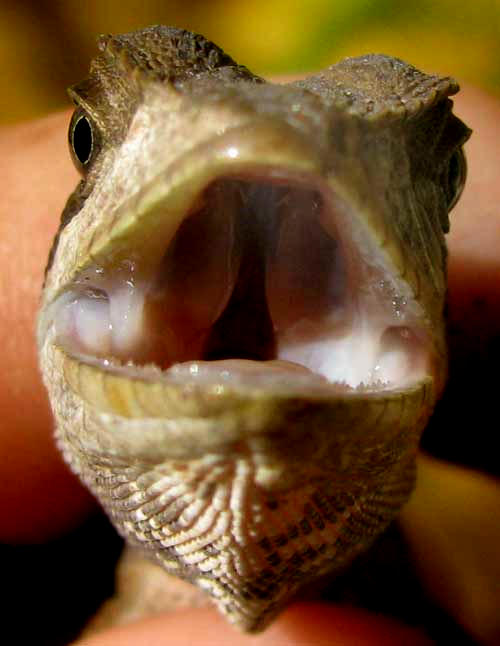
What caught my attention were the two large holes in the mouth's back, where the jaws hinge. They're such conspicuous features that they must be important. I had to do a search on "lizard mouth anatomy" to figure it out: They're Eustachian tube openings. Eustachian tubes connect the middle ears to the nasopharynx (back of the throat) region. In humans they equalize air pressure on the two sides of the eardrums. However, human Eustachian tubes are narrow, inconspicuous structures. Why would a basilisk's be so relatively pronounced?
A little search-engine work brought up a paper on the "Evolution of sound localization in lizards," presented at a scientific meeting in New Orleans in 2007. It states that primitive middle ears -- which a basilisk would have -- are not enclosed in cavities, as are human ones, but rather open into the mouth cavity. The Eustachian tube openings we see in the basilisk mouth would represent that connection to the mouth cavity.
Animals with such arrangements thus have their two ears "acoustically coupled" through their mouth cavities. Sound waves travel from one eardrum through the mouth cavity to the back surface of the other eardrum, creating an "inherently directional pressure difference receiver," as the investigators term it, enabling the greatest directionality in hearing of all terrestrial vertebrates. There's more detailed and illustrated explanation freely accessible online at https://acoustics.org/pressroom/httpdocs/154th/carr.html.
So, lizards like our basilisk enjoy a kind of "binocular vision" with their hearing, something that's much less developed in us mammals. Such direction finding ability would help a lizard locate bugs scurrying through loose debris on the ground.
While the basilisk was in my hand I photographed his head from the side, where you can see his facial scales and tiny teeth. Also, behind the jaw, there's an ear's circular interface with the outer world. It's below: