PLANTS | ANIMALS | ECOLOGY | FUNGI | GEOLOGY | GARDENING | TOOLS
MEXICAN PLANTS & ANIMALS HOME

An Excerpt from Jim Conrad's
Naturalist Newsletter
from the January 12, 2007 Newsletter issued from Sierra Gorda Biosphere Reserve Headquarters in Jalpan, Querétaro, MÉXICO
ANEMIA PHYLLITIDIS
On both sides of the reservoir several miles of one-lane gravel roads have been cut into the mountainsides. Besides displaying fine examples of the region's much folded and faulted limestone geology, the roadcuts display a goodly number of plants adapted to rock faces, especially ferns. One particular fern species is common but I've had a dickens of a time trying to identify it, because there are no fieldguides here. It's shown below.
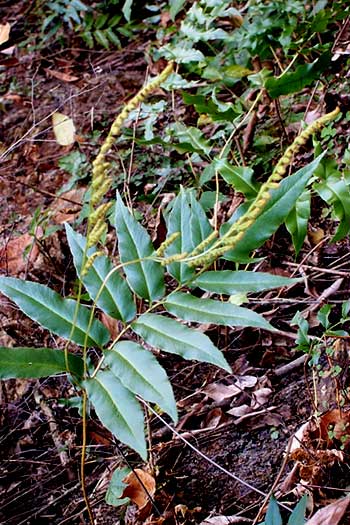
If you're familiar with the fern groups, particularly the North's "rattlesnake ferns," genus Botrychium, this might look a little familiar to you. Rattlesnake ferns have much-dissected, triangular leaves from which a single rattlesnake-tail-like, spore-producing "fertile frond" arises from the fern stem. What jars the fern-expert's sense of propriety is that our fern has two of those fertile fronds, not one.
One name for this fern is "Blooming Fern." It's ANEMIA PHYLLITIDIS.