
 Cicada nyphs climbing Red Maple tree in Beltsville, MD. Image by J. A. Pyle
In the spring of 2004, much of the US's eastern coast experienced something amazing. People went into their backyards at night and saw something similar to what's shown at the right. Most people already knew what was happening because local TV stations and newspapers had informed them that the honey-colored things were the immature stages, or nymphs, of periodical cicadas. The media further reminded us that this mass emergence of cicada nymphs occurs every seventeen years or so. Insect nymphs are immature forms of those species who undergo simple metamorphosis, such as cicadas.
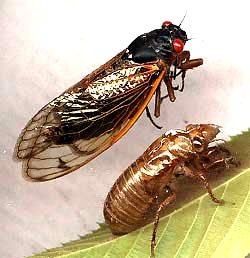
In the upper part of the picture at the left you see a red-eyed, adult periodical cicada. Below it is the abandoned shell, or exoskeleton, of its nymph, which had burrowed underground all those years. Here's more of the story:
Adults lay their eggs at the end of tree branches. This damages the twigs somewhat, so later these twigs may die or snap off on breezy days. What hatches from the egg, the earliest stage of the nymph, looks like a tiny termite or white ant. It feeds on sap issuing from the wound made when their mother deposited the egg in a slit in the tree branch. After a certain time this ever-growing nymph drops to the ground, digs in, and begins eating roots -- first smaller roots like those of grass, then later, tree roots.
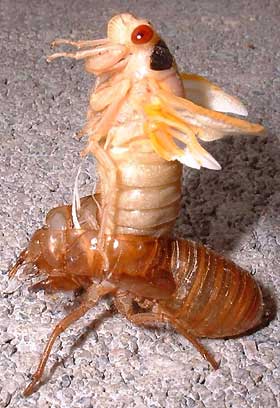
After as long as 17 years, depending on the species, the nymph has grown considerably, and emerges from the ground. This is what's seen climbing the tree at the top of our page. The nymph stops climbing at a certain point, anchors itself on the tree's bark with its feet, and the top of its exoskeleton -- its brittle "skin" -- splits open, and you get what's shown at the right.
That picture, also taken by J. A. Pyle in Maryland, shows the winged adult, still not fully formed, emerging from the split at the top of the nymph's exoskeleton. The emerged adult now seeks someplace where it can remain quiet for a few hours as its new and larger exoskeleton hardens, darkens, and its wings expand tremendously, and stiffen. Below you see a freshly emerged annual cicada, genus Tibicen, only partly darkened, and though its wings are much expanded, they are still far too soft and pliable for flying. Below the cicada hangs the abandoned exoskeleton of its nymph stage.
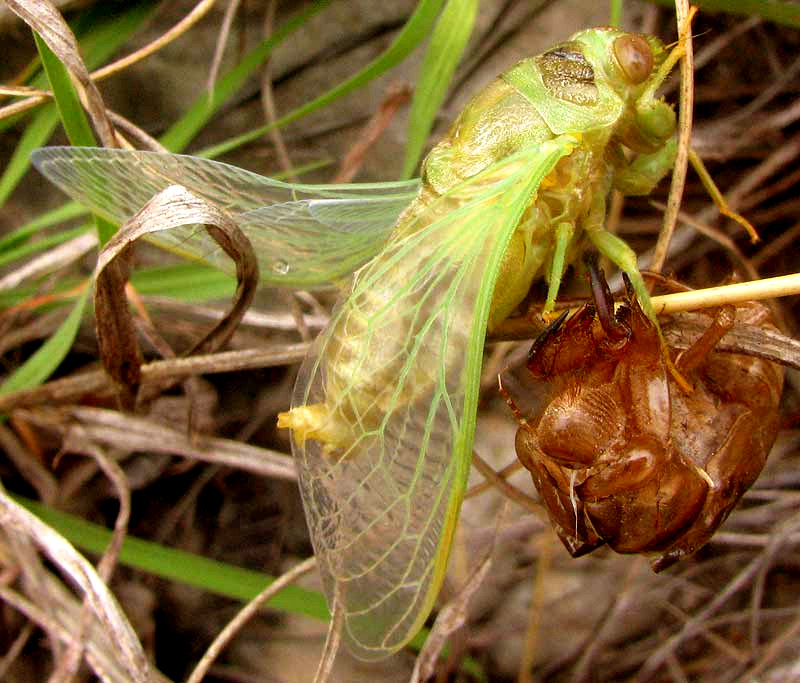
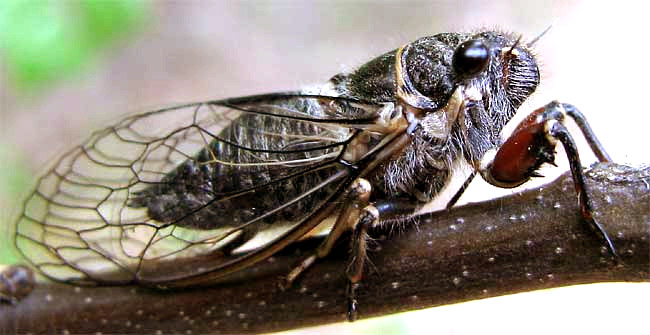
In some cultures people collect large numbers of cicadas during this brief, pale "softshell" stage, deep-fry them, and eat them like crunchy, high-protein popcorn! Below is a fully-grown adult of one of many cicada species, the Salmonfly Cicada, Platypedia areolata, of the US's Pacific Northwest:
Once the exoskeletons of the adults are hard and the wings are stiff, more amazing events unfold. For days now the landscape buzzes as millions and millions of cicadas call. These are males calling for females. During the 2004 East Coast emergence, in many places at least two distinct cicada species were singing, and the differences between the two songs could be clearly heard. The overwhelming sound drove some people nuts, but to those sensitive to the cycles of nature and the majesty of natural events, it was a rare concert which was an honor to experience.
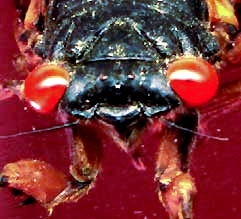
At the left you see a close-up of a periodical cicada's face. The round, red items are its compound eyes -- each compound eye composed of hundreds of tiny, simple eyes. Beneath the eyes you see two whiskerlike antennae, which the insect uses for feeling its way about. The face is somewhat triangular and at the pointed bottom of the triangle there's a sharp beak. Like other members of the insect order Homoptera, cicadas don't chew, but rather stick their sharp beaks into food sources and suck up what they can.
A few weeks after the cicadas' droning begins, when the adults have mated and the eggs for the next generation have been laid, the adults begin dying. They fall from the trees, flutter for a while, and then simply die. You can't see anything wrong with them. It's as if they simply run out of energy, and maybe that's exactly what happens.
Though the cicadas making such a fuss along the US eastern coast in 2004 were on a 17-year cycle, every year we can hear cicadas -- but not always as loudly as in 2004 along the East Coast. That's because many strains exist, and they exhibit different, often overlapping cycles. Annual cicadas appear yearly. In the US Southeast, the main periodical cicadas are on a 13-year cycle, not a 17-year one.