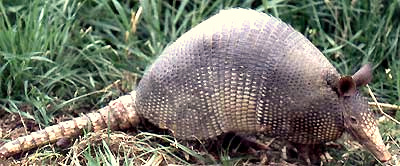
Reptiles arose from amphibians, and birds arose from reptiles. However, mammals, such as the Armadillo shown above in my backyard, did not arise from birds. Mammals, like birds, arose from early reptiles, though from a different reptilian stock than the birds. Here are the main "new inventions" nature came up with that made us mammals more complex beings than amphibians, reptiles and birds:
- Mammals, like birds, but unlike most of their reptilian ancestors, are
warm-blooded -- their bodies stay warm, even when surrounded by cold air. - Mammal bodies are covered with
hair , which helps the body stay warm; even the armadillo above has hairs. - Mammal
teeth come in a variety of shapes, known as incisors, canines, premolars and/or molars, with each tooth type specialized for stabbing, cutting, tearing, or grinding of food. Reptilian teeth aren't nearly as diverse. - Mammal
ears are relatively complex, the middle ear containing three bones, as opposed to only one bone in the middle ear of reptiles and birds. - Mammal
brains are much larger than those of reptiles, enabling greater intelligence and consequent flexibility of behavior. - Female mammals possess
mammary glands which secrete nourishing milk for the newborn. - Modern mammals
don't lay eggs , as reptiles and birds do. This enables mammal females to remain active as the embryo undergoes its early development -- instead of spending so much time incubating eggs.
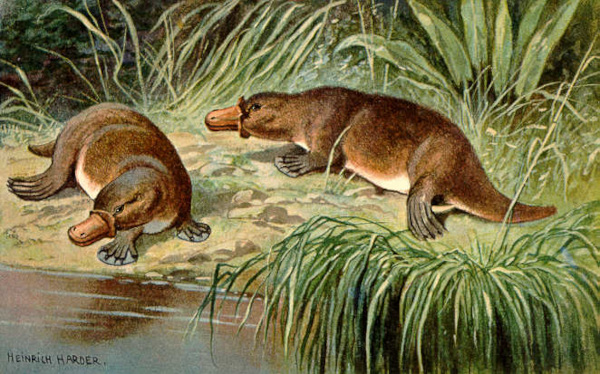
Archaeopteryx, the earliest-known fossilized bird, was a curious mixture with both reptilian and bird features. The same sort of "missing link" exists for the mammals, except that this link is still alive. There's a very primitive group of mammals found in Australia and New Zealand known as monotremes which do lay eggs, just like their reptilian ancestors. Only two monotreme species survive: the Duck-billed Platypus and the Spiny Anteater. Though these creatures lay eggs, their females also produce milk. As the illustration below shows, the Duck-billed Platypus also has a very unmammal-like duck-bill. Some scientists have seriously suggested that monotremes, instead of being reptile-like mammals, are mammal-like reptiles!
To give a feeling for the diversity of the non-egg-laying subclass of mammals, here's a list of the best-known orders:
CHIROPTERA: bats
PRIMATES: monkeys, apes, humans
EDENTATA: armadillos, anteaters
LAGOMORPHA: rabbits, hares
RODENTIA: mice, rats, squirrels, porcupines
CETACEA: whales, dolphins, porpoises
CARNIVORA: dogs, cats, raccoons, skunks, seals
PROBOSCIDEA: elephants
PERISSODACTYLA: horses, zebras, rhinoceroses
ARTIODACTYLA: pigs, deer, cattle, hippopotamuses
Other entire orders of mammal exist, which you've probably never heard of. For instance, there's an order for the flying lemur, one for the pangolin, another for the aardvark, and several others -- maybe 19 orders in all.
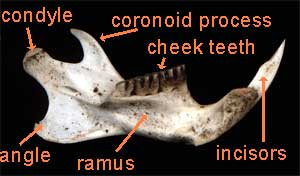
After you've spent some time tramping in the fields and woods, you're surprised by how often you find a mammal's skeletal skull or lower jaws, with no hint of the rest of the animal, like the lower jaw shown at the right:
The jaw is small one, only about 1¼-inch long (33 mm), and the first thought might be that it's a rat's jaw. However, using an old copy of Key-Guide to Mammal Skulls and Lower Jaws by Aryan I. Roest, the jaw was "keyed out" to be that of a chipmunk. While using the key, some interesting terms had to be learned, such as condyle, coronoid process and ramus, but that was fun!
Clearly, once we learn "mammal basics" by becoming familiar with our backyard mammals, we have a whole world of interesting critters out there to meet!
You might enjoy browsing Naturalist Jim Conrad's field notes on mammals encountered during his travels.
Wikipedia provides free online access to the 1992 Lynx Edicions publication Handbook of the Mammals of the World. Arriving at the appropriate page, hover your cursor over the linked-to mammal names for a pop-up picture and short introduction.