
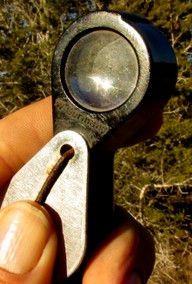
Two main kinds of magnifying glasses are useful to backyard naturalists. The best for general-purpose naturalizing is the hand lens, sometimes referred to as the jewelers' loupe, shown at the right. Hand lenses differ from the second kind of magnifying glass, the lollipop type consisting of a large lens mounted on a narrow handle, in four main ways:
- Hand lens lenses are much smaller than the lollipop type
- Instead of just one lens, hand lenses have two, with one lens mounted above the other
- The hand lens usually swivels into its handle, thus protecting the lenses from scratches
- Hand lenses provide much more magnification than the lollipop type
USES FOR A HAND LENS
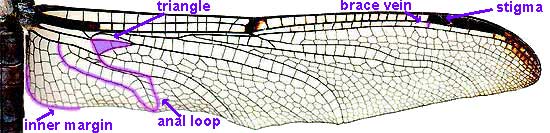
Average naturalists, to whom an acorn is as interesting as a sea gull, probably use hand lenses even more than binoculars. Hand lenses are useful, for instance, when we must examine an insect's mouthparts, tarsi, and the wing venation, for example, that of a dragonfly, as shown above. With a hand lens you can see the wonderful diversity of insect egg types found in every garden, and nematodes in nodules of infested roots.
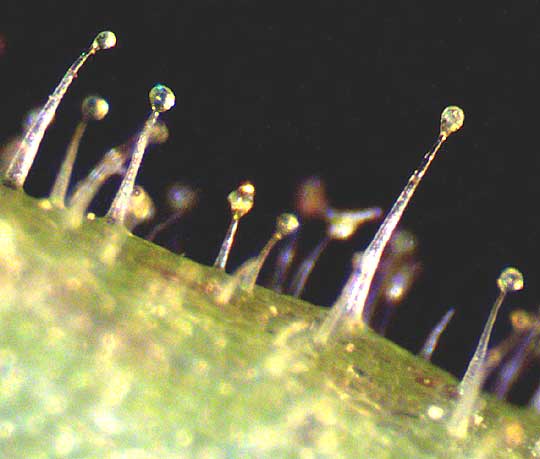
Many organisms produce tiny but very interesting features you may have never known existed. For example, with a hand lens you can see the gland-tipped hairs on a flower pedicel of the Five-eyes wildflower, Chamaesaracha edwardsiana, shown at the right. Needless to say, you're lost without a hand lens when studying mosses, lichens, and ferns.
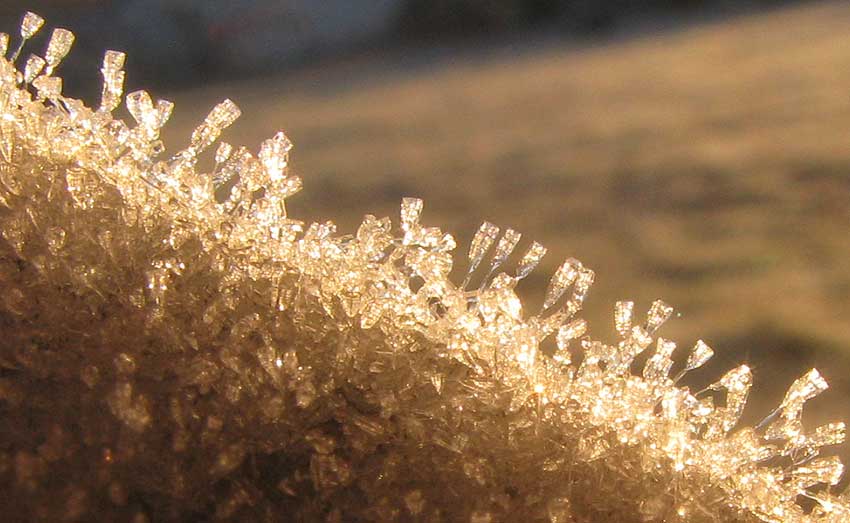
On a frosty morning, you can see many forms of ice crystals such as those at the left, on a fence post. Field geologists also use hand lenses to identify minerals in rocks by the appearance of their crystals. Calcite crystals are rhombohedral in form, while typical quartz crystals are hexagonal.
THREE TRICKS FOR USING A HAND LENS
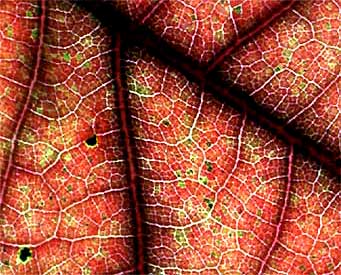
Here are three important rules for using hand lenses:
- Hold the hand lens right up to the eye you're looking through, maybe even with the back of your thumb resting on your cheek
- The thing you're looking at must be very close to the hand lens, probably less than an inch (2cm) away
- Think small! A whole world of tiny organisms and other natural features are never seen by most of us simply because it never occurs to us look in usually unnoticed places.
GETTING A HAND LENS
Jewelry shops sometimes display them, but usually at prices much higher than you need to pay. Camera shops often have one or two displayed among the dozens of lenses inside their display cases. You might find some in the toy section of the local super-store, maybe as part of a detective kit. That way you'd get a badge and false mustache, to boot! However, toy lenses usually are plastic and scratch too easily.
A good magnification power is ten (10 X). Weaker lenses won't show some of the details we want but stronger ones have such shallow depths of field that most of what is looked at may be out of focus.
BIG LOLLIPOP-TYPES ARE NICE, TOO
Less powerful but bigger lollipop-type magnifying glasses display larger areas than hand lenses and thus are useful for looking at spiders and other small critters you don't want to get too close to. Or maybe you're watching a large number of ants devour a caterpillar and you want to magnify the whole field of carnage. So, there are uses for the reading kind of magnifying glass, but if you have to choose having just one, the little hand lens is more useful.