During early years of speculation about loess's origins, most naturalists assumed that running water had somehow deposited our loess. That's because where loose dirt lies very thick someplace, as in a river's floodplain, it's usually because water has deposited it there. However, not everyone agreed with this hypothesis.
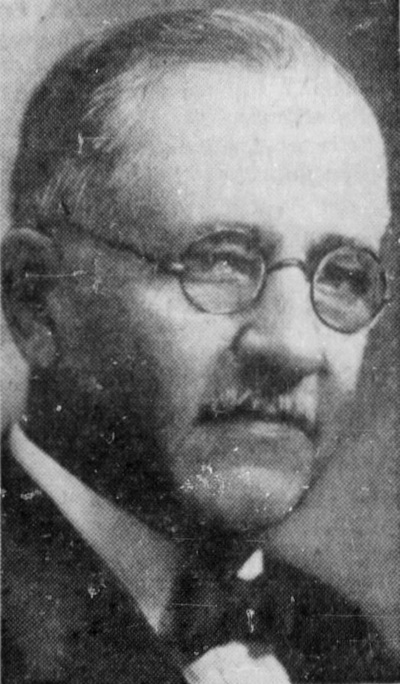 Bohumil Shimek (1861-1937); public domain image from Wikimedia Commons
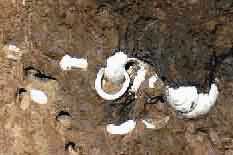
Foremost among the doubters was Bohumil Shimek, a Czech-American naturalist, conservationist and professor at the University of Iowa. Bohumil Shimek had an absolute passion for fossil snails, and he enjoyed using his detective skills. One day Mr. Shimek went to Natchez, Mississippi, because he'd heard that in the steep walls of our Loess Hills "bayous" lots of white snail-shells were embedded within the loess -- snails exactly like those above, photographed in a loess bluff just south of Natchez. Sometimes there were few or no shells, but other times shells appeared in abundance. Moreover, different from the bones of mammoths, ground sloths, ancient forms of horses and the like which are nearly always buried deep below heavy deposits of loess, these fossil white snail shells occurred throughout the loess, from top to bottom.
In 1902 B. Shimek published an important paper in the prestigious journal called American Geologist. The paper's title was "The loess of Natchez, Mississippi." In that article he argued that Natchez's loess couldn't possibly have been deposited by water because fossil snail shells prove it! Exactly like a Sherlock Holmes of geology, in his article he gathered together and spread before the world his evidence:
- POINT 1: Snail species found embedded in our loess are forest leaf-litter snails, not streambed snails. There's no ambiguity over their lifestyle, because nearly all the species found in loess are species that still can be found living in the landscape. This clearly suggests that the loess surrounding the snails was deposited in some way other than by water.
- POINT 2: When a snail withdraws into its shell, as seen at the right, it moves a stiff scale, called an operculum in place to block the shell's opening. In the picture, the scale looks silvery at the shell's opening, and is shown apart in the inset. In Nature, soon after a snail dies and decays, the operculum falls away. However, at Natchez, several fossil shells embedded in loess had their operculums in place at the shell's opening. If water had deposited those shells along with the loess, the operculums would never have been found in place.
- POINT 3: Even extremely delicate shells of snails' eggs were found in the loess, and certainly they are so fragile that they could never have been deposited by swirling water.
- POINT 4: Empty snail shells embedded in the loess were not filled with clay, which would have been the case if the'd been deposited by water.
- POINT 5: Snails found in the loess were very similar to the species still living in the Natchez area. If these shells had been transported by water from a distant area, there would have been less similarity.
- POINT 6: In the loess zone, there are no traces of ancient beaches or shorelines of large bodies of water, which would probably be the case if the former theory of loess deposition by water were correct.
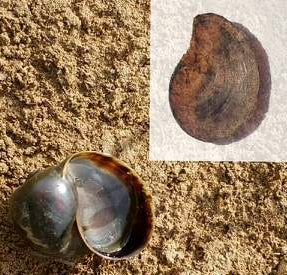 Pomacea snail closed with operculum, inset showing operculum; copyright free image courtesy of "Mário NET" and Wikimedia Commons
Therefore, if not water, then what?
Wind, Shimek recommended. Wind, wind, wind...
But, old ideas never die easily. A lot of important people for a long time kept saying that it was perfectly obvious that the agent that always lays down lots of loose dirt like loess is water, water, water!