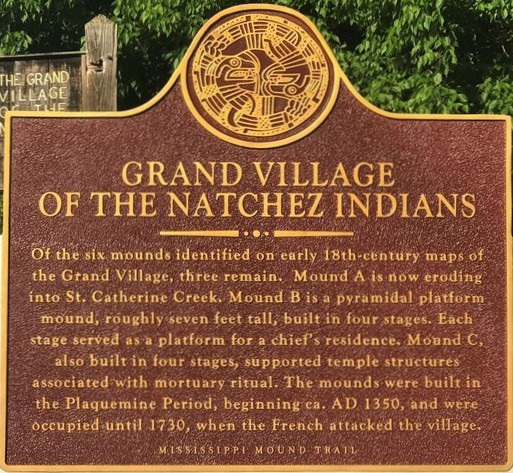
 Historical marker information for the Grand Villge of the Natchez Indians in Natchez, Mississippi; image courtesy of 'Loris565' and Wikimedia Commons
During the 1700s, several travelers among the Loess Hills of the Lower Mississippi Valley left important eye-witness accounts of what they saw and experienced among the Natchez people at their original home.
A French carpenter by the name of André Pénicaut visited the Natchez trading post during the European occupation from 1715 to 1729. He wrote that the Natchez "owned" nine villages, including two "refugee villages" inhabited by the Grigras and Tioux people. In his opinion the Natchez lived comfortably in well-built houses around which peach trees were often planted for fruit and shade.
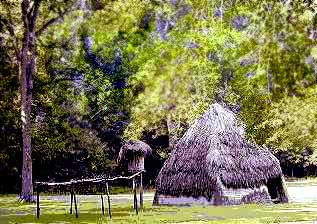
The thatch-roofed dwelling at the left is a reconstruction of a typical Natchez home at the time of Pénicaut's visit. It's on display at the Grand Village of The Natchez Indians archaeological park and museum in Natchez, Mississippi.
Pénicaut further reported that women wore white dresses woven of nettle and mulberry-bark fibers, the dresses covering them from neck to foot. The men wore deerskin leather jackets, breechcloths and leggings.
Pénicaut was especially taken with the Natchez's festivals, and the behavior of young, unmarried women. To him, the young women took aggressive roles in courtship comparable to that of men in his French culture.
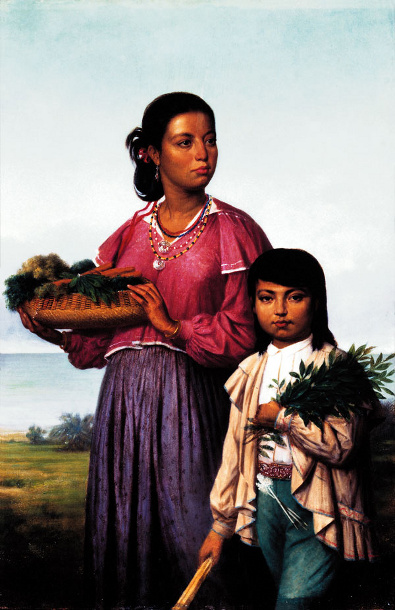 Du Pratz received much of his information form a Chitimacha slave girl he acquired; The above Chitimachans were painted by François Bernard, 1870; public domain image courtesy Wikimedia Commons
Antoine Simon Le Page Du Pratz has left us the most extensive eyewitness accounts of the Natchez. Du Pratz was an educated, affluent veteran of the War of the Spanish Succession in Europe, and more than anything he wanted to live the Good Life on a plantation situated in an interesting place. He found what he wanted beside the trail connecting the newly constructed French Fort Rosalie with the main village of th Natchez people. Here, in 1720, he bought a cabin from the Natchez, along with four hundred acres of land.
During eight years at Natchez he became friends with the Natchez people, whom he said "make good use of their reason, who think justly, who are prudent, faithful, generous, much more than certain civilized nations." Much of his basic knowledge about indigenous Americans at that time came from a Chitimacha slave girl whom he had acquired.
Du Pratz tells us about the Natchez's class system. At the very top was the Great Sun, who ruled the tribe as an absolute monarch. The Great Sun's feet never touched the earth, for he was carried everywhere on a litter, and mats were spread before him as he walked.
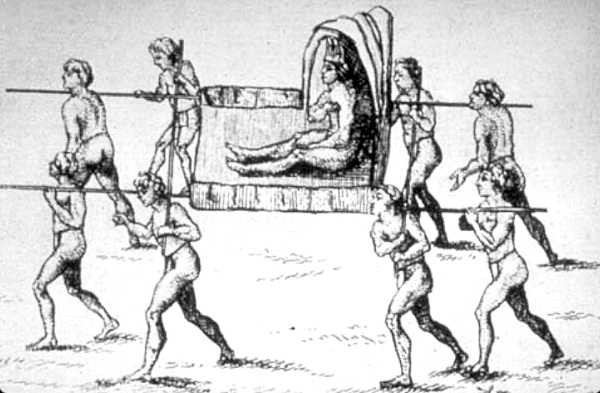 Public domain drawing from 1758 book Histoire de la Louisiane by Antoine-Simone Le Page du Pratz
When The Great Sun died, his successor had to be the son of his eldest sister. When any member of the Suns, died, whether male or female, the spouse, several friends and followers, and slaves would be strangled to death sacrificially so that they could cross to the spirit world with the Sun. Dying for this cause was considered to be a joyous opportunity. Du Pratz witnessed such an occasion.
Even though the Natchez peoples' traditional life was destroyed by encroaching Europeans, and the Natchez themselves were either killed, died of illness, forced to seek protection living with other tribes, or enslaved and sent far away, it can be assumed that a significant number of the surviving Natchez remembered and honored their heritage, and passed it along to their children. In fact, recently we received an email from K.T. (Hutke) Fields, Principal Peace Chief of the Natchez Nation, living in Oklahoma, with the tongue-in-cheek message that "...we ain't all dead... "
You may be interested in visiting the Natchez Nation Homepage [In 2025, page is "disabled."] We also have a page contributed by Chief Fields himself, dealing with the history and current status of the Natchez Indians.
In the spring of 1725, the Great Sun's brother, Tattooed Serpent, died. The Great Sun, a friend of Du Pratz, elected to follow Tattooed Serpent into death, but Du Pratz and some other colonists stopped him. However, one noblewoman, a friend of Tattooed Serpent and someone famous for her knowledge of medicine, could not be dissuaded. A child was also selected, and the members of Tattooed Serpent's household died. Tattooed Serpent's wife was amused at the Frenchmen's objections, and insisted that she died joyfully.
The Natchez community consisted of several villages, and each village had its own temple, which sat upon a mound. Du Pratz learned from the guardian of one temple a story about the Natchez Indians' past. According to it, the Natchez appeared in the east, migrated westward, but finally returned back east to the loess bluffs of the Mississippi. Also, he was told of the "Ancient Word," which had been passed from generation to generation by way of a select group of young men who had sworn not to change the story in any way.
The story related how the Infinite Spirit fashioned the first man from clay, breathed life into him, and likewise created small spirits with limited power, to serve as the Infinite Spirit's helpers. There was also an evil spirit in the world, but the Infinite Spirit had bound it to prevent it from doing harm. However, the evil spirit also had his little army of small spirit-helpers, and these managed to cause trouble from time to time. People eventually went astray, so the Infinite Spirit sent a man and woman from the Sun to set people back on the right path.
The Sun-people brought with them a code of conduct. The most important rules were:
Kill only in self-defense
Do not commit adultery
Do not be greedy
Share everything joyfully
Some have wondered whether this story may not have been influenced by Christianity, because by Du Pratz's time Christian missionaries had been at work in the Natchez area for more than twenty years.
Further reading: