Within the class of reptiles, the snakes and lizards are placed in the same order. That's because, from the zoologist's point of view, snakes and lizards are practically the same thing -- just that lizards have legs! Having legs is not considered a big deal in this case. In the history of animal evolution it's clear that legs can come and go.
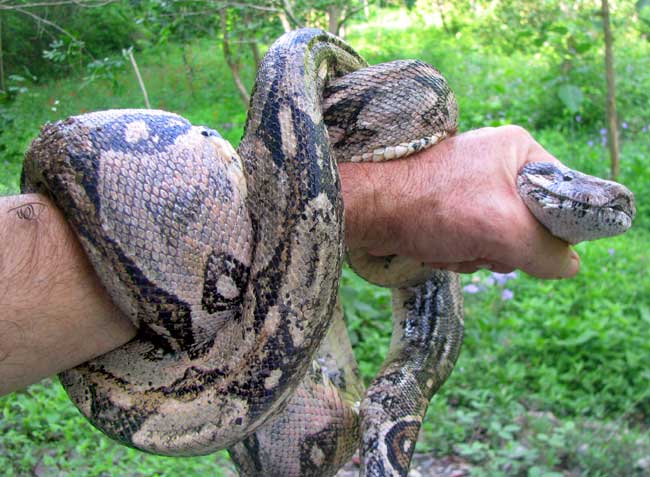
For example, consider the python, which is a huge tropical snake on which are found vestiges of the hind legs their ancestors once had -- "vestigial" legs. Also, "glass lizards" are actually legless, snakelike lizards.
Taxonomically, experts are not in agreement on how the various groupings of scaled reptiles should be defined. Here's a widely accepted view of how lizards and snakes shake out, as of early 2011, focusing mainly on species found in North America:
ORDER: Squamata (scaled reptiles)
The National Audubon Society Field Guide to North American Reptile and Amphibians by John Behler says that there are about 3,000 lizard species worldwide. Of the world's 17 lizard families, 8 are native to North America. In North America north of Mexico, about 115 species, some of them introduced, can be observed.